Lindsay Clancy Trial: Closing arguments expected Thursday morning
Published in News & Features
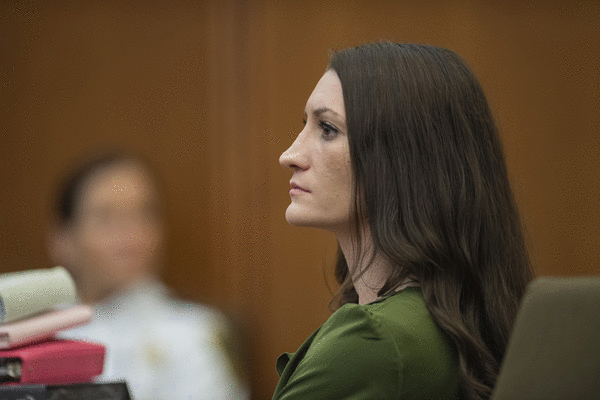
BOSTON — Now that jurors have heard all the evidence in Lindsay Clancy’s murder trial, the prosecution and defense are expected to deliver their closing arguments.
Plymouth Assistant District Attorney Jennifer Sprague and Clancy’s attorney Kevin Reddington will close their cases in the morning, according to Judge William Sullivan. The prosecutor estimated she’d take about an hour with her closing, while Reddington said he’d be “quick,” about half an hour.
After closing, Sullivan will instruct jurors, saying during a charge conference that he plans to use the Supreme Judicial Court’s model jury instructions for criminal responsibility in homicide.
Those instructions say that to be found not guilty by reason of insanity, a person must have been suffering at the time of the alleged crime from a “mental disease or defect,” which caused them to lose their appreciation for the wrongfulness of what they did or the ability to comport their behavior to the law.
Sullivan will also give instruction on first-degree and second-degree murder, as well as manslaughter, he said.
A randomly selected group of 12 of the 18 jurors currently sitting for the trial will go into the deliberations.
Through the course of the trial, jurors heard from more than 80 witnesses. They will have hundreds of exhibits available to them in the deliberation room, including medical records, crime scene materials and downloads from Clancy’s phone.
Clancy isn’t disputing that she killed her children, Cora, 5, Dawson, 3, and Callan, eight months, on Jan. 24, 2023. Instead, Reddington put up an insanity defense, arguing that the Duxbury mom was suffering from postpartum psychosis at the time and can’t be held criminally responsible.
Several defense experts said Clancy was psychotic when she heard a voice urging her to kill her kids, then herself, the night of the children’s deaths and her own suicide attempt. Clancy is now paralyzed after jumping out of her second-story bedroom window.
But the Commonwealth’s last rebuttal witness, Dr. Gregory Saathoff, disagreed that the voice was consistent with an auditory hallucination.
He said it was atypical that Clancy only had an auditory hallucination once, and that the first time she heard it, she obeyed it.
Saathoff testified that the fact that Ativan, which is not an antipsychotic drug, helped some of the dark and intrusive thoughts Clancy had reported starting in December pointed to them being thoughts and not hallucinations.
Sprague also asked the doctor if a person who is experiencing auditory hallucinations can know the difference between right and wrong.
“Well, hallucinations, even command hallucinations, when they occur, don’t propel an individual to automatically obey them,” the doctor said, telling the jurors that people often engage in behavior to try to stop the voices or distract from them.
He said that reaction “makes sense when the command is so serious and so against someone’s values.”
Saathoff said people in psychosis can and do resist voices, giving the example of a person hearing a voice when they are near a police officer and refraining from engaging in the behavior the voice commands.
“Even though a voice may be saying this, there is other decision-making going on because of the environment,” he said.
Looking at Clancy specifically, although he said that she was suffering from a mental disease or defect at the time of the killings, she could appreciate the wrongfulness of her acts.
He pointed to what he characterized as her planning before the killings, including researching a restaurant for takeout and medication for Cora before asking Patrick to leave the house and pick up both.
Saathoff said Clancy’s “avoidance of a witness,” who could have either recorded or intervened in the killings and suicide attempt, also showed that she knew what she was doing was wrong.
The doctor said she was also able to control her behavior and had for most of the day prior – taking Cora to the doctor, watching after the children. Even her decisions around when, how, and where to kill the children and herself “indicated that she had control, control of the sequence of what she was doing, throughout.”
“It is my opinion… that Ms. Clancy was criminally responsible,” he said.
On cross-examination, Reddington asked Saathoff more about psychosis.
The doctor agreed that it can come on rapidly in postpartum cases, that insomnia, which Clancy reported, can cause psychosis, and that stopping breastfeeding can also set off disturbances in mothers’ hormones and brain chemistry.
Reddington also read out parts of the prosecution’s opening statements, which said that Clancy was calculating, that she’d sought out doctors for pills she barely tried and made a “selfish choice” to kill herself and take her kids with her when she didn’t like her life anymore.
When Reddington asked if Saathoff agreed with it, the doctor said, “I think that statement that you read really minimizes what she was going through.”
_____
©2026 MediaNews Group, Inc. Visit at bostonherald.com. Distributed by Tribune Content Agency, LLC.






Comments