Judge rules ICE agent arrested for shooting in Minneapolis can be released from Texas jail
Published in News & Features
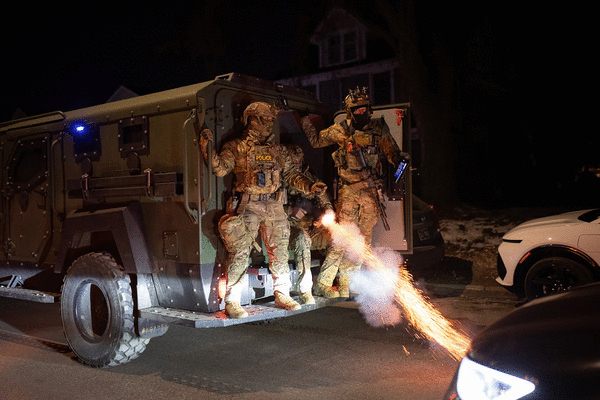
MINNEAPOLIS — In a blow to Minnesota law enforcement, a federal judge set the stage for ICE agent Christian Castro to be released from a Texas jail after he was arrested three months ago on charges that he shot a Venezuelan national in Minneapolis during Operation Metro Surge and later lied about it.
On Wednesday, U.S. District Judge Fernando Rodriguez Jr. rejected Minnesota’s request for the court to immediately compel Castro’s extradition, determining Texas Gov. Greg Abbott has neither “agreed nor refused to sign” the warrant for Castro, as Minnesota officials had claimed.
“The court accepts that Governor Abbott has considered this particular extradition request for an atypically long duration,” Rodriguez wrote. “Nevertheless, Minnesota identifies no statutory or constitutional provision requiring Governor Abbott to complete his investigation and decide whether to sign the rendition warrant within a particular time period.”
Because Texas law only allows Castro to be held for 90 days in jail while awaiting extradition, the ruling opens the door for him to be released from custody Thursday and leaves any potential extradition to Minnesota in Abbott’s hands.
The order stipulated that while Minnesota officials argued Abbott was in violation of several federal and state laws surrounding extradition, those arguments were premature because Abbott’s investigation into whether Castro is a fugitive is ongoing.
“Minnesota cannot premise its causes of action on the allegation that Governor Abbott may violate those authorities in the future,” Rodriguez wrote. “It must prove that a violation has already occurred.”
A nation of laws
Castro was arrested by Texas Rangers on May 28, with members of the Minnesota Bureau of Criminal Apprehension also present. His arrest came after Hennepin County Attorney Mary Moriarty filed a nationwide search warrant for Castro on May 18, charging him with four counts of second-degree assault with a dangerous weapon and one count of falsely reporting a crime in connection with the Jan. 14 shooting of Julio Cesar Sosa-Celis.
Abbott recently said he does not trust Minnesota Gov. Tim Walz “on anything” and that if Walz wants Castro extradited he must first acknowledge his responsibility for the rampant fraud that has taken place in federal programs in Minnesota.
In a statement Wednesday, Abbott press secretary Andrew Mahaleris applauded the court for rejecting “Governor Walz’s absurd claim” and Minnesota’s efforts to have the federal court system commandeer Abbott’s authority in Texas.
In a statement, Walz responded: “We are a nation of laws. It’s incumbent on all of us to uphold them. Texas has previously fulfilled every extradition — as has Minnesota — and this case should be no different.”
Minnesota Attorney General Keith Ellison asked the federal court to order Castro’s extradition from Texas and block his release from custody. After the order was released on Wednesday, Ellison said in a statement that he “respectfully but strongly” disagrees with the court’s decision and that his office will continue to litigate the case.
“If a governor can delay extraditions and cherry-pick cases according to their political tastes, then no state will be able to hold fugitive criminals accountable,” Ellison said.
Prosecutors argued Castro posed a risk of fleeing the country because of his strong ties to Mexico, including conversations he had with a woman about getting married and buying a house there.
Is Castro a fugitive?
Abbott argued in court filings that he needed more time to determine if Castro was actually a fugitive from justice because a preliminary investigation carried out by Texas Secretary of State Robert Howden indicated that Castro may have been ordered to Texas by ICE and was not fleeing prosecution in Minnesota.
Trevor Ezell, Abbott’s general counsel, wrote that determining whether Castro needed to be returned to Minnesota was “heady stuff” and “the governor has serious doubts that Mr. Castro qualifies as a fugitive” because “the ordinary meaning of a fugitive entails a volitional act of fleeing, not merely involuntary movement across state lines.”
Rodriguez said he doubted Abbott’s argument that Castro was not a fugitive because ICE ordered him to leave Minnesota. Rodriguez wrote that the U.S. Supreme Court has found that determining whether a person is a fugitive rests not on “the accused’s reasons for leaving the state, but simply on whether or not he in fact left.”
Texas law allows Abbott to investigate extradition requests from other states. Minnesota prosecutors had argued that federal law and the U.S. Constitution required Abbott to sign the extradition paperwork as an administrative process to give Minnesota the right to carry out justice.
Abbott said he was not required to “unthinkingly accept Minnesota’s characterization” of Castro’s fugitive status and that the Uniform Criminal Extradition Act does not allow Minnesota to set a time limit on him to decide whether to approve an extradition.
He also argued that the only venue that could properly consider Minnesota’s federal lawsuit against Texas was the U.S. Supreme Court.
Wednesday marked Castro’s 90th day in the Cameron County jail where he had been held in lieu of $200,000 bail.
Abbott argued there was no evidence Castro posed a flight risk and that he was under “active orders and supervision of the federal government.”
“He spent more than three months in Texas before he was arrested on a Minnesota warrant,” the court filing said. “He did not flee during that time. Nothing in the record suggests that he made any effort to evade Minnesota, much less that he intends to flee to Mexico now.”
On top of that, Castro is under investigation by the Justice Department for his actions in Minneapolis and Abbott “fully expects that the United States is taking measures to ensure Mr. Castro does not leave the country.”
Ethan Lowens, an expert on interstate extradition, said Rodriguez was right to side with Texas on this case because complicated extradition investigations can take months to complete.
What Lowens was less certain about is what makes this extradition so complicated.
“What is it that Texas needs so much time to look into?” he said. “There is not really a basis in law or in common sense to say that the issue that Texas flags – which is whether or not Castro is a fugitive – holds water.”
Lowens also noted that Rodriguez’s order was unclear on when a state delay of an extradition ruling would “constitute the denial of the demand.” Lowens said the U.S. Supreme Court has never ruled on how long a governor can take to decide on extradition. Prior cases always centered on a governor’s refusal to sign an extradition request.
“The judge leaves open very explicitly the possibility that they could delay indefinitely,” Lowens said.
‘We are on the precipice’
The ruling by Rodriguez shows the starkly different outcomes that may come from efforts to hold federal agents accountable for alleged crimes carried out in the state during Operation Metro Surge. Another ICE agent charged by the Hennepin County Attorney’s Office surrendered himself in Minnesota after a nationwide warrant was issued for his arrest for allegedly pointing his gun at two drivers on Hwy. 62.
The shooting of Sosa-Celis came exactly one week after Renee Good was shot and killed by ICE agent Jonathan Ross. The gunfire sparked a chaotic night of unrest in north Minneapolis. Then-Homeland Security spokesperson Tricia McLaughlin said Sosa-Celis and his roommate, Alfredo Alejandro Aljorna “began to resist and violently assault the officer” and that Castro fired a defensive shot while on the ground because he feared for his life.
The Justice Department later moved to dismiss the charges against Sosa-Celis and Aljorna in a rare reversal, citing new evidence that conflicted with the initial allegations made by Castro.
At a press conference Wednesday, Moriarty said Abbott had strung along Minnesota officials for months over the extradition and that he was now harboring a fugitive from justice over political views. She said Castro could have waived his extradition at any time to come face his charges. Instead, he might walk out of jail Thursday with no conditions on his release.
“We are on the precipice of having something like this happen where the political views of governors make a difference in extradition,” Moriarty said. She added, “That is not tenable. That is chaos.”
_____
(Allison Kite of the Minnesota Star Tribune contributed to this story.)
_____
©2026 The Minnesota Star Tribune. Visit startribune.com. Distributed by Tribune Content Agency, LLC





Comments