Remarkable student at Miami Dade College became record-breaking faculty member
Published in News & Features
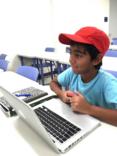

MIAMI — Nathan Thomas remembers his first day of college as being a normal day.
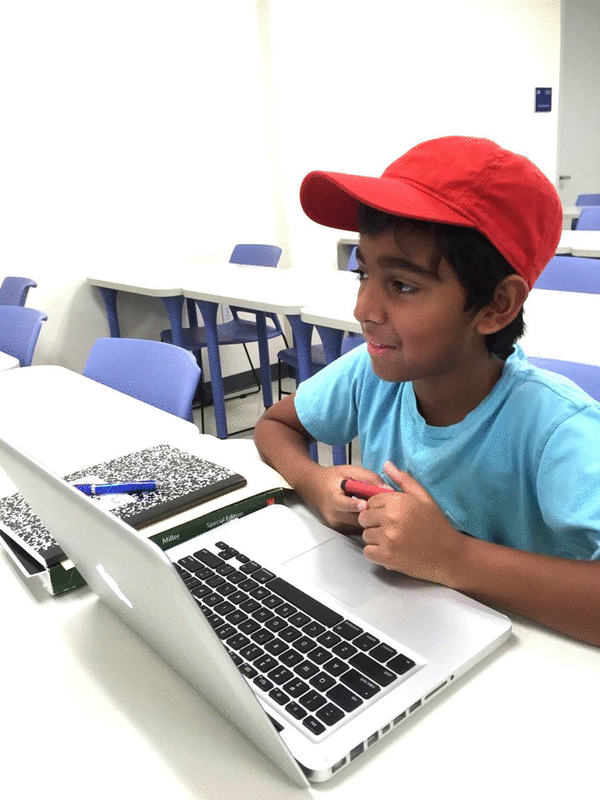
When the 10-year-old walked into his algebra class at Miami Dade College, he drew a few curious looks from his older classmates. But once class began, Thomas quickly settled in — and excelled.
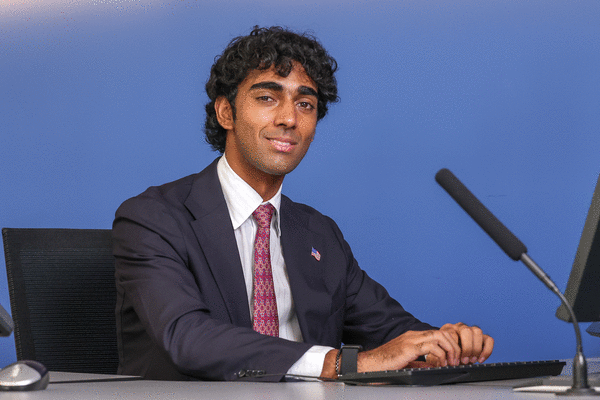
He had a similar experience when he taught his first course at Miami Dade College at just 18 years and 346 days old. Thomas, now 20, has been officially recognized by Guinness World Records as the world’s youngest male professor, breaking a 306-year-old record once held by a 19-year-old. He is also the youngest professor overall.
Nathan was 16 days younger than Alia Sabur when she claimed the title as the youngest professor in 2008.
“I tried to emphasize that like my age is not important...(to) what we’re doing here,” he said of teaching. “So I never really brought it up again after the first day.”
Thomas, was born in California to two engineer parents. His father’s work as a contractor moved the family around a lot during his adolescence. One of his father’s projects brought them to South Florida, where the family eventually settled in Miami-Dade County.
“It was my dream come true when I had Nathan.” his mother, Merlyn Rani Thomas, said. “My mom was watching me pack the bag to the hospital for the delivery, and she said, ‘You’re putting a book in?’ I said, ‘Yeah, we’re gonna start reading the first day he’s born.’ And we did. The day he was born, I started reading to him.”
In California, Nathan attended a multilingual school where he was taught in German. Unable to find a school like that in Miami, Nathan’s mother did what any engineer might do: she built a spreadsheet ranking Miami’s schools.
Compared with California, Miami’s public schools offered far more options, she said. She explored private schools but wasn’t impressed, so she started calling principals directly. One call led her to Coral Park Elementary, where the principal invited her and her child to visit a pre-K classroom.
“That was just an amazing experience for me,” Nathan’s mother said of the visit.
Nathan stayed at Coral Park through kindergarten but joined a first-grade gifted class. The unusual age gap made it difficult socially.
“Nathan is the kind of child who does not like to stand out, and you know the kids in the first-grade gifted class thought he was weird because he was a little kid coming into their class, and the kids in the kindergarten class thought he was weird again because he could read and write sentences,” his mother said.
Then a school counselor stepped in. “I’ve never done this in my life,” the mom recounted of what the counselor said, “but I think we’re doing an injustice to this child.”
That was when the family decided to give homeschooling a shot — and do it differently.
Learning about money meant a trip to the grocery store with $10 to spend, including figuring out taxes. A lesson about the post office became a real-world project. Reading could happen at the park or on the beach. In Miami’s winter weather, the classroom was often wherever they happened to be.
Before kindergarten, Nathan tested at a third-grade level. But after starting school, his academic progress actually slipped — another sign that the traditional classroom wasn’t working for him.
After four months of homeschooling, Nathan had jumped two grade levels.
“There was never any pressure to accelerate or you know be at a certain level,” his mother said.
‘Genius-level mind”
Nathan was introduced to Miami Dade College professor David Tseng through an after-school program that he and his wife ran. Tseng was eventually hired as Nathan’s private tutor.
“I tested him with a number sequence: 1, 1, 2, 3, 5, 8, and asked what came next. Within about a minute, he had not only given me the answer but worked out the rule himself, that each number is the sum of the two before it. My first thought was that this was a genius-level mind. He couldn’t be treated as an average student, or even an average gifted student,” Tseng told the Miami Herald.
Tseng became his first mentor and, impressed by his curiosity and ability, invited him to sit in on one of his classes at MDC.
Nathan’s mother, however, was understandably skeptical. Sending a 10-year-old to sit in a college classroom sounded a little wild.
Instead, she decided to enroll him as a non-degree-seeking student so he could be on campus. But when she spoke with a Miami Dade College counselor, she got an unexpected surprise: the college was opening dual enrollment to sixth-graders.
His mother didn’t want to overwhelm him with a full college schedule, so he started with just one course per semester while continuing his homeschooling.
“He was younger and smaller, obviously, but intellectually, he was ahead of them. He absorbed material immediately and had a remarkable attitude toward learning,” Tseng said.
For roughly three years, he balanced the two — doing his regular homeschool work while quietly racking up college credits on the side.
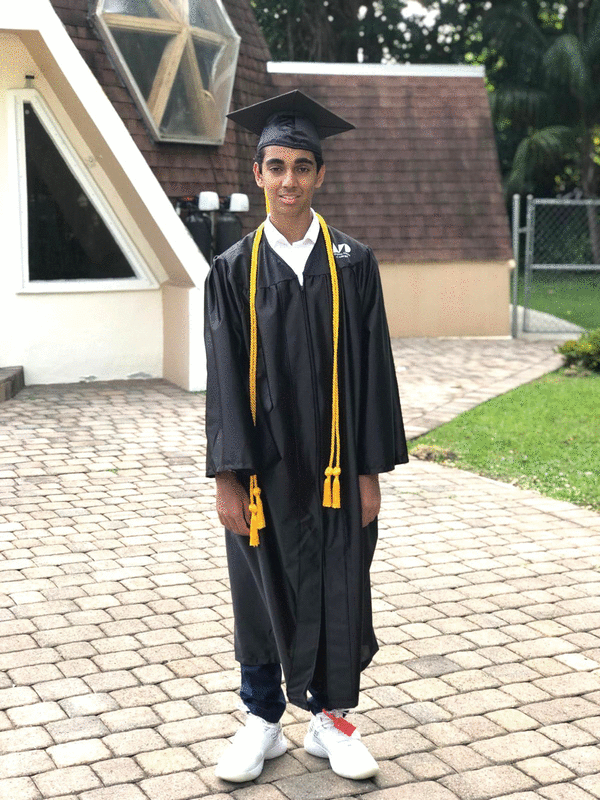
Then, at 14, he took a look at his transcript and realized he had accumulated about 60 college credits — enough to qualify for an associate degree. He had his high-school diploma and AA done by 14.
He went on to graduate from Florida International University with a bachelor’s degree in electrical engineering at 16 years old and a master’s degree in electrical engineering at 18 years old.
A gap year to teaching career
After graduating, Nathan decided law school was his future. He planned to take two years off before starting law school — a chance to relax, have some fun and, in theory, do nothing.
But sitting around doing nothing didn’t exactly fit his personality.
Instead, he started looking for a job that would give him something meaningful to do during those two years. That’s when he thought about Miami Dade College.
He reached out to several deans at the college, and they were eager to bring him on. He began teaching at 18, right after finishing his master’s degree.
“I was able to help a lot of kids figure out what they wanted to do, and that was really good,” Nathan said.
Nathan, now in his second year of law school at the University of Miami, is taking a break from teaching. He is interning at the U.S. Attorney’s Office.
“Miami is my home,” Nathan said. “That’s why I chose UM.”
“We travel a lot. He’s seen more than, I think, 35 countries around the world, and every time he came back home, he would say, ‘Mom, this is the best place on Earth’,” his mother said.
A world record
The Guinness world record recognition came as something of a surprise — and, for him, it was hardly a life-changing moment.
His mother had been closely following the Guinness process and believed he had broken a record. She encouraged him to apply, but he wasn’t particularly convinced it would amount to much.
Then, about three years after he initially applied, an email finally arrived.
He had officially earned the record.
His reaction? A casual, “Oh, pretty cool, I guess.”
His parents, on the other hand, were thrilled. His mother was especially excited, practically jumping up and down when she saw the news.
His mother’s goal for him? “I want him to be happy and healthy,” she said.
There’s a common misconception that community college is somehow a lesser path. For Nathan’s mother, that couldn’t be further from the truth.
She hopes to be a voice for the opportunities that community colleges can provide, pointing to her son’s experience at Miami Dade College as a prime example.
“We do have resources in our community that everybody can use without going into debt, and you know, build something beautiful,” his mother said.
_____
©2026 Miami Herald. Visit miamiherald.com. Distributed by Tribune Content Agency, LLC.






Comments