Luigi Mangione's double jeopardy gambit could see him freed from prison before he turns 60
Published in News & Features
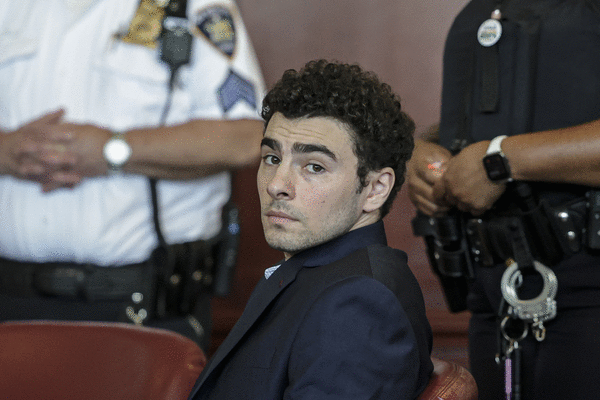
NEW YORK — Luigi Mangione’s stunning eleventh-hour guilty plea to federal stalking charges is expected to send him to prison for decades, but the risky gambit might result in his release before his 60th birthday.
Mangione on Aug. 14 admitted in Manhattan Federal Court to stalking UnitedHealthcare CEO Brian Thompson with the intent to kill him on Dec. 4, 2024, motivated by a yearslong nightmare navigating the health insurance system with a broken back.
Within an hour of admitting guilt in the federal case, Mangione’s lawyers filed a motion in his separate state case saying New York’s double jeopardy law had been triggered and that Manhattan Justice Gregory Carro was thus required to throw out the prosecution. The state’s case, which had been expected to go to trial in September but is now in legal limbo, accuses Mangione of second-degree murder and weapons offenses.
The question is whether the state’s murder charges and the feds’ stalking charges add up to double jeopardy.
Under New York law, a person cannot be successively prosecuted for the same crime, barring limited exceptions, like separate charges that address “very different” types of “harm or evil.” The Manhattan district attorney’s office is expected to oppose Mangione’s motion by Oct. 9.
“The State has an overriding interest in trying this defendant for the cold-blooded execution of Brian Thompson,” the lead prosecutor in the state case, Joel Seidemann, said in a January filing.
Veteran civil rights attorney Ron Kuby told The News he believes the dueling cases fail to meet the criteria.
“The elements are very different in many ways, but the harm involved — which is murdering somebody — is the identical harm, and so much of the prosecution’s evidence of the murder is also proof of the stalking,” Kuby said.
“Is there a risk here that Judge Carro will deny the defense motion? There’s always a risk when you’re not in control of the events, but it is a very well calculated risk, and certainly, if I were in their position, this is what I would have done.”
Central to Mangione’s argument is a critical technicality: by pleading guilty in federal court and resolving that case first, his lawyers say the state’s case became a successive, not simultaneous, action, and should thus be thrown out as a matter of law.
“Today’s guilty plea in federal court ‘terminates’ the federal proceeding, within the meaning of New York’s double jeopardy law,” Karen Friedman Agnifilo wrote. “As a result, this federal proceeding is a ‘previous prosecution’ such that this New York State proceeding is now a ‘second prosecution’ under the law.”
The sequence allowed Mangione to make his double jeopardy claim under New York law, rather than under the federal double jeopardy clause, which is narrower and less favorable to the defense, Kuby said. Had he instead gone to trial in the state case first — and lost — he could have headed into a second trial forced to make his argument under federal rules.
“He would have lost,” Kuby said. “That’s why the defense was constantly maneuvering to get the federal case tried first, and the DA’s office was desperately trying to have the state case go first.”
A calculated risk
The calculation by Mangione’s team came after they racked up several significant pretrial wins, including getting a death penalty-eligible charge in the federal case and terrorism charges in the state case dismissed.
But the Maryland man’s team failed to get critical evidence barred from the cases, giving prosecutors ample room to prove Mangione’s guilt.
The Manhattan U.S. attorney’s office told the judge they were prepared to show a jury CCTV footage of Mangione shooting Thompson outside the Hilton hotel in Midtown and stalking the executive around the building in the days beforehand. They also cited video of him fleeing the scene on a bicycle.
A 9 mm pistol found on Mangione when he was arrested at a McDonald’s in Altoona, Pennsylvania, five days after the shooting, which matched shell casings found at the murder scene, would also have featured in the government’s evidence, they said, in addition to DNA and fingerprints matching Mangione’s. The feds also planned to present notebook entries of Mangione’s expressing desire to kill a healthcare executive, specifically at UnitedHealthcare.
Given the evidence, Mangione’s lawyers appear to have made a calculated, if risky, decision, legal experts say. Admitting guilt in the federal case guarantees Mangione will serve a long term. But if they prevail on the double jeopardy issue and it’s the only sentence he serves, he could be released from prison as a middle-aged man.
“The case against him was very strong, evidentiary wise,” defense attorney Mark Bederow, a former Manhattan prosecutor, said. “I think they looked at it as, He’s screwed, what do we do? And I think running to federal court and taking a plea in the way they did was smart.”
The charges Mangione pleaded guilty to — interstate travel for stalking Thompson, resulting in his death, and cyberstalking the executive, resulting in his death — could carry a potential life sentence, which federal prosecutors said they intend to seek. However, they have estimated to his defense team that federal sentencing guidelines would recommend he serve a term between 24 and just over 30 years.
That calculation does not bind Federal Judge Margaret Garnett, whose decision on what term to impose won’t be known until she announces it on Dec. 18.
The federal judge is expected to be inundated with letters in Mangione’s support. The University of Pennsylvania graduate has cultivated folk-hero status among many Americans amid widespread disdain and distrust of the U.S. health insurance industry, raising more than $1.5 million in public donations toward his legal fees.
If Mangione’s double jeopardy bid fails, and the state tries him and sees to his conviction for second-degree murder, he could be looking at a potential life sentence tacked onto his federal term — meaning he would have virtually no chance of seeing freedom until he’d be quite elderly.
He told Garnett he was aware of the possibility.
But if his gambit succeeds, Mangione could walk out before he’s 60, if not years sooner. There is no parole in the federal system, though he could see up to 15% of his sentence shaved off for good behavior, plus credit for the two years he’s been in jail pretrial.
“New York law doesn’t favor what the Manhattan DA wants to do generally. I think the next step is just going to be, hopefully for [the defense], killing the state case,” Bederow said.
“I think this guy, given what he was facing, is in a pretty good situation, and frankly seems to be the beneficiary of federal and state squabbling over what to do with him — because if the state system went first, we wouldn’t be having this conversation.”
©2026 New York Daily News. Visit at nydailynews.com. Distributed by Tribune Content Agency, LLC.






Comments