RFK Jr. touts Minnesota as model for new national autism alert system
Published in News & Features
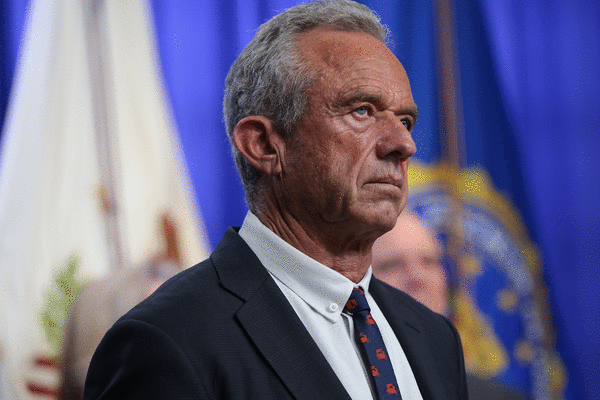
ROCHESTER, Minn. — Law enforcement and first responders here have trained for decades on how to track and approach autistic people who have wandered away from their homes. Federal officials could soon use similar tactics nationwide.
U.S. Health and Human Services Secretary Robert F. Kennedy Jr. on Friday announced federal officials plan to create a new national alert system for missing autistic people based on existing systems like the Amber Alert, which sends emergency notices out whenever children go missing.
During a news conference inside a law enforcement training center in Rochester, Kennedy pointed to Olmsted County sheriff’s deputies and Rochester police as examples for how federal officials should train first responders to get people with autism safely home. That includes encouraging the use of wearable trackers and purposefully and regularly interacting with the area’s autism community.
“Here in Rochester, they have a perfect record of recovery without losing anybody, and that’s what we want nationally,” Kennedy said.
Although he made the announcement in Mayo Clinic’s hometown, Kennedy has drawn criticism for controversial healthcare and medical views that often run contrary to accepted medical practice, including the false claim that vaccines may cause autism in children.
Yet advocates around Minnesota said Kennedy’s announcement was a positive step to help prevent serious injuries and deaths to residents on the autism spectrum.
Children and adults with autism are more likely to wander from safe places, a behavior often called elopement, and potentially drown in nearby bodies of water. Data compiled by the National Autism Association found that in 2024 alone, more than 9 out of 10 wandering-related fatalities were caused by drowning.
Jen Diederich, the chief compliance officer at the nonprofit services provider MAC Midwest, said she tried to teach as many clients as she could to swim back when she was a behavioral therapist because of drowning concerns.
Diederich said she was encouraged by the announcement, in part because federal officials are promising to offer more training and input on what to do after missing people with autism are located.
“Once you find someone that has wandered, then how do you help them? That’s a whole other part of it,” she said.
While other advocates welcomed the news, they were still concerned with how federal officials address autism-related issues in the future.
Daren Howard of the Autism Society of Minnesota said the advocacy group is nonpartisan but has had to dedicate resources to refuting misinformation coming from health officials in President Donald Trump’s administration, including repeatedly debunking the claim — made as recently as last week — that vaccines are linked to autism.
“The hope is that this initiative will save lives,” Howard said. “The concern is that this administration hasn’t demonstrated a clear understanding of our community, and this administration has demonstrated a reckless disregard for our community.”
Kennedy and other officials didn’t say how long it would take to build a new alert system or what kind of training and funding would be provided to local agencies and nonprofits. Kennedy said he was traveling to communities like Rochester across the U.S. to help develop best practices.
Rochester and Olmsted County law enforcement have used equipment from Project Lifesaver, a group that makes trackable wrist and ankle bracelets, since 2007 to help families keep tabs on loved ones with autism. Officers and deputies also help change batteries on the trackers every six weeks or so, which helps establish relationships with people with autism and their families.
Project Lifesaver works with 37 Minnesota counties.
Brad Trahan, a longtime advocate who helped found the Rochester Area Autism Association and has pushed for state funding for similar equipment in the past, noted advocates have been asking for more attention and funding for alert programs for decades.
“We have a responsibility as parents and as a government to make sure that we take care of our most vulnerable,” Trahan said.
_____
©2026 The Minnesota Star Tribune. Visit at startribune.com. Distributed by Tribune Content Agency, LLC.



Comments