Plane that crashed in Southwest Alaska, killing 8, was attempting to land in foggy conditions
Published in News & Features
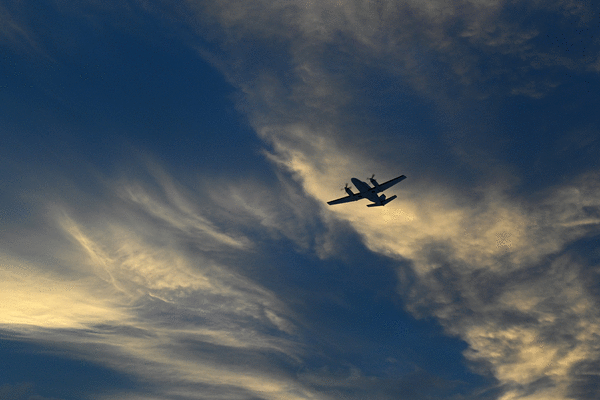

ANCHORAGE, Alaska — A charter aircraft carrying eight people crashed Thursday as it tried to land near a remote radar site on the Bering Sea coast in Southwest Alaska, killing all on board.
The crash occurred as the plane landed at Cape Newenham Long Range Radar Site Airport, authorities said Friday. The remote radar site, one of 15 across Alaska, is about 450 miles southwest of Anchorage. The National Weather Service reported fog and extremely low visibility in the area just after the crash.
The plane took off from Ted Stevens Anchorage International Airport at about 9:15 a.m. and crashed west of the radar site at about 11:45 a.m. Thursday, federal investigators said.
The Security Aviation twin-engine turbo prop Cessna Conquest was chartered by the U.S. Army Corps of Engineers. Two Security Aviation pilots and six passengers were on the plane, according to Clint Johnson, the National Transportation Safety Board’s Alaska region chief.
Two Army Corps of Engineers employees were on the flight. Four additional contractors were also on the plane, Johnson said during a media briefing Friday. None of the people involved in the crash had been identified as of Friday afternoon.
The plane came down in steep terrain just west of the runway, a fiery impact that left the wreckage “highly fragmented,” Johnson said. The nearby radar facility captured its flight path, he said.
Within an hour of the crash, weather at the site included fog and mist with three-quarters of a mile of visibility, according to weather service observations for the area. By about 10 minutes after the crash, visibility had closed in to almost nothing, according to the site.
Low visibility prompted the pilot to abort at least one landing, climb and try again, investigators say.
The plane was on an instrument approach, on an instrument flight rules flight plan, Johnson said, because weather conditions didn’t allow them to see the ground visually.
The pilot made at least one attempt to land but missed the approach and tried again, Johnson said. He said regulations governing instrument flight dictate a “go-around” if a pilot can’t see the runway at a predetermined point.
The pilot was making another approach to land, headed south, when the crash occurred, he said. Air traffic controllers lost contact with the plane before it came down and notified officials when it became clear the plane hadn’t landed, investigators say.
It wasn’t immediately clear what weather information the pilots received as they got to the radar site to land, Johnson said. That’s one of the areas that investigators will focus on, he said.
Security Aviation, in a statement issued Friday, said the company is “heartbroken” by the crash and extended condolences to the families, friends and loved ones of those lost.
“Our thoughts are also with our employees, colleagues and the many people across Alaska whose lives have been touched by this loss,” the statement said. “The messages of support coming in from across the state have meant a great deal to the entire Security Aviation team as we navigate the days ahead.”
The company expressed gratitude to the military and search and rescue personnel who responded to the crash site and said it is cooperating fully with authorities.
“We will not speculate about the circumstances or potential cause and will defer questions regarding the investigation to the agencies leading that work,” the statement said.
Search and rescue forces arrived at the scene of the crash by Thursday evening, according to Alaskan Command officials who oversee the Alaska Rescue Coordination Center at Joint Base Elmendorf-Richardson.
Supported by an HC-130J Combat King II, an Alaska Air National Guard HH-60W Jolly Green II landed near the crash site Thursday, according to a statement Friday from the Alaskan Command. Personnel from the 212th Rescue Squadron confirmed there were no survivors.
The radar site, managed by the Pacific Air Forces Regional Support Center, is part of a network of remote sites that tracks aircraft operating in Alaska’s airspace and along its borders, according to Alaskan Command. The sites are primarily operated by contractors.
The airport is a military airstrip and not accessible to the general public. It provides access to the radar station.
The military did not provide details on the specific work the individuals were doing. The company that holds a contract to operate the sites did not respond to messages Friday.
“This is a devastating loss for our military family and the communities we serve,” U.S. Air Force Lt. Gen. Robert Davis, commander of Alaskan Command, the Alaskan North American Aerospace Defense Command Region and Eleventh Air Force, said in the statement.
Members of Alaska’s congressional delegation expressed condolences in social media messages late Thursday.
U.S. Sen. Dan Sullivan said he’s requested a briefing from federal investigators “as we all seek answers on what caused this horrific tragedy.”
U.S. Sen. Lisa Murkowski said she’s traveled extensively with Security Aviation throughout the state, “and have met many of their experienced pilots.”
U.S. Rep. Nick Begich called the crash “incredibly difficult news for many Alaskans, especially those in our close-knit aviation community.”
The NTSB has launched a six-member team to investigate the crash, representing different areas including air traffic control and weather, Johnson said. The FAA is also launching an investigator. The location and terrain will make it “a bit of a challenge” to investigate and recover the wreckage, he said.
Johnson, who is retiring at the end of the month after several decades with the agency and years as its Alaska chief, also expressed condolences to the families of the people involved in the crash.
“We’ve all been doing this a long time,” he said during the briefing. “It never gets easier.”
©2026 Anchorage Daily News. Visit at adn.com. Distributed by Tribune Content Agency, LLC.





Comments