Erasing Carolinas history? Signs removed at NC, SC national parks under Trump order
Published in News & Features
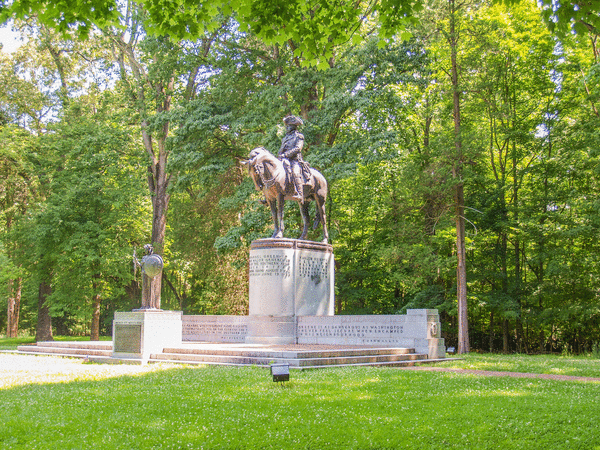
CHARLOTTE, N.C. — In Greensboro, a display at the Guilford Courthouse National Military Park explains that North Carolina women submitted to their husbands and observed a “monastic seclusion” before the American Revolution.
It reports that most women could not read or write and that they were “bred to the Needle and Spinning” and “to the dairy and domestic affairs”
But sometime in the last two decades, signs were added sharing that 51 women signed a resolution to boycott English goods, a move praised throughout the colonies. The sign also says that women petitioned the state asking to divorce their husbands, and that enslaved women appealed for their freedom.
That information may vanish, along with other educational signs and materials at the park and other sites around the Carolinas. The targeted literature ranges from the importance of clean air to a pamphlet kids can pick up at Cape Hatteras National Seashore that mentions women pirates dressed like men to hide among the crew in the early 1700s.
That’s because President Donald Trump wants to alter or remove historical and educational materials at federal sites that his administration deems disparaging to Americans or emphasizes matters unrelated to the beauty of the natural feature at the site.
Trump’s 2025 executive order “Restoring Truth and Sanity to American History” called on the Interior Secretary to ensure that all literature in parks falls in line with “our extraordinary heritage, consistent progress toward becoming a more perfect Union, and unmatched record of advancing liberty, prosperity, and human flourishing.”
The administration has not been transparent about its process so it’s unclear what signs have been removed, what are being reviewed and what are on the chopping block.
But at least 100 signs have already been censored in 41 National Park Service sites around the country, according to the “Save our Signs” censorship tracker, which is part of a project to document park signs around the nation.
The Trump administration says a “revisionist” movement took hold over the last decade that casts U.S. history in a negative light. ”Our nation’s unparalleled legacy of advancing liberty, individual rights and human happiness is reconstructed as inherently racist, sexist, oppressive, or otherwise irredeemably flawed,” according to the executive order.
Park advocates and historians call Trump’s move “a sustained campaign to erase history and undermine science,” in a lawsuit against the Department of Interior.
Guilford Courthouse National Military Park
The Guilford Courthouse National Military Park commemorates the Battle of Guilford Courthouse, fought on March 15, 1781. British General Charles Cornwallis won the battle but lost more than a quarter of his soldiers, which forced him to retreat and ultimately surrender at Yorktown, Virginia.
An exhibit at the park 100 miles from Charlotte explains events that led up to the birth of our nation, including policy debates, slavery, women and conflict with the Cherokee Indians. Many slides were flagged for review when parks were asked to inspect material to comply with Trump’s order.
Among the targeted displays is a sign titled “An Elected King?” which explains that people debated how presidency should be structured.
“Antifederalists charged that the position was an elected king, and the electoral college used to select him was an ‘aristocratic junto.’ They wanted voters to have more control over the choice of the President,” the sign said.
The sign explained that some at the Constitutional Convention wanted the president to serve for life, some wanted only one term, some wanted the president to have veto power while others thought that felt too similar to the power of kings.
“What role should the chief executive have in government?” The sign asks.
The Blue Ridge Parkway
Signage has been removed along the Blue Ridge Parkway. At least 14 signs have been flagged.
A display at Cumberland Knob, about 20 miles from Mount Airy near the Virginia border, explains that Black visitors traveling the parkway in the 1930s had to use separate picnic grounds, campgrounds and cabins from white visitors.
While gas stations, sandwich shops and lunch counters were not segregated, facilities with larger dining rooms and restrooms were segregated, the sign said.
Another sign on Mount Jefferson about 30 miles north of Boone informs visitors that the mountain used to be called “Negro Mountain” because escaped slaves supposedly hid out there while fleeing to the north.
A sign about the Qualla Indian Reservation along the parkway is also on the list for review.
“The Cherokee domain once extended far beyond the distant mountains but the white man, with broken treaties and fruitless promises, brought trouble to these Indians, and caused their banishment to an Oklahoma Reservation,” the sign says.
It further explains that some people escaped and fled to the Smokies, forming the Eastern Band that now lives on the Qualla Reservation.
At the Blue Ridge Music Center in Galax, Virginia, a poster about an 1869 minstrel band has gone missing, according to Anne Mitchell Whisnant, who wrote the book “Super-Scenic Motorway: A Blue Ridge Parkway History.”
In minstrel shows, white performers wore Black face and mocked Black people for entertainment.
Other signs have to do with the natural landscape. One sign, titled “Forest Decline,” explains that a tiny insect native to Europe started attacking the Fraser fir forests in the 1970s. The sign also says that airborne pollutants create “acid precipitation” that may slow the growth of trees and leave them vulnerable to disease and damage.
Fort Sumter and Fort Moultrie National Park
At Fort Sumter and Fort Moultrie National Park on the coast outside of Charleston, signs at water bottle refill stations have been removed, along with a sign about climate change.
Fort Sumter was built on an island constructed from 50,000 tons of granite shipped from New York and New England. The American Civil War officially started there.
The lawsuit against the Trump administration describes Fort Sumter as “one of the country’s most environmentally endangered parks.”
The sign removed from the park explained that the rising sea level, as earth’s climate changes, could inundate the fort’s walls. If the mean sea level there rose just four feet, the historic parade ground would be completely underwater.
“The effects of climate change seriously endanger future generations’ interaction with and understanding of this historic place,” the sign said.
Other removed signs encouraged guests to carry reusable water bottles and refill them at stations around the park. “This park is a climate friendly site committed to helping decrease greenhouse gas emissions,” one sign said.
Librarians try to track what’s lost
After Trump signed the executive order last year, a group of librarians set out to find a database of national park signs to try to preserve educational materials funded by taxpayers across America.
None existed. So they started building one.
Their project, called Save our Signs, asks the public to submit photographs of educational signs at national parks, as well as places where signs have obviously been removed. Park-goers met the call with enthusiasm, submitting about 17,000 photos since last summer and gratitude to the people organizing the effort.
“It just gives me so much faith in democracy, and people’s commitment to democracy and to shared resources, and to what I consider to be some of the most powerful institutions: shared knowledge, i.e. libraries, shared public lands, shared narratives,” said cofounder Kirsten Delegard. “People are passionately invested in those things.”
Submissions, which are anonymous, track signs nationwide. The project features the information in a searchable database and an interactive map.
Delegard said park-goers generally want to learn about complex histories. When the Trump administration posted QR codes at parks asking for people to report signs that disparaged American history, only 47 comments out of 35,700 actually flagged a sign for removal.
Commenters instead expressed support for protecting the parks and preserving history and opposition to the executive order, according to the Center for Western Priorities.
“They don’t want to go someplace and just see a series of dates and see a cookie cutter history of great men and great accomplishments,” Delegard said. “They want tools to help them understand how we got to this place.”
What’s next for the national parks
The National Parks Conservation Association, along with several other groups, is asking a federal court in Massachusetts to strike the Interior Secretary’s order to implement Trump’s directive.
The lawsuit stresses that the national parks are “American’s largest classroom” and that one of the first directors of the park system in the late 1900s said education was a chief function.
According to the lawsuit, the Park Service has acknowledged that its role is not to “judge what history is worth telling,” and the need to “share and accurate and comprehensive history” including the “good, the bad, the ugly and everything in between.”
The Trump administration argued that “this political dispute does not belong in federal court.”
“Plaintiffs disagree with the President’s decision to remove properties that inappropriately disparage Americans from federal sites because his decision moves the National Park System in the opposite direction of their vision,” the administration argued.
United States District Judge Angel Kelley denied the administration’s motion to dismiss the case, so it is ongoing. However, the administration is allowed to continue removing signs while litigation continues.
Mitchell Whisnant, who wrote a Blue Ridge Parkway history book, said the administration’s process for reviewing and removing signs seems random and arbitrary, and the lack of transparency about what is being altered erodes trust.
“Imagine if it were books, with pages cut out,” she said. “Then you start asking yourself: what else is not in here? Do I trust this author? I think the ability of some of our institutions, such as the National Park Service, to recover a sense of authoritativeness and their role as an honest teller is being hurt by this.”
©2026 The Charlotte Observer. Visit at charlotteobserver.com. Distributed by Tribune Content Agency, LLC.


Comments