Trump's new national forest rule change would impact Yuba, American river watersheds
Published in News & Features
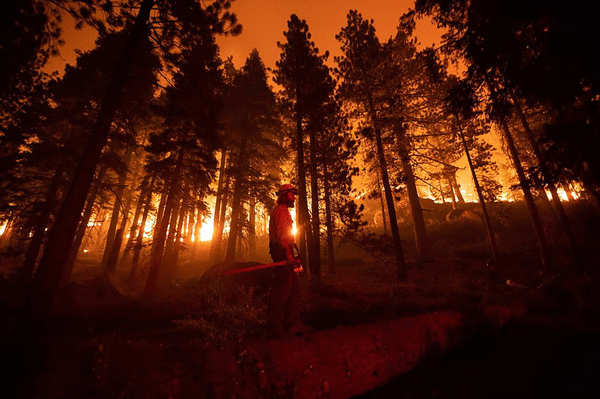
From the air, the stretches of U.S. National Forest that hug the higher reaches of the American and Rubicon rivers in the Sierra do not look entirely pristine.
They are cut through with old roads and have been thinned in places by wildfires and logging. Timber slash piles dot at least one ridge, waiting for removal or burning.
But these areas have enjoyed considerable environmental protections since 2001, due to what’s called the U.S. Forest Service’s “roadless rule.” The rule has prevented the construction of new roads in over 45 million acres of public land around the country, as well as timber extraction and oil, gas and coal development.
U.S. Secretary of Agriculture Brooke Rollins on Tuesday announced a long-expected repeal of that rule, setting off waves of protest — and likely future litigation — from environmental groups.
The rule protects swaths of the Sierra surrounding Lake Tahoe, including watersheds of the American, Rubicon and Yuba rivers. Around 4 million acres of federal land in California are protected by the act. Many of those areas still hold routes cut in before the roadless rule existed, allowing for wildfire mitigation work and recreational access.
“Roadless doesn’t mean there’s no roads in it,” said Gary Kraft, a pilot with the nonprofit EcoFlight who flew local environmentalists and Sacramento Bee journalists over roadless areas in the Sierra on Aug. 6.
But still, the roadless rule is critical in protecting water quality and habitat for species like salmon, trout and deer, conservation group Trout Unlimited said in a statement.
“The Roadless Rule is and always has been about valuing our public lands and the open space, prime hunting and fishing, clean drinking water, and freedom they provide,” Chris Wood, the group’s director and an architect “Instead of repealing it, the Forest Service should shelve this idea and work with stakeholders on better ways of balancing protecting roadless areas and managing our national forests to mitigate the risks of unnaturally intense wildfires.”
Wildfires have been a major part of the debate over the rules. Republicans have argued the rule prevents logging projects to clear out overgrown forests, as well as road construction that would aid firefighters responding to fire starts deep in the backcountry.
“Across the country, we’ve watched preventable conditions — overgrown stands, insect outbreaks and disease — turn healthy landscapes into tinderboxes,” Rollins said in a news release announcing the repeal. “For too long, outdated restrictions have kept tens of millions of forested acres off-limits to the very treatments that improve forest health and reduce wildfire risk to our communities.”
But advocates for the rule say the wildfire argument is a red herring to allow for more commercial exploitation of the national forests. The vast majority of fires are human-caused, and building roads into new areas would lead to the types of spark-inducing activities that often lead to torched forests, environmental groups say.
The roadless rule hasn’t prevented wildfire mitigation work, its proponents also say. In California, foresters have conducted vegetation management to reduce wildfire risk on more than 240,000 acres of land protected under the rule, California Secretary of Natural Resources Wade Crowfoot wrote in a September letter opposing the proposal.
In other western states, however, elected officials welcomed the rule change.
Republican governors of Wyoming, Utah and Montana cheered Rollins’ decision in her office’s news release.
“Management of our public lands closer to the people that actually live, work, and play there has been a steady drumbeat of mine,” Wyoming Gov. Mark Gordon said.
Two western states, Colorado and Idaho, have enacted laws that would protect the areas regardless of whether the federal government’s repeal goes through.
In California, lawmakers reacted to the repeal announcement with concern. They include Rep. Kevin Kiley, the former Republican lawmaker turned Independent whose sprawling district included much of the Sierra range until it was redrawn by state Democrats this year. Kiley said he opposes a unilateral repeal of the rule.
“Protecting our public lands and protecting outdoor recreation is vital, certainly to the character of my district, and the character of California as a whole,” he said. “I think Congress needs to be centrally engaged on this.”
Sen. Adam Schiff, D-Los Angeles, compared the repeal of the roadless rule to efforts to cut into areas protected as National Monuments by past administrations. Those protections are often put in place with local buy-in, he said, but Trump has sought to mandate changes and roll backs.
The lawmakers spoke to reporters at an annual gathering on the shore of Lake Tahoe, where Nevada and California elected officials joined to celebrate bipartisan efforts to protect the famed waters of the lake. Rock climber Tommy Caldwell, a pioneer climber of El Capitan in Yosemite National Park, gave the event’s keynote address, where he spoke about a trip he took to Alaska’s Tongass National Forest to try and raise awareness of the threatened area’s majesty.
The 9-million-acre Tongass forest, part of the largest intact temperate rainforest in the world, was “totally spectacular,” he told The Bee, especially it’s remaining old growth areas. Like the Tahoe Basin, much of the Tongass was logged before environmental protections were enacted, but many old trees remain.
“There’s some left, he said. “And I’m a believer that we’ve got to hold on to that.”
At a press conference in Hayward, meanwhile, Gov. Gavin Newsom panned Trump’s move as destructive and pandering to industrial interests. The state would seek to preserve the roadless rule, he promised.
“They’re stone cold ideologues,” he said of the Trump administration. “They’re fanatics for special interests… wholly owned subsidiaries of oil and gas interests and developers.”
California leaders would “do everything we can, to use our moral authority and our formal authority,” he said, and referenced the state’s history of suing the Trump administration over a wide range of federal actions.
____
(The Bee’s Sofia Williams contributed to this story.)
____
©2026 The Sacramento Bee. Visit at sacbee.com. Distributed by Tribune Content Agency, LLC.





Comments