On mining, a more assertive Minnesota Gov. Tim Walz tests the reach of his power
Published in News & Features
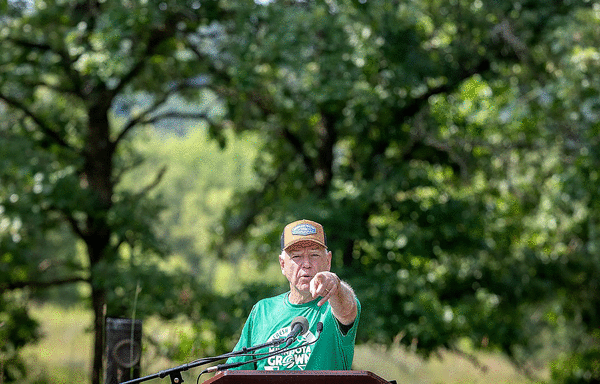
MINNEAPOLIS — Gov. Tim Walz spent much of his nearly eight years in office arguing that Minnesota’s most contentious environmental disputes should not be settled by decree.
On Tuesday, with his tenure nearing its end, Walz issued one.
“As far as my administration is concerned, the fight for the future of the Boundary Waters is over,” Walz said, as he invoked his executive authority to block copper-nickel mining in the watershed flowing toward the wilderness. “The verdict is in. The decision is made. We will protect this place forever.”
It was a surprising declaration from a governor who for years pointed to Minnesota’s laws and regulatory bureaucracy when issues arose over environmental protection around a major pipeline or mining project.
Circumventing the process to block a project he opposed would invite a future governor to do the same to approve one, he argued.
Walz’s evolution on the mining issue is a microcosm of how his style of governing, and his views of his office’s powers, has changed over his two terms.
The rural congressman who arrived at the Capitol preaching “One Minnesota” and political consensus has become one of his party’s more prominent and combative national figures, more confident in wielding executive power and increasingly willing to put Minnesota in direct conflict with his Republican opponents, especially President Donald Trump.
Walz cast Tuesday’s action partly in those terms, calling it a defense against an “unprecedented power grab by the federal government” after Republicans in Washington lifted restrictions on mining near the Boundary Waters. But speaking in front of crowd of activists and conservationists who had pressed him to act for years, Walz acknowledged that their demands were nothing new.
“For folks here, the sense of urgency’s been around for 20 years,” he said.
One of Walz’s first major environmental tests came early in his first term, when environmentalists faced off against labor organizers in a battle over Enbridge’s Line 3 oil pipeline. Both sides looked to Walz to act. Ultimately, he allowed a state legal challenge to proceed but rejected demands that he stop the pipeline himself.
“If you fall on the side that says, ‘Well, the governor should just stop this; it’s the right thing to do,’ then you would be making the case that the next governor should just build one, without any environmental review, without any process involved,” Walz said at a 2019 forum at the Humphrey School of Public Affairs.
He took a similar posture toward PolyMet, broadly supporting the proposed copper-nickel mine in the Lake Superior watershed while his administration defended its permits against environmental groups’ legal challenges.
That was the early Walz approach: sympathetic to environmentalists, but reluctant to substitute his judgment for a regulatory process. That caution fit his political identity in his early days as governor. He was a flannel-wearing former congressman from Mankato who had won repeatedly in a politically divided southern Minnesota district and once carried the endorsement of the National Rifle Association.
But for Walz, Twin Metals was always different. The project, proposed on the edge of the Boundary Waters, raised concerns that pollution from copper-nickel mining could cause lasting damage to the wilderness. Still, Walz put his faith in environmental review. In 2019, he accused the first Trump administration of short-circuiting that process as it revived the project.
The project continued to be a political football in Washington. In 2023, the Biden administration imposed a 20-year mining moratorium near the Boundary Waters. Republicans in Congress and President Trump overturned it this spring.
Around the same time, a state administrative review concluded that Minnesota’s existing mining rules were inadequate to protect the Boundary Waters from some effects of nonferrous mining.
Walz leans heavily on that state finding in his executive order, allowing him to point to the review process he had leaned on for years.
Save The Boundary Waters Executive Director Ingrid Lyons cast Walz’s order as standing up against Trump and “pulling out all the stops” to protect the region.
Others saw a more fundamental break in Walz’s approach to mining: a shift from deferring to the process to taking a political side.
Tom Dicklich, executive director of the Minnesota State Building and Construction Trades Council, said Walz has repeatedly said his role during permitting disputes was to “just call balls and strikes.”
After Tuesday’s executive action, Dicklich said those assurances were little more than talking points.
Over nearly eight years in office, Walz has grown more comfortable using the power of the governor’s office. The pandemic brought a burst of executive orders, and in the years since, he has increasingly turned to executive action to pursue his policy agenda.
That shift has accelerated as Trump has focused attention on Minnesota and Walz, the Democratic Party’s 2024 vice presidential nominee. Walz has increasingly positioned the state as a counterweight to Washington, pushing back on the Trump administration over immigration, federal spending and now environmental policy.
But the mining order, which remains in effect until shortly after Walz leaves office in January, does more than push back on Trump. A successor who disagrees with Walz will have to reverse his actions, a potentially fraught decision, particularly for another Democrat.
U.S. Sen. Amy Klobuchar, the Democrat running to succeed Walz as governor, has taken a position on mining that more closely resembles the approach Walz brought to the governor’s office eight years ago.
She opposed Republicans’ effort this year to overturn the Biden-era mining moratorium near the Boundary Waters, but has emphasized environmental review and permitting in deciding whether mining projects should move forward.
Her spokesman reiterated that position Tuesday, saying Klobuchar has concerns about mining near the Boundary Waters while supporting projects elsewhere that can meet environmental standards.
“She has long supported mining and workers in northern Minnesota and believes there are mining projects, including the soon-to-be-open Mesabi Metallics, which can be done in a safe and responsible manner consistent with science after appropriate environmental reviews and permits.”
It’s the kind of answer Walz once gave himself.
—Minnesota Star Tribune reporters Walker Orenstein, Jana Hollingsworth, Chloe Johnson and Allison Kite contributed to this story.
©2026 The Minnesota Star Tribune. Visit at startribune.com. Distributed by Tribune Content Agency, LLC.






Comments