'ICE Out' pledge divides Chicago aldermen amid campaign finance reform push
Published in News & Features
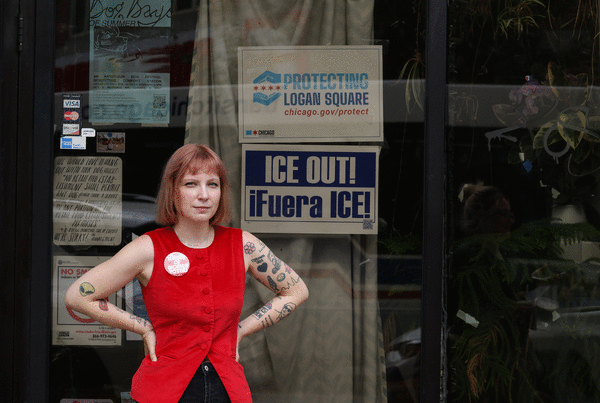
CHICAGO — A pledge signed by nearly half of Chicago’s aldermen to reject campaign contributions from companies allegedly tied to federal immigration crackdowns has split the City Council — with supporters calling it a critical show of solidarity and detractors dismissing it as an insincere political gesture.
The “ICE Out” pledge has garnered signatures from 21 aldermen since its launch in late July. Each promised not to accept money from 12 businesses that activists say have profited from President Donald Trump’s strong-armed deportation campaign, including its Immigration and Customs Enforcement agency, with many using the pledge as proof of their anti-Trump bona fides.
But a Chicago Tribune analysis found the targeted companies have contributed $1.16 million since 2010 to every aldermanic candidate, sitting alderman, ward organization and city candidate combined. Of that, only about $381,000 has gone to the campaign accounts of the 50 current council members — a small fraction of what those aldermen have raised in total during that time.
Several council members who declined to sign the pledge argue the effort is misdirected. And even some who signed it acknowledge that dollar figures are not really the point. To one who signed, Alderman Jessie Fuentes, 26th, the pledge is about showing her Humboldt Park ward that she won’t accept money tied to the “federal terrorism” that has hit the neighborhood in the last year.
“Contributions come with commitments. They come with alignments. They come with values articulated,” Fuentes said. “It doesn’t matter if it’s $10,000, if it’s $1,000, if it’s $500.”
That tension — a money-targeting pledge that ultimately has little initial impact on how much money is raised — traces back to the pledge’s origins.
It was developed by the Fair Elections Chicago coalition, a big-umbrella group of more than two dozen organizations, including the Chicago Democratic Socialists of America, the Sierra Club and Better Streets Chicago, that came together in June 2024 to advocate for a broader goal of leveling the campaign playing field through a program that would match small campaign contributions with taxpayer funds. New York City and Los Angeles have had public campaign funding programs in place for decades.
Jane Ruby, president of the League of Women Voters of Chicago and a coalition member, described ICE Out as “low-hanging fruit” — a symbolic opening move meant to start a conversation about the outsize role of money in Chicago politics ahead of the group’s bigger push for the matching-funds program, which has repeatedly been sidelined and is currently stalled in the City Council.
That framing raises an obvious question: Does targeting companies with relatively modest direct contributions actually advance the coalition’s stated goal of reducing big money’s influence, or does it instead serve as a messaging vehicle for the larger reform fight?
Ruby acknowledged the ICE Out pledge has become a “sensitive issue,” but argued that the short-term pursuit is a necessary strike against negative influences, even as it bolsters the group’s bigger goal.
“I think it’s a combination,” she said. “I don’t think the money is particularly small. If you were to ask voters, even a few hundred dollars is more than many people have in their savings account.”
But Alderman Matt O’Shea, 19th, who hasn’t signed the pledge, doesn’t buy the justification. He argued that council members who haven’t signed the pledge — or who happened to take money from one of the dozen companies identified as being too closely tied to Trump’s immigration efforts — could be unfairly tarnished.
“I think it’s somewhat disingenuous, because nobody can point to what these companies’ associations are,” O’Shea said.
The Beverly alderman has collectively received $36,850 from four of the entities named in the petition: Amazon, Motorola, Waste Management and the Illinois Hotel & Motel PAC, a hotel industry political action committee. Other companies named in the pledge are Dell, Deloitte, Enterprise, FedEx, Home Depot, Microsoft, SP+ Parking and Target. Several of the companies deny having close ties to Trump’s immigration enforcement efforts.
Among other sitting aldermen, only Brendan Reilly, 42nd, with $82,267, and Brian Hopkins, 2nd, with $53,200, raised more from those groups since 2010. All three are long-serving council members.
In terms of giving, the Hotel & Motel PAC accounted for $262,650, about two-thirds of the roughly $381,000 total. Amazon spent $52,000 in city races, while Motorola spent $47,150.
Like all other top earners, most of the money O’Shea received came from the Hotel & Motel PAC. He said he worked closely with Motorola to expand camera coverage at Chicago’s airports, arguing the Chicago-based company “has made our city a much safer place” and that more of its cameras and license plate readers should be placed citywide.
O’Shea also questioned the consistency of aldermen who signed the pledge, asking whether they had any ties to some of the companies, several of which are the nation’s largest and, frankly, most unavoidable. He pointedly asked whether aldermen would remove Dell computers or Microsoft software from their ward offices.
“I’d bet my next paycheck that the majority of whatever aldermen signed (the pledge) had a package sent to their house from Amazon within the last six months,” he said. “I think that whoever’s behind this should put their money where their mouth is if they mean it. Cut all those ties.”
O’Shea logged a $1,000 contribution from Amazon five days before the pledge was published. A week earlier, Alderman Timmy Knudsen, 43rd — who went on to sign the pledge — disclosed that he received $1,000 from the e-commerce giant.
Knudsen, who has received less money from the targeted companies than most of his colleagues, only $2,000, said he has since donated those funds.
“The general pledge of not taking money and really looking into groups to make sure that they are not supporting ICE, I totally stand with,” he said. “This is a really important teaching tool for everybody that we should be looking at where elected officials and candidates are taking money.”
In total, 33 aldermen have received political dollars directly from the 12 companies, according to a Tribune review of state campaign finance records.
The pledge was first published with 12 aldermanic signatures and has since seen its support nearly double in recent weeks. Many signees have marked their support in social media posts, and organizers have encouraged Chicagoans to pressure their aldermen to add their names to the list.
Aldermen who sign are not being asked to return past contributions from the targeted companies, Ruby said. The promise comes as corporate spending soars in Chicagoland elections, she added. Ruby said Mayor Brandon Johnson has not been asked to sign the pledge, and he did not receive any significant contributions from the dozen entities, records show.
“I think people are really sick and tired of elections costing as much as they do when people can’t afford to take their kids to the doctor,” Ruby said. “What are you willing to do to control where campaign money is coming from? And what are you willing to have as a baseline for your morals and values?”
The pledge “came out of an exercise” done by the coalition and was later workshopped with several aldermen, including Fuentes and Alderman Andre Vasquez, 40th, Ruby said. Organizers shared it first with the City Council’s Progressive Caucus, then with the full council before publishing it, she added.
Ruby defended the pledge as a “reasonable test,” saying the coalition carefully vetted the companies’ financial ties to federal immigration enforcement. If the pledge makes some aldermen uncomfortable, she added, that discomfort is itself a sign it is resonating with voters.
The coalition hopes to expand the pledge to state and national candidates, and expects to present it to candidates in the city’s 2027 elections, Ruby said.
The dozen companies involved have spent far more on state politics. But the roughly $381,000 they’ve given to current City Council members across multiple election cycles is dwarfed by what those aldermen have raised for reelections overall. Even before the April 2023 runoff election, more than $21 million had poured into aldermanic races, according to a Block Club Chicago analysis.
Asked to respond to critics who call the pledge political pandering and virtue signaling, Fuentes called it a “value add” that demonstrates political decisions won’t be influenced by companies cooperating with federal immigration agents.
“It is not something we are using to tout symbols,” she said. “It’s real to our praxis.”
She added that the pledge is far from the only action she and other signees have taken against the administration’s deportation campaign.
Fuentes, one of 17 aldermen who received no money from the targeted companies, filed a federal lawsuit against Trump’s administration in May, alleging federal immigration agents shoved, threatened and detained her last fall as she questioned their presence at a Humboldt Park hospital.
But several of the companies listed in the pledge flatly reject the accusation they coordinate with ICE.
Home Depot spokesperson Beth Marlowe told the Tribune the company is not notified when federal immigration agents plan to take action near its stores and does not coordinate with the agency or interfere with law enforcement.
Target spokesperson Lauren Frank said the company has no agreements with ICE.
Michael Jacobson, president and CEO of the Illinois Hotel & Lodging Association, argued the pledge “creates a slippery slope and establishes a troubling precedent” regarding who is permitted to stay in hotels. The industry group, which is aligned with the Illinois Hotel & Motel PAC, was targeted because the Marriott and Hilton hotel chains “allow immigration agents to stay at their properties,” according to the pledge.
“Asking hotels to decide who should or should not receive accommodations based on a person’s occupation, affiliations or political beliefs puts hotel employees in an impossible position and undermines two core values of hospitality: welcoming all and guest privacy,” Jacobson wrote in a statement.
Fuentes said the pledge was never about tourists vacationing with family.
“We’re talking about an entire department leasing floors,” she said. “I don’t know if hotels renting dozens of rooms to Homeland Security and Border Patrol while they terrorize residents downtown is necessarily creating a welcoming environment.”
Knudsen, who previously provided pro bono legal aid to LGBTQ+ foreigners applying for asylum, said the hotel industry group’s inclusion “struck a chord” as he weighed whether to sign, noting the group’s role in securing work authorization for migrants across the city, he said.
“They really are an employer of so many, you know, undocumented folks in good-paying jobs, good-paying union jobs,” he said, before adding that he nonetheless decided to sign.
Hopkins defended the hotel industry group and the $45,000 in contributions he has received from it, crediting the association with driving much-needed tourism to the city.
“I don’t support ICE, and neither does the Hotel Association,” he wrote in a texted statement. “In fact, the lodging industry is one of Chicago’s top sources of jobs for recent immigrants.”
Reilly did not respond to a request for comment.
Activists nationwide have called for boycotts against dozens of major companies tied to Trump’s deportation efforts, including Apple, which reportedly blocked access to apps designed to track immigration agents, and Google, which has run ads recruiting immigration agents.
O’Shea said he would quickly sign a pledge stating he does not support ICE, but argued that ties among large companies and the administration’s immigration policy are common.
“I promise you, you spend an hour Googling, you would find a JCDecaux subsidiary that flew ICE somewhere,” he said, referring to a major city contractor. “You would find a subsidiary of Kraft, of Heinz ketchup.”
Organizers said they compiled the list of 12 companies by examining a federal contracting database, SEC filings and city data, but noted the list is not exhaustive. Companies that change their policies can be dropped from the list, while others that take on new immigration-related contracts can be added, the pledge states.
Asked about the choices made to target specific businesses, Vasquez said his decision was in part about deferring to the coalition making the request, not about scoring “political points.”
“I would leave it up to an individual constituent to decide if it’s virtue signaling or not. For me, it’s more being deferential to the organizations asking us to do it,” he said.
Vasquez, who led training sessions last fall on resisting immigration agents and has since pushed for public hearings on Trump’s Operation Midway Blitz surge in immigration arrests last year, urged Chicagoans evaluating the pledge to also consider how aldermen have voted on immigration-related legislation. He has received $2,750 from the companies, most recently Motorola in December.
Signing the pledge was a “no-brainer,” said Vasquez, who chairs the council’s Latino Caucus, Progressive Caucus and Immigration Committee. But he said the city must also strengthen its sanctuary city rules and protect street vendors facing deportation.
“The pledge itself is the beginning.”
_____
©2026 Chicago Tribune. Visit chicagotribune.com. Distributed by Tribune Content Agency, LLC.




Comments