Missed opportunities, incomplete investigations preceded discovery of 56 bodies at Chicago funeral home
Published in News & Features


CHICAGO — After city and state officials discovered 56 decomposing bodies in a Chicago funeral home, Gov. JB Pritzker defended the state’s response to complaints against the husband and wife in charge of the facility.
Pritzker’s message, delivered during a downstate event, was simple: State government did its job.
The comptroller’s office, he said, “did what they should do” in shutting down a notorious crematorium run by the same family in the south suburbs where mishandled bodies and hundreds of unreturned remains were discovered in 2025.
The licensing board, he said, “did what it is supposed to do” about the pair who also were running South Chicago Chapel, where the most recent discovery was made.
The people who didn’t do what’s right, Pritzker said, were the couple, Clark and Johanna Morgan.
“We’re talking about some really bad actors,” Pritzker said. “The process was followed, the process that’s in the law now, and obviously there was no report that came in that would lead anybody to discover this” until late last month, he added at another recent news conference.
A Tribune investigation, however, found regulatory shortcomings that allowed those apparently bad actors to persist, with the state failing to fully shut down Clark and Johanna Morgan’s businesses or take their licenses even after they were found to have mishandled human remains at their south suburban facility, Heights Crematory.
This story is based on a review of business licenses, hundreds of pages of court filings across two states, police reports, inspection documents and interviews with more than two dozen people. The Morgans did not return repeated messages seeking comment.
At several key moments, the Tribune review found, government and law enforcement failed to stop them from operating in the industry — despite discoveries along the way of an altered state credential, and allegations in a barrage of lawsuits.
State licensing regulators visited South Chicago Chapel funeral home at least twice in the wake of problems at its owners’ crematory business. But there is no indication in state paperwork that the problems found at Heights Crematory or other red flags triggered aggressive regular inspections of the Morgans’ businesses, or their ongoing operating practices.
Because that’s not how the system is set up: Illinois investigations of funeral homes typically come only after complaints are made, according to state guidance.
“It’s pretty obvious to be angry at the Morgans for their alleged nefarious activities, but frankly at this point I’m really angry at the agencies in Illinois that should have been keeping their eye on them,” said Michael D. Sharkey, general counsel at the Illinois Funeral Directors Association.
The ongoing investigation into South Chicago Chapel is just the latest grim incident involving the so-called death care industry and it highlights weaknesses within state law and enforcement.
In July 2009, authorities revealed that workers at the historic Burr Oak Cemetery, one of the area’s first cemeteries to allow the bodies of Black people to be interred, were reselling graves and dumping hundreds of old remains in an abandoned, weed-covered lot.
Three years ago, state officials discovered mishandled cremains by a central Illinois funeral director. Both scandals spurred reforms by state lawmakers that nevertheless failed to streamline a complex disciplinary process and left gaps for troubled businesses to continue operating.
“These tragedies are the culmination of a variety of different things that, when looked at from a bird’s-eye view, are apparent,” said Brent Adams, the former head of the Illinois Department of Financial and Professional Regulation (IDFPR) who presided over the agency during the Burr Oak scandal, though he added he didn’t know the specifics of the recent funeral home case. “Unless someone takes a step back and looks at it from a macro point of view, you’re not going to see a systemic problem in how this is being handled.”
Some steps taken
Illinois Comptroller Susana Mendoza did shut down the Heights Crematory tied to the Morgans.
And while her office brought its findings to the Illinois State Police and Cook County state’s attorney, a spokesperson said, Cook County State’s Attorney Eileen O’Neill Burke declined to immediately bring charges. Instead, Burke asked the state police for more investigation, which they did not conclude.
“Based on that preliminary review and feedback from the State’s Attorney’s Office, the investigation continued and is on going,” state police said.
There still have not been charges in that case, even though more than two dozen families filed lawsuits alleging that they mishandled their family’s remains.
After Mendoza shut down and sanctioned Heights Crematory in the south suburbs, state officials allowed Johanna Morgan, Clark Morgan’s wife who was listed as the business’s president, to retain her funeral home director license, with the key regulator, IDFPR, saying it inspected South Chicago Chapel funeral home twice in 2025 without finding evidence of mishandled remains.
“The deceased are uniquely unable to protect themselves from fraud and abuse,” said Adams, the former IDFPR head. And as the current law uses a complaint-driven model, “How can that possibly work when the key witness is a deceased person?”
Dennis O’Neill, a lawyer registered in state business records as the agent for South Chicago Chapel, said he had no comment.
“I have no intention of answering any of your questions,” he said.
Checkered past
Records show the Morgans have a long and troubled history in the funeral and cremation industry.
Johanna Morgan first became a licensed funeral director and embalmer intern in December 1996, state records show. A year later, Clark Morgan received his funeral director and embalmer intern license, according to the state.
Despite his presence in the funeral industry, Clark Morgan never had a full funeral director license, according to state records. After his intern license expired in 2019, Clark Morgan “altered the credential to make it appear valid and continued practicing without authorization,” the IDFPR said.
But the department didn’t discipline him for that until 2024, when it fined him $10,000 and “revoked” the expired license. Records show he was president of South Chicago Chapel in late 2024, with his wife carrying her director’s license.
Johanna Morgan became a full funeral director and embalmer in 1998.
In 2005, the Morgans registered Heights Crematory with the secretary of state’s office. Heights Crematory operated in Chicago Heights, a low-income south suburb that’s largely Black and Latino.
Clark Morgan testified in a deposition obtained by the Tribune that he opened the facility in 2006. A 2007 filing with the secretary of state’s office listed Johanna Morgan as the president, which she remained in the most recent filing in 2024.
Records show the Morgans’ involvement with other businesses.
Johanna Morgan is listed as president of Planet Green Cremations in Glenwood, as well as Fur Get Me Not and Wags and Whiskers Pet Cremation Services, tied to the same address as the Heights Crematory, records show. All three businesses are listed as dissolved in state records.
Part of the community
The Rev. Venus Vaughn said she first met Clark Morgan a decade ago. When her uncle, Oscar Jackson died, Clark Morgan performed the services and she started recommending him to other families.
Until this month, Vaughn was pleased with the relationship.
“He was a very happy-going person to me. You was able to just relax with him. You was able to relax with him in every situation,” Vaughn said. “He was there, he came to your house to walk you through the process. If you didn’t have the money, he set up a payment plan with you. He was someone you expected to be a professional person and caring person.”
But the flurry of business activity came with speed bumps. Later in the 2010s, the Morgans began running into problems with state officials.
In 2017, the Illinois Department of Financial and Professional Regulation fined and reprimanded Johanna Morgan after she “failed to file a death certificate in a timely manner,” state records show.
Around the same time, the Illinois attorney general sued the Morgans over minimum wage violations at Heights Crematory.
That December, both Morgans had their licenses suspended over state income taxes. They were reinstated a month later. But deeper problems were on the horizon.
Regulation gaps
The so-called death care industry in Illinois is a long-known weakness in state regulation.
After the horrific scandal at Burr Oak Cemetery, then-Gov. Pat Quinn assembled a state task force to review the circumstances of the case and “provide detailed recommendations on what policies, laws, rules and regulations should be implemented” to try to prevent such scandals in the future.
Through its review, including a series of public hearings, the panel identified “a systemic failure of oversight and regulation.” Its 82-page report concluded there was “a direct connection between the hodgepodge of regulations governing the death industry and the deterioration of Burr Oak Cemetery and other cemeteries” and that it was “likely that the lack of regulatory oversight was a contributing factor to the criminal scheme that allegedly unfolded.”
The September 2009 report warned: “Without legislative reform and increased oversight of cemetery operations, the events that occurred at Burr Oak and other cemeteries in this State will continue to occur, and the same types of tragic stories the public has already heard too many times will continue to be told.”
The top recommendation was to consolidate funeral and burial oversight under the auspices of the Department of Financial and Professional Regulation so that a “uniform system of oversight and regulation” could be established.
Almost 17 years later, after several attempted legislative fixes in response to subsequent horror stories involving Illinois funeral homes and cemeteries, those duties remain divided between the department, with oversight of funeral directors, and the comptroller’s office, with jurisdiction over crematories.
Because the Burr Oak scandal prompted the report, it focused largely on weaknesses in cemetery oversight and regulation. But its review of regulatory structures in other states pointed to one gap in funeral home oversight that, were it closed, perhaps could have caught the appalling conditions at South Chicago Chapel.
At the time of the report, states including Florida, Georgia, Hawaii, Louisiana, New York and Texas required some form of licensing or registration for funeral homes themselves, apart from licensing for funeral directors or embalmers.
Several also required regular inspection of the facilities, rather than relying on a complaint-based system, as has been the case in Illinois. In Texas, for example, facilities then had to have a surprise inspection every other year. In 2019, the time frame was extended to once every three years.
IDFPR generally may investigate the actions of any licensed funeral director or person who is acting as a funeral director, according to state law, but the department isn’t tasked with regular inspections of all facilities.
After authorities found a central Illinois funeral home mishandled dozens of human remains, lawmakers added a requirement effective in 2025 that IDFPR inspect any funeral home premises within 10 business days of them being named in a complaint related to misidentification or mishandling of remains. Lawmakers also required that funeral businesses maintain “chain of custody records” ensuring they can identify human remains in their possession throughout all phases of the process.
The 2025 change made it a misdemeanor, as opposed to a licensing violation punishable by fines, to act as a funeral director or embalmer without a license. Knowingly violating the requirements related to preparation rooms — the area where bodies are prepared for embalming and burial — is a felony under the revised state law, as are some types of records violations.
“When I saw that in the news, I was just devastated,” the bill’s sponsor, Democratic state Sen. Doris Turner, said of the South Chicago Chapel discoveries. “I could not believe that it was happening again.”
The South Chicago Chapel case has spurred Turner’s interest in strengthening regulations further, she said.
“We want to take a look at it and see if there’s something we can do to tighten it up, or if it’s just a case of people (flouting) the law,” she said.
The comptroller’s office, which does on-site inspections of crematories, in response to the Heights Crematory findings also received even more oversight power, pushing for legislation that raises penalties and will allow them to suspend crematory licenses before a hearing in extreme cases. It goes into effect next year.
While he maintained that state agencies properly followed the current process, Pritzker on Wednesday signaled he was open to more changes. The comptroller’s office, his state licensing agency and lawmakers “are going to have to work together to see if there’s a better mechanism,” he said.
“IDFPR is a licensing organization, but the investigatory endeavor — you know, we should all discuss whether that’s something that should belong to IDFPR or to some other body,” Pritzker said.
Asked why IDFPR didn’t regularly check on a business with known “bad actors,” Pritzker said the agency’s responsibility is to look into reports. No reports came in recent months that would lead to the discovery until the complaints in late July, he said.
Heights crematory
The year 2024 was critical for the Morgans.
That March, the state fined Johanna Morgan $5,000 and reprimanded her “for failure to complete three records in a timely manner in 2020.” In April came the revocation of Clark Morgan’s altered license and the $10,000 fine.
In July 2024, comptroller’s office officials visiting Heights found a body in a broken refrigerator and “six to seven bodies waiting to be cremated” on the main floor, according to comptroller office documents. “Licensee Clark Morgan” also told the comptroller’s auditor at the time that “he would have answers” to a complaint related to “lost cremains,” the document said. Johanna Morgan in an email later disputed the idea that the cremains were lost and said there was a disagreement with the family, according to documents obtained by the Tribune.
State officials gave them two weeks to correct the problems. The complaint about cremains was later resolved, a comptroller spokesperson said.
In February 2025, comptroller officials performed a surprise inspection and found “many unembalmed bodies in an inoperable cooler inside the facility,” according to a lawsuit against the crematory. The IDFPR visiting the South Chicago Chapel in March and October that year was a “proactive” step taken because of the issues at Heights Crematory, officials said, but there was no indication they returned until the complaint this summer.
Heights Crematory agreed to stop operating in 2025.
Mendoza took a victory lap last spring after Heights Crematory shut down, issuing a press release vowing that “its owners will never operate a crematorium in the state of Illinois again.”
IDFPR defended its handling of both Morgans’ licenses.
“Even as (Clark) Morgan attempted to conceal the expired status of his intern license, the Department’s enforcement tools ensured that the misconduct was detected, documented, and addressed through formal discipline,” IDFPR said in an email.
The fact that funeral homes themselves are not licensed — noted in the 2009 report following the problems at Burr Oak — is a key issue in Illinois’ current system, said Mark Styninger, a licensed funeral home director of more than 40 years and the coroner in downstate Washington County.
“A funeral home is supposed to be operated by a licensed funeral home director. But you don’t have to be a licensed funeral director to own a funeral home in Illinois,” Styninger said.
As such, while some of the financial operations of funeral homes are regularly audited and IDFPR licenses directors themselves, the homes are not regularly subject to thorough inspection in Illinois as they are in some other states, Styninger said.
That needs to change, Styninger said, as does the splitting of industry oversight between different parts of state government. The recent changes to law requiring more records will only catch bad actors if the state follows up with enforcement, he said. Otherwise, “it’s a joke.”
The shocking find
In 2022, Johanna Morgan incorporated South Chicago Chapel with the secretary of state’s office.
As of December 2024, Clark was the business’s president, according to state records.
The eventual state inspections this summer at South Chicago Chapel came in response to a complaint in late July at a crematory not owned by the Morgans, Bohemian National Cemetery.
The comptroller’s office found Bohemian had malfunctioning equipment, and an auditor flagged bodies “that appeared to be in very poor condition” from the Morgans’ businesses to IDFPR, said Kim Howard, a spokesperson for the comptroller’s office. Of the 35 bodies that were found at Bohemian National Cemetery crematory, at least 22 came from businesses run by the Morgans, she said. IDFPR then investigated South Chicago Chapel.
Reached by phone for comment, David Pimm, the president of the Bohemian National Cemetery Association, said two of the cemetery’s three retorts, or furnaces, were not working due to an electrical fire. The cemetery had continued taking bodies for cremation in the third retort, Pimm said, and they were cooperating with the state’s follow-up efforts.
Pimm estimated that the Morgans had been cremating bodies at Bohemian National Cemetery for “maybe two years” but was adamant that “if there was wrongdoing, we knew nothing about that.”
The tips ultimately led regulators to visit and discover bodies Aug. 3, according to the state, later accompanied by law enforcement.
What they found generated international news and shocked even veteran police officers.
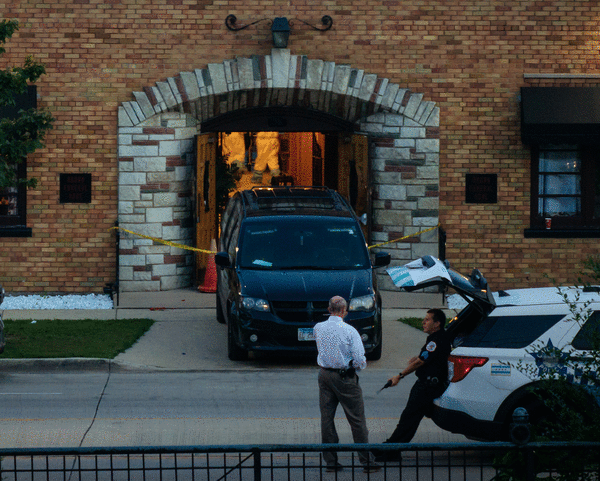
When the state regulator and police arrived at South Chicago Chapel early in the afternoon Aug. 6, a funeral was underway. Clark Morgan walked the regulator and three cops through the building, where officials found nearly five dozen bodies. IDFPR had suspended Johanna Morgan’s license a day prior.
According to police sources, some bodies laid in plastic bags on gurneys while others were on shelves alongside miscellaneous equipment like spray cans and cardboard boxes. Sinks were full of other cans and rags, sources said. Some of the corpses were not in bags and only haphazardly covered. Some of them had limbs that had apparently been severed.
Morgan refused to let the police back into the building without a warrant, though police told him they could do a business license check anytime the business was open, according to the police report.
At that point, Morgan locked the doors, and firefighters had to break them down.
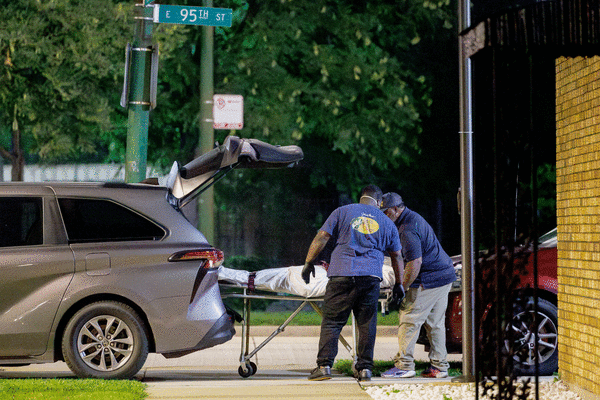
Overnight and into the morning, a crew of body removal workers slowly wheeled 56 corpses out of the building. Authorities also later announced they’d recovered 56 boxes of already cremated remains from the funeral home.
On Wednesday afternoon, Planet Green Cremations had a handwritten sign taped to its front door that read “closed for power outage.” Inside, a replica King Tut sarcophagus stood against a cinderblock wall, looking out at a table and some chairs. A printout of different urns for sale was taped above the table.
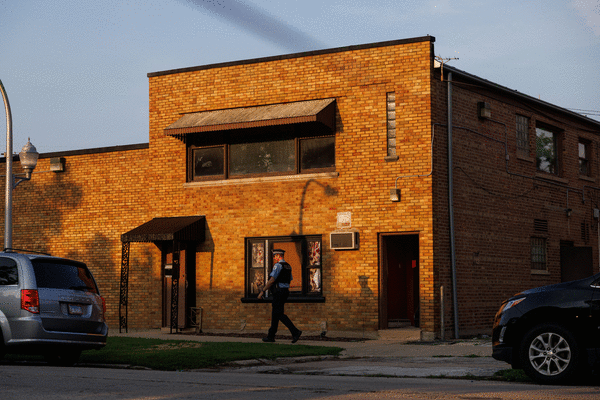
At South Chicago Chapel, the doors and first-floor windows to the funeral home were boarded up. An orange city business closure notice was tacked to one of the windows.
Three hearses stood in the parking lot. A black minivan and a Chicago police barricade blocked the front entrance.
Someone was still answering the phone for the funeral home, though: A man picked up and answered for South Chicago Chapel. After hearing a Tribune reporter on the other end of the line, he hung up.
____
©2026 Chicago Tribune. Visit at chicagotribune.com. Distributed by Tribune Content Agency, LLC.





Comments