Minneapolis may close schools again. On the North Side, old fears resurface
Published in News & Features
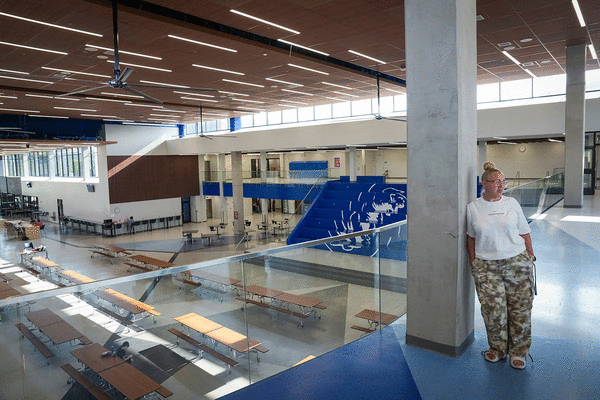
MINNEAPOLIS — Mauri Friestleben knows what it’s like to close schools in north Minneapolis, having served 20 years ago as an assistant to former Superintendent Bill Green when Willard Elementary and other buildings were shuttered.
“It was really hard. It was emotional,” she said. “I think people are assuming that’s what we’re about to experience again.”
The same forces again are in play: Enrollment in the state’s third-largest district has dropped to 30,079 students in a system built to serve 43,000 kids, leaving behind a glut of underused buildings and a series of multimillion dollar deficits.
North Side parents, including those who have stuck with the district when many sent children elsewhere, are worried their schools again will be at risk when officials unveil three options for a new “transformation” plan in September that could right-size the district.
Of the nearly two-dozen schools that fall short of district enrollment targets aimed at providing every student a well-rounded education, 10 are on the North Side. There, Black parents pulled their students in big numbers to attend other schools after a widely-derided district redesign went into effect in 2021-22.
School Board Chair Collin Beachy said he would not expect anything “big and drastic” to occur on the closure front — he only says, for now, that he expects closings and consolidations to be an option — adding that the board will weigh concerns from its Black Parent Advisory Council (BPAC) and others before any board action is expected in November.
One North Side school, though, could provide an interesting case study against closures. Fifteen years ago, North High was slated to close due to its low enrollment and dismal academic results, but officials reversed the decision due to public outcry over saving the city’s oldest high school.
Now, under Friestleben as its principal, graduation rates and enrollment are up, and with the help of assistant principal Steve White, North High has data at the ready for all teachers showing where every student stands in securing the credits needed to graduate.
North High also underwent a $100 million-plus renovation that includes a spacious student commons area and a Career and Technical Education Center that leaders hope can attract students from other districts.
But the challenges of sluggish enrollment and academic achievement the district faced in 2010 continue today. Many North Siders now are anxious for district leaders to reveal the three options next month. They say: “Can you just rip the Band-Aid off and tell us what we’re looking at here?” Friestleben said.
“There is a quiet assumption within current MPS employees that we all know schools need to close,” she added. “It just seems natural: Like, you’re having money problems, you got to let something go.”
When he took office in 2023, Beachy was resistant to the idea of school closings and consolidations, he said, thinking: “We’re not going to do that; we’re going to pump money in it,” he recalls.
But after a string of budget deficits in the tens of millions of dollars, and less than rosy forecasts at the state and federal levels, Beachy said he now is left to conclude: “What money?”
He’s optimistic, however, when it comes to seeing what administrators come up with next month when the “transformation” plan options are revealed in the bid to ensure that every student across the city has access to a well-rounded education.
“We just have to structurally make it happen,” he said.
More than half of the district’s schools, including North High, sit at less than 70% capacity, but officials say that where a building ranks in terms of efficiency is not as important as the number of students attending. North High’s enrollment, for example, has grown steadily from 487 students in 2023-24 to 616 students in 2025-26.
Districtwide, enrollment has risen slightly by about 100 students since 2023-24. But the district’s physical footprint is so wide that it’s become difficult, officials say, for every school to draw the number of students needed to deliver a holistic education.
Black parents say it’s important that any decisions to downsize do not deprive Black, brown and immigrant students of equal academic opportunities.
“A true guaranteed experience [in MPS] means that any school remaining on the North Side must have the exact same level of robust, high quality and community appropriate programming as any remaining school on the South Side,” said Elleni Fellows, a BPAC member.
In a recent email to BPAC members, Deputy Superintendent Ty Thompson said that the district has adopted for the coming year a new reading curriculum, “Arts & Letters,” which aligns with BPAC’s goal of increasing student literacy.
“We recognize that significant work remains to improve academic outcomes and experiences for all students,” Thompson said. “We value our partnership and look forward to continued dialogue.”
Ann Johnson is vice president of education at Northside Achievement Zone, a Minneapolis group that works with partner schools, nonprofits and others to help families bridge opportunity and income gaps. She said she senses that residents are prepared for the potential consolidation of school sites.
When asked if she expects buildings to be closed, she said: “Oh, yes, for sure, everyone expects it’s going to happen.”
Northside Achievement Zone has a partnership with the district where it’s helped restore positions lost to budget cuts. It also has aided student recruitment at Nellie Stone Johnson Elementary, which on paper, at least, falls just short of the enrollment target associated with the transformation push.
As a result, Johnson is working closely with Superintendent Lisa Sayles-Adams to make sure community members are being heard. No one wants to be “blindsided,” Johnson said, and the reasons for any moves should be understood.
No specific schools have been mentioned as potential targets, she added, but the expectation is students still would be staying on the North Side.
“They’re doing great things there,” Johnson said of Nellie Stone Johnson Elementary, adding that a grandson who’s a third-grader there is reading at a fifth-grade level.
Sixteen years have passed since the final round of what had been a steady wave of Minneapolis school closures beginning in 2005 due to declining enrollment and multimillion deficits.
The district currently has six vacated buildings. Two on the North Side — Willard and Gordon — have active purchase agreements totaling $1.35 million.
The district’s most recent deficit was $39.7 million. Critics argue that school closings and any subsequent sales are not a cure to chronic budget woes.
A recent study out of California showed that some potential savings associated with closings can be offset by a loss of students to neighboring districts and charter schools, and that the reassignment of teachers to other schools limits personnel savings, according to the publication Education Week.
Standing in opposition to closings are the powerful Minneapolis Federation of Educators and a new parents group, Minnesota Families for Public Schools, that backed union demands last fall for a new contract lowering class sizes.
Parents group leaders say the school board won’t have enough time for community input before it acts.
Beachy said the district’s transformation goals also call for enrollment-boosting measures such as expanding preschool options and retaining students between fifth and sixth grade, and cannot be delayed: “I understand the tension about closing schools, but so many other things [in any eventual plan] will be helpful to MPS,” he said.
The district also needs to end the cycle of budget strife — experiencing “the same damn thing every year,” Beachy said.
At North High, Friestleben said the school lost nine staff positions due to this year’s budget cuts, and class sizes are projected to grow from 24 to 25 students to 34 to 35 students.
Before, “teachers would know: ‘I may be in a tougher part of the city, but I’ve got lower class sizes,’” she said. “They’re struggling with this going into this year.”
She acknowledged that research indicates that school closings might not be a reliable budget fix. But those buildings still have a principal, a nurse and a building engineer, Friestleben said, and savings from such costs could come in handy elsewhere — like North High.
©2026 The Minnesota Star Tribune. Visit at startribune.com. Distributed by Tribune Content Agency, LLC.






Comments