How data centers in Missouri converted neighbors into activists, from cities to farms
Published in News & Features
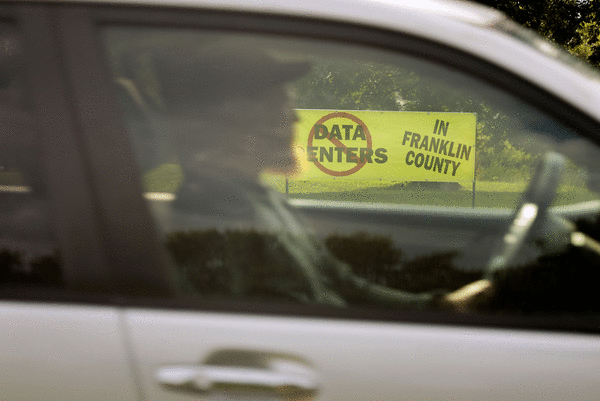



ST. LOUIS — The letters were hand-delivered in the January cold, slid into mailboxes along Sugar Lake Road by an unknown person who had signed them, “A Concerned Citizen.”
A second data center is in the works for Franklin County, Missouri, the letters said.
“Please do your homework on what these data centers bring to the area,” the Concerned Citizen advised.
Ten days later, on a snowy Tuesday morning, a special meeting of the Pacific Board of Aldermen drew a spillover crowd to City Hall.
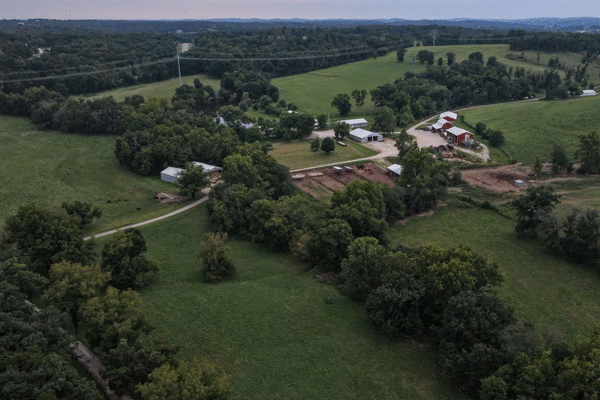
Keith Ketcherside was one of three dozen people who grilled the board about the operation. His property abuts Crooked Creek Farm, the suggested site for a 500-acre data center near Pacific, a town of about 8,000.
“Many other things need to be brought to light,” Ketcherside told the aldermen. “I don’t understand the potential upside to the community.”
It’s a skepticism that has been echoed by countless folks across Missouri as proposals for hyperscale data centers — with names like Project Green and Project Butterfly — have proliferated. Resistance to the rapid expansion has unified neighbors and transformed bystanders into activists, in both rural and urban areas.
Data center opponents have mobilized by holding the floor for hours at council meetings, including a 10-hour overnight marathon at Union High School in March. They have committed themselves to finding answers they believe developers — and sometimes their elected officials — have failed to provide. With the same fervor as baseball statisticians, they are diving into metrics, comparing numbers and plotting out strategy.
Through Facebook groups, text threads and Dropbox accounts, they share information. Much of the organizing is being done the old-fashioned way: over coffee, at political rallies and during potluck fundraisers.
Everyone is welcome to contribute: Third-generation residents. Newcomers. Democrats. Republicans. It does not matter whom you voted for in the past or whether you voted at all. The antipathy toward data centers transcends political tribalism.
“I have met lots of cool, smart people,” said Ketcherside, who has attended dozens of meetings over the past six months. “We’ve become friends with so many other people as a result of this.”
Cloud-computing data centers are on the rise across the United States, propelled by the booming artificial intelligence industry. More than 600 are operational, according to the online DataCenterMap USA, and another 300 are in progress.
Almost everywhere, they have drawn criticism about their energy use, the potential impact on utility bills and property values, and the effects on the environment. A Reuters/Ipsos poll last month found that two-thirds of Americans objected to the surge in data center construction, and only 14% said they would be OK with one being built near their homes.
Amazon, Microsoft and Google are the biggest players nationwide; Atlanta-based Beltline Energy is the developer seeking approval for the Crooked Creek land in Franklin County.
Missouri already has six hyperscale data centers, with four more under construction. At least a dozen additional sites have been floated in the past year, from an abandoned warehouse in the heart of St. Louis to a former tree farm in Montgomery County.
Steve Jeffery, an environmental lawyer in Chesterfield who has been hired by citizen groups across the state, says the distrust is fueled by closed-door deals and nondisclosure agreements.
“There’s a commonality,” he said. “The lack of transparency.”
Activists have been notching victories — including a growing list of communities enacting moratoriums on new projects. In April, critics of an approved hyperscale data center voted out three Festus City Council members who backed the project. The residents are now trying to force a recall election of other city officials.
The opposition has put developers and business leaders on their heels. Ron Kitchens, managing partner of the business group Greater St. Louis Inc. and a booster of data centers, argues that many of the objections are overblown and warns of misinformation. He and other business leaders have said the region risks losing prime development and tax revenue by batting away data centers.
But Kitchens conceded that the messaging around data centers should have started earlier and could have been clearer.
“We’ve got to do a better job of burdening people with knowledge, telling people about the opportunities,” he said.
'We kept showing up'
It wasn’t until late April that Joyce Huston learned about the data center proposal at the former Emerson campus in Ferguson, more than a month after a town hall meeting was held with Jim Onder, an attorney and real estate developer who was under contract to buy the property.
Huston saw a press release from the St. Louis County NAACP that challenged Onder’s plan to renovate the 217-acre site into a technology hub, including modernizing Emerson’s old data center.
“There has been insufficient opportunity for true community discussion, exploration of potential impacts, or understanding of the health, environmental, and economic consequences,” the NAACP statement read.
“The voices of those most likely to be impacted — residents in nearby communities — have not been sufficiently included,” it continued.
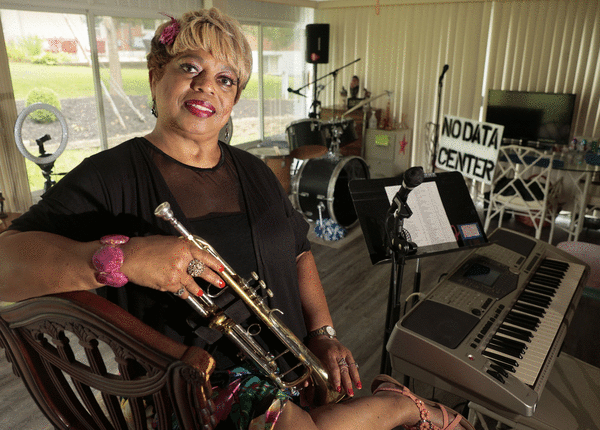
That’s all it took for Huston. Her voice is her livelihood. For a quarter of a century, “Lady J” performed in Las Vegas as a blues trumpeter and vocalist.
Soon after she saw the NAACP statement, she was protesting outside Ferguson City Hall, hoisting a yard sign with “No Data Centers” hand-stenciled across it.
“I’m not shy,” said Huston. “I ended up on TV channels.”
She started a Facebook page, “No Data Center in Ferguson MO,” and a core group of activists emerged.
“We kept showing up at the same places,” Huston said.
On Saturdays, she would meet with a half-dozen regulars, sometimes at a cafe, sometimes in her kitchen. They were people she otherwise would never have gotten to know.
They shared a disdain for their elected officials and a concern that the unknowns would come back to bite Ferguson residents.
Huston’s beef with data centers is unconnected to artificial intelligence.
“I’m an avid AI user,” she said.
Her top concern, she says, is for her and her neighbors’ well-being. Huston grew up in the 1960s in the Pruitt-Igoe housing complex, which was secretly sprayed with zinc cadmium sulfide, a carcinogenic chemical powder.
She attributes her respiratory problems, including asthma, to that experience. She fears that air pollution from a data center could worsen her breathing.
The demand on resources such as water and electricity is too high, the Ferguson activists argue. The effects on the environment are untested, and the city could be on the hook if things go awry. They draw a parallel to the fallout from nuclear waste disposal in north St. Louis County after World War II.
“We’re not opposed to economic development," said Henry Iwenofu, who ran unsuccessfully in the Democratic primary for the 73rd district state House seat. "We’re opposed to getting screwed."
Joseph Duggan, a Republican who once worked as a speech writer for President George H.W. Bush, feels like the data center rollout laid bare bigger problems within Ferguson’s City Council, which deadlocked over whether the proposed center should be awarded tax abatements.
“For a year or more, there have been secret talks about it,” said Duggan, who moved back to Ferguson in 2020. “Suddenly, it’s an urgent matter.”
Onder has said that the data center would use "clean" energy and rely on its own private energy sources. In June, he still purchased the Emerson campus, despite the lack of tax incentives. He has not said whether he will go through with the original redevelopment.
'Sense of community'
Kitchens, with Greater St. Louis Inc., pushed back on complaints over secrecy and quality-of-life concerns.
“People don’t negotiate for their home and tell their neighbors what their negotiation is for,” said Kitchens. “That’s not how business negotiation works. That’s not how representative democracy works.”
He has traveled to hundreds of data centers over the past several years, he said, and has found that newer facilities are more energy efficient and less noisy than older ones.
Greater St. Louis Inc. hosted a panel in late May that included representatives from labor unions and other business interests. They asserted that data centers are job creators, economic engines and necessary to a society that is reliant on internet streaming, cloud data storage and artificial intelligence.
A couple of weeks before that gathering, Bob Clark, CEO of the Berkeley-based manufacturing company Clayco, held a news conference to speak in favor of data centers. CRG, an affiliate of Clayco, builds large-scale data centers.
“I feel like St. Louis has been left behind in many ways,” Clark said at the time. “I don’t want Missouri to be left off the map ... This is going to be the new economy in the United States.”
Most activists acknowledge the need for data centers. But, they say, they want answers, guarantees and breathing room.
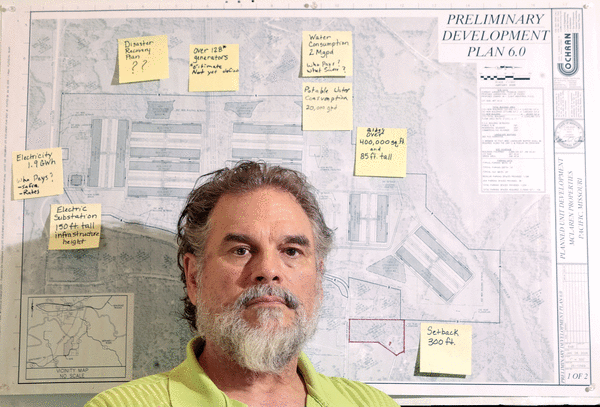
In Franklin County, Ketcherside, who works in information technology, made a posterboard map of the Crooked Creek proposal to hang in his home office.
“I look at it all day long,” he said.
It’s festooned with yellow Post-its. One lists the estimated water consumption: 2 million gallons per day.
“Who pays? What source?” the sticky note asks.
Ryan Sanders, the managing partner at Beltline Energy, did not respond to an interview request for this story. Neither did Dave Schatz, the presiding commissioner of Franklin County, or anyone on the Franklin County Planning and Zoning Commission.
Ketcherside worries that the “sanctuary” he and his wife found when they moved to Franklin County 16 years ago is under threat.
“It’s a quiet, peaceful way of life,” he said.
The hum of the generators won’t disrupt just people, he said, but also wildlife. The lights will wash out the night sky and upset circadian rhythms.
Pollution and stormwater runoff could jeopardize the habitats of bald eagles, salamanders and fish, the Missouri Department of Conservation has warned.
Massive banks of lithium-ion batteries raise the risk of fire, and the proximity to the Meramec River means flooding is possible, Ketcherside said.
He has asked county officials for a disaster-recovery plan and independent engineering studies.
“We want empirical data, not just color brochures,” he said.
Alison Quennoz, a professional photographer, often collaborates with Ketcherside, who lives 3 miles south of her. She cofounded the Pacific ROOT Coalition in February to help coordinate efforts among her neighbors.
“It’s not like putting a Walmart on this property, where we would know what to expect,” said Quennoz. “Once things are signed, there’s no going back.”
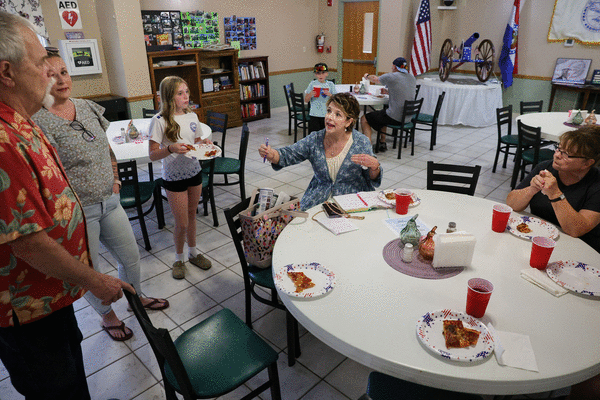
Her grassroots organization has raised money for legal advice with small-dollar donations, a potluck luncheon at a senior center and a 50-50 raffle.
The highlighter-yellow “No Data Center” T-shirts the coalition sold have been spotted at meetings, during rallies and in grocery stores around town.
“The sense of community that’s come out of this has been really awesome,” said Quennoz, whose grandfather once served as mayor of Pacific.
She has become adept at filing open-records requests and weeding through hundreds of pages of emails and documents. She stations the baby monitor next to her laptop so she can hear when her young son wakes up from his nap.
“I never thought I would be doing this,” Quennoz said. “I just happen to be good at organizing.”
The activists’ success — the Pacific Board of Aldermen on Tuesday adopted a one-year pause on data center applications — stems from their tenacity, she said.
All this time later, Quennoz has no idea who distributed the warning letter to the homes on Sugar Lake and Phelan roads. Whoever might know is keeping mum.
But they’re not staying quiet about anything else.
“There have been so many people in this process,” Quennoz said. “It’s been very cool to see everyone come out of the woodwork.”
© 2026 the St. Louis Post-Dispatch. Visit www.stltoday.com. Distributed by Tribune Content Agency, LLC. ©2026 STLtoday.com. Distributed by Tribune Content Agency, LLC.





Comments