Devastating start to Pacific Northwest fire season offers a warning
Published in News & Features
INCHELIUM, Colville Reservation, Wash. — Flames thrashed in the crowns of the ponderosas, spewing chunky embers as a family fought to halt the fire’s spread toward their home.
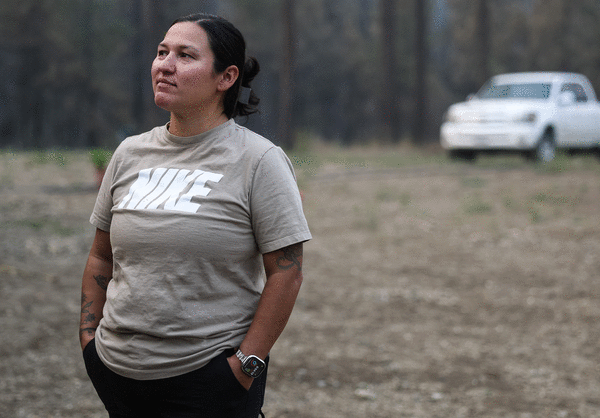
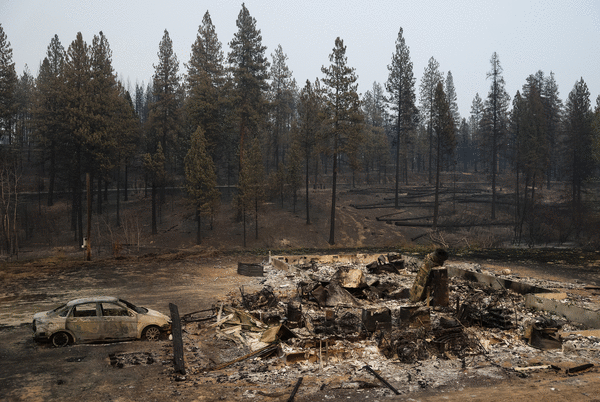
The Modrite fire raced toward Inchelium along the Columbia River on the Colville Reservation in late July, consuming homes and just about everything else in its path. It was only as Frankie Seymour huddled her children in a shed near their home that she questioned why she had stayed to fight.
“I’ve also never seen a fire of this magnitude,” said Seymour, a member of the Colville Tribes who was born and raised in Inchelium, some 80 miles northwest of Spokane.
By the time the blaze made a run here, fires had already consumed dozens of homes across the Pacific Northwest amid a rip-roaring start to the season. Crews were spread thin across the American West, battling difficult, wind-driven blazes fueled by prolonged drought and heat. Firefighters had been killed in extreme fire conditions in late June. The National Weather Service issued an unprecedented “Particularly Dangerous Situation” alert in Washington state.
Massive wildfires are burning across the Pacific Northwest, etching a path of destruction. A trio of wildfires broke into Spokane, displacing tens of thousands in what may be the region’s worst disaster in recent memory. Just a week later, the next wave of harsh weather ushered in a threat to Malden, an Eastern Washington town that lost nearly everything to a wildfire six years ago.
Firefighters and resources are all but exhausted. For several weeks, the U.S. has been at the highest preparedness level, meaning the maximum number of crews, aircraft and fire leadership have been deployed across fires. And months remain in the wildfire season with little respite in the forecast. Stories from the front lines of these early season fires offer a warning.
It’s an all-hands year. Firefighters have had to continue fighting to protect their communities after learning what they had lost themselves. Residents have faced flames in their backyards. Help is coming from as far as New Zealand and Australia, and everyone is pushing through with little rest.
During a more typical fire season, firefighters may have longer breaks between assignments, but this has been the busiest fire season in recorded history in the Northwest, said Jean Nelson-Dean, a spokesperson for the Northwest Coordination Center, which leads responses, including dispatching resources and providing fire intelligence, for large fires in the region.
“Fire activity, acreage burned, and the demand for incident management resources have all reached exceptional levels, record-breaking levels,” Nelson-Dean said, “and we’re only halfway through.”
As of Wednesday, more than 4,600 square miles have burned in Washington and Oregon, with more than 1,100 square miles burned in Washington. Lightning was in the forecast through Sunday, heightening fire risk.
Traditionally and culturally, Native people managed these arid Northwest landscapes with fires lit by hand in the spring, said Roger Finley, a council member of the Confederated Tribes of the Colville Reservation. These practices, dating back millennia, were banned and replaced with aggressive fire suppression. Fuels for fire exploded. Today, the state leans on Colville and other tribal nations for their leadership in forest management.
“We’re so far behind now,” Finley said, “it’s going to take a long time to catch up.”
Prescribed fires are one of the best tools to reduce the risk of catastrophic wildfires. But dangerous conditions set up early this year, granting only a short window to safely ignite these fires in northeastern Washington, said Cody Desautel, executive director of the Confederated Tribes of the Colville Reservation.
Days when wildfire risk is the highest — known as fire-weather days — have increased in northeastern Washington since the early 1970s, said Shel Winkley, chief meteorologist for the nonprofit Climate Central. On average, the region now sees about 21 more fire-weather days each year than it did more than half a century ago.
“The conditions are present for a long-duration, challenging wildfire season,” said Cody Rohrbach, fire chief of Spokane County Fire District 3. “It’s not even close to over yet.”
Ahead of schedule
Rohrbach took off in his pickup around noon Aug. 1. A new fire was tearing through Riverside State Park near Spokane, headed toward a neighborhood. Rohrbach took the reins, leading operations on what would become the Old Trails fire.
The first responding aircraft reported embers starting fires over half a mile ahead of the main fire. When the pilot circled back minutes later, one spot fire was 40 acres. Multiple other fires had sparked in front of the main body of the fire. The smoke column obscured pilots’ targets at the head of the fire.
Wildfires across the Northwest are moving quicker and becoming larger, Rohrbach said. “We have the most advanced suppression workforce that we’ve ever had in history,” he said. But the fires are much more challenging.
This year, grasses shot up with late spring rains, he said. There was about 27% of normal precipitation in June, and the abundant fuels rapidly dried out. “So you come into fire season already ahead of schedule,” he said. More than a dozen homes were lost in a June blaze in another area on the edges of Spokane.
Spokane County’s firefighting resources are among the best prepared in the Northwest, Rohrbach said, but the fires sparking Aug. 1 quickly overwhelmed local crews.
“Some things are out of your control,” Rohrbach said, describing the rapid fire spread. The focus was on getting residents out alive. No injuries or deaths were reported as a result of the fires.
Nancy Fuller was in an upstairs bedroom of her home between the Spokane River and Highway 291 when she saw the smoke column rise and flames heading toward her neighbor’s home. “Get in the truck,” her husband, Scott Fuller, called to her. “We have got to go.”
“That would have taken our life,” she said. “It was such a hot fire, and it came so fast.”
People fleeing the flames crept in bumper-to-bumper traffic to evacuate.
The California Interagency Incident Management Team 7, one of the national teams that helms responses to large fires, was about to lead the fight against another fire in Oregon when they got a call to drop everything and head to Spokane. The team, made up of more than 100 state, federal and local employees, has been on the road most of the summer since being called to help with fires in Colorado on July 4.
Incident Commander Tom Clemo watched the early response to the Spokane fires on his tablet on the drive. He could see the fire growth and the aircraft assigned on the map. As the team rolled into town around 8 p.m. Aug. 1, they could smell homes burning.
In a year like this, “you have more incidents than teams,” Clemo said. The number of teams available to lead the response to these large fires has been in a steady decline. They were the closest team available to take on a large fire.
“We’ve got a long year ahead of us,” Clemo said, swirling a cough drop around his mouth, “unfortunately.”
No days off
Alex Blondin guided his dozer through the charred trees, brush and grass, cutting a path down to the mineral soil the night the Spokane fires sparked. The flames’ heat radiated through the glass as it burned along his left side.
In a movie about the 19 Hotshots who died in a 2013 fire, “Only the Brave,” a character tells a story about a bear running by on fire, Blondin said. “That’s what it’s like,” he said of the Spokane fires. “That’s what I felt like the chaos was.”
He felt the earth shake as propane tanks blew up. The flames would melt aluminum and glass.
“Once I got in the dozer and started cutting line, I felt good. I felt at home,” he said. He watched the fire’s edge moving toward him and made sure he didn’t push embers over to the green, unburned side.
He spent nearly 24 hours on the Old Trails fire line, mostly in his dozer. He’d heard the radio chatter as the fire raced across a road and burned a Spokane District 10 fire engine. The driver was able to escape.
It’s not hard to imagine a different outcome. Multiple wildland firefighters have lost their lives this season.
Blondin works for Blue Line Services, a Spokane-based equipment company contracted by the state and federal governments to fight fire in the Northwest. He grew up on his grandfather’s farm in Yakima Valley and remembers sitting on his lap as he operated a Caterpillar D9. He learned to fight fire in Grant County before the pandemic hit.
This has been his busiest year yet. Fire season doesn’t usually start until about the end of August, he said. “I left home July 9, and I haven’t slept, we haven’t taken a day off since then.”
After coming back from a fire in Oregon, Blondin was finishing up paperwork and working on his equipment. The state had asked them to be ready for fire at home with extreme weather in the forecast. His day began around 6 a.m. to get his equipment in order for the fire weather warning. By noon he was called to help.
Late in the evening, he got a text: The home he was moving into had burned. Some items he kept from his late grandfather were there.
“I wasn’t trying to keep my mind on that,” he said. He continued cutting line, halting the spread of the fire toward other neighborhoods. “I wanted to stay focused on the task because one wrong move, and you become a casualty.”
He got off around 8 the next morning, and after hours of loading, fueling, paperwork and getting his equipment back to the shop, he didn’t clock out until around 3 p.m. He retired for the night at his boss’s Spokane-area home and was up by 6 a.m. for the daily briefing at incident command.
“I was exhausted,” he said.
Blondin was released from the Spokane fires this week and received his next assignment: the Big Grass fire, burning along the border of Oregon and Idaho near Nevada. He was packing up to leave Wednesday night.
‘Unimaginable’
Seymour’s daughter, Collise, smoothed silky chocolate frosting across the cake she’d baked for her grandma Linda’s 64th birthday. The sun hung orange in the smoky sky above the charred tufts of pines outside of Inchelium.
Just a week earlier, Collise and her siblings were scooping water from a kiddie pool to snuff out flames in their yard as her family held back the Modrite fire. Now they were able to gather in the home they’d saved.
The community made a stand as the fire approached, rolling out water tenders, cutting fire lines and backburning. Many in the community have wildland fire training themselves or are currently firefighters. There are all kinds of stories of residents fighting the blaze, including uses of water bottles and a leaf rake.
“Fire acts different now, it rages,” said Finley, the Colville council member. It was important for him to show up for the community, leveraging his firefighting background on the front lines. “I make sure I do my best for them.”
Frankie’s husband, Cole, and brother-in-law, Scotty, are both seasoned wildland firefighters and briefed their family on what to expect. Embers swirled overhead and torched their yard as the kids used watering cans and buckets to put out spot fires and hold the fire outside a firebreak they’d dug in the soil. They tied wet bandannas around their faces to breathe through the choking smoke.
“We have home insurance, we have all of the things,” Frankie Seymour said, “but when my husband said it was defensible, I took his word at face value.”
After the flames passed, she could see the silhouette of a neighbor’s home ablaze on the hillside. Seymour knew she was going to have to call and let them know. She was heartbroken driving into town. Teachers, childcare providers and women who help raise and uplift the community had lost their homes.
“We’ve had fires, definitely, and they’ve been destructive,” Seymour said. But this felt different. She didn’t anticipate it would reach their home when it started because of lightning miles away. “For it to make it as far as it did, and to get as big as it did — the destruction is just unimaginable.”
Ultimately, more than two dozen homes were destroyed. Other residents lost First Foods — camas, moose, huckleberries and others — kept in their freezers as evacuations and power outages dragged on.
In the wake of this loss, a grassroots organization led by Indigenous women known as the River Warrior Society has filled in the gaps of residents’ needs, despite being affected by fires themselves. Colville council members, neighbors and others have delivered canned goods, fresh salmon and fruit to the Inchelium Community Center.
“When somebody is in need, everybody comes together and does what they can,” said Colville Councilmember Dayna Seymour. “That’s just Inchelium.”
Just days after the Spokane fires sparked, Rohrbach was packing to head to the next blaze. He would join his incident management team on the Modrite fire as it continued to burn.
When we understand the potential for these megafires, Rohrbach said, then we understand how to prepare.
“It’s not going away. If anything,” he said, “it’s becoming more challenging.”
—Seattle Times staff reporter Conrad Swanson and staff photojournalist Nick Wagner contributed reporting.
©2026 The Seattle Times. Visit seattletimes.com. Distributed by Tribune Content Agency, LLC.





Comments