Carnegie Mellon moves to limit speech as controversial posts test limits of academic freedom
Published in News & Features
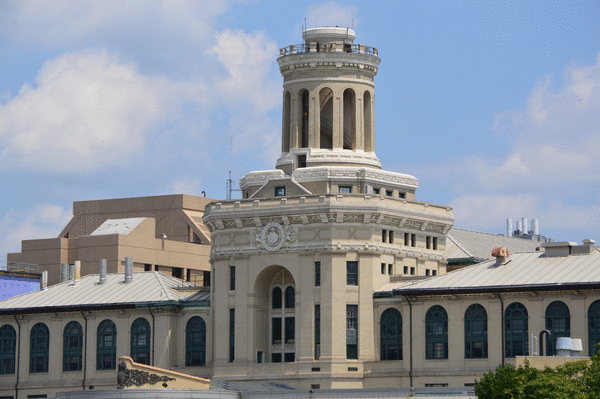
Carnegie Mellon University leadership has promised “swift action” against a professor whose controversial posts invoking death, race and her CMU colleagues sparked a social media storm and calls for her termination.
The announcement earlier this week came a few days after CMU started an interim policy that would prohibit some speech on The Fence, a century-old campus landmark that has long stood as a beacon of free expression and become a point of controversy in recent years. The public announcements of action on free speech issues on campus came as universities around the country face similar challenges to policies of tolerance for controversial words.
In the case of Uju Anya — a tenured Nigerian-American professor who has worked at the university since 2021 — the university hasn’t detailed what “swift action” might be. But if that involves disciplinary moves against her, CMU leaders will bear the burden to prove Anya’s speech violates school policy and isn’t shielded by stringent academic freedom protections.
Anya, a language professor who is currently on voluntary professional leave and isn’t teaching courses this academic year, has long drawn scrutiny for her posts on X.
In September 2022, after the death of Queen Elizabeth II, she tweeted in part, “May her pain be excruciating,” and last November, she responded to a profile of a person based in Nigeria with the message, “You die first. Choke and die painfully so I can find the ditch where they throw your body and piss on it.”
She again drew outrage this month after she began sharing posts celebrating first anniversary of conservative activist Charlie Kirk’s assassination on Sept. 10.
When those posts went viral and sparked backlash, Anya continued posting controversial messages. On Sept. 11, she replied to one account, “Die first, white man, then ask yourself why I’m dancing,” which was circulated by businessman and X owner Elon Musk to his 241 million followers.
She also began invoking CMU colleagues in her messaging. In one post, she said her department chair “just texted me saying they’re throwing all your emails in the trash” in response to growing outrage.
Anya’s X account has since been deactivated. She did not respond to a Post-Gazette request for comment.
CMU leaders say they are “reviewing this matter closely” and called Anya’s posts “hostile and threatening.” CMU employees have been doxed and received “threatening messages” as a result of the controversy, officials said.
“In her social media posts, Dr. Anya repeatedly and prominently invoked her connection to Carnegie Mellon and implied support from university colleagues, blurring the line between personal expression and academic authority,” CMU President Farnam Jahanian and Provost James Garrett co-wrote in a Monday message to campus. “In her posts, she used expletives, racial slurs and derogatory language that demeaned, dehumanized and intimidated.”
Jahanian and Garrett added that the school was taking “swift action in accordance with our processes.” School policy prevents officials from sharing further information about personnel matters, they said.
Anya’s future on campus could now be subject to whether CMU’s administration and a panel of her peers determine that her comments violated campus policy and aren’t protected by academic freedom, which grants professors the right to speak freely as both academics and private citizens without fear of retaliation.
“The fact that speech is offensive doesn’t in and of itself answer the question of whether a faculty member should be disciplined for it,” said Lynn Pasquerella, president of the American Association of Colleges and Universities.
“When professors speak as citizens, they should be free from institutional censorship or discipline, while recognizing the obligations of accuracy, restraint, respect for others and clarity that they’re not speaking for the institution. I understand the institution’s concern that there’s not either restraint or clarity around speaking for the institution.”
The Fence
The university’s stance on The Fence had already led to opposition by students before the new policy was announced. Coated with hundreds of layers of paint, The Fence is a student-maintained piece of free speech that only CMU students can paint. Prior to this policy, they were permitted to cover it with any message or artwork, provided that they followed conduct regulations surrounding when and how the structure could be decorated.
Last summer, an anonymous group wrote “No rapists on campus” during President Donald Trump’s visit to campus for an artificial intelligence summit. University staff painted over the message, and CMU convened a working group to consider The Fence’s role at CMU.
Staff again painted over a message this summer that read “Death to Zionism” in Yiddish. Several students are under investigation and one faces possible expulsion over the message that university administrators called “discriminatory.”
Under the interim policy, the university will prohibit speech on the student-painted structure that violates CMU policy or the law, or creates legal liability for CMU.
This move by CMU is a “crazy tightening of grip,” said Jack Hebert, a senior and president of Young Americans for Liberty, a libertarian-conservative group that was one of nine student organizations to support the spring petition.
When professors can be disciplined
Under CMU’s appointment and tenure policy, professors with or without tenure can be dismissed for substantial neglect of duties, demonstrable incompetence, moral turpitude, violation of criminal law, and persistent and willful violation of faculty conduct standards.
Both the university president and a faculty review committee — consisting of 11 professors appointed by the Faculty Senate — must agree on dismissal.
The president and faculty review committee can also jointly agree to impose sanctions, such as reduction in salary or censure, on a professor.
CMU policy allows Jahanian to suspend faculty members without pay if their behavior amounts to “gross misconduct,” meaning a professor is “unfit” to associate with students or a professor’s actions cause “immediate and substantial danger” to life or property.
The Dietrich College of Humanities and Social Sciences also outlines in its commitment to diversity that it does not tolerate “harassment, discrimination or disrespect” in personal off-campus communications “where there is a reasonable perception or expectation that we are acting as representatives” of a department, college or CMU.
Safety vs. academic freedom
Academic freedom has long protected extramural speech, or what is said as a private citizen outside of one’s role as a scholar or teacher, said Mark Criley, a senior program officer with the American Association of University Professors. Generally, that speech must cast “grave doubt” on one’s professional fitness to draw disciplinary action, he said.
For instance, several professors who were fired for making controversial statements about Kirk’s assassination last year were rehired by or received settlements from their universities.
“For the most part, extramural utterances are really not going to be relevant to somebody's fitness in those capacities,” Criley said.
Professors with CMU’s newly formed AAUP chapter didn’t comment on this matter specifically, but said in an email that they generally support faculty members’ rights to speak freely as private citizens “so long as they are not claiming to represent the university writ large or speak on behalf of other members of the university community without their consent.”
Others on campus have argued that the nature and frequency of Anya’s controversial posts, as well as the invocation of her CMU colleagues, should lead to disciplinary action. CMU’s College Republicans chapter called for the professor’s termination.
“A university that prides itself on inclusion and safety cannot allow a faculty member who promotes violence, even rhetorically, to remain on its payroll,” the group wrote in a statement.
In their statement to campus, Jahanian and Garrett acknowledged the delicate balance between academic freedom and safety concerns.
“We recognize freedom of expression and academic freedom as essential to our mission. These freedoms allow for ideas to be debated, tested and challenged,” the president and provost wrote in their message about Anya. “At the same time, these freedoms do not relieve any member of our community from their responsibility to support a respectful, safe and welcoming campus environment. Achieving and maintaining this balance is both challenging and the daily work of a university community.”
Pasquerella, of the American Association of Colleges and Universities, said she expects such issues to be more common as higher education becomes more politicized.
“This is a challenge,” she said. “(Universities) want to reaffirm a commitment to the dignity and equal treatment of every member of their communities, support students who themselves feel threatened or demeaned, and still insist that decisions about faculty discipline have to be made according to established principles rather than public pressure.”
_____
© 2026 the Pittsburgh Post-Gazette. Visit www.post-gazette.com. Distributed by Tribune Content Agency, LLC.


Comments