Trump administration denies nuclear safety watchdog crucial access
Published in News & Features
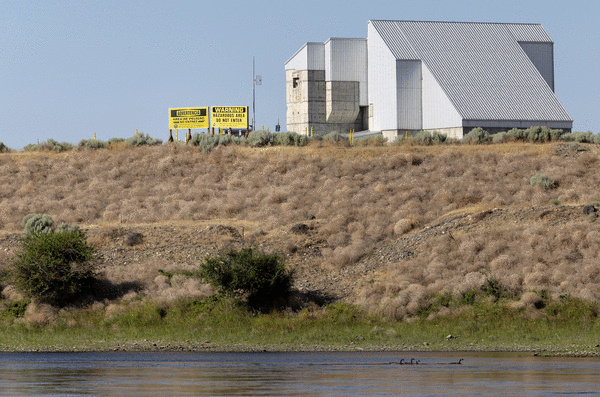
The U.S. Department of Energy is denying access to some information that the nation’s only independent safety agency for work on nuclear weapons says it needs to oversee operations at sites where the atomic arsenal is built and maintained.
The denials of access to records and meetings are “the most significant” in the history of the Defense Nuclear Facilities Safety Board, according to a letter the board sent Congress in July.
Safety board technical experts and Washington state’s senior senator worry that workers at DOE sites will be less safe. They also noted that the denials are happening at the same time that the Trump administration is considering relaxing or eliminating some safety standards and worker protections at nuclear weapon sites, including the Hanford Nuclear Reservation.
“It is crucial that DNFSB can enter nuclear facilities to carry out investigations, deliver reports, and continue to provide DOE with recommendations,” Democratic Sen. Patty Murray wrote in an email responding to questions from The Seattle Times. “I know nuclear facilities can have some of the most dangerous workplaces — that’s why workers and the Tri-Cities community deserve unobstructed safety oversight from the DNFSB.”
The Energy Department’s refusal to share some information comes as:
—Weapons manufacturing is accelerating, raising productivity expectations for high-hazard work.
—The DOE this year has relaxed some of its own safety standards, including radiation exposure limits, and is looking to streamline the processes that focus on safety, especially for workers at DOE sites.
—The safety board has been without a quorum since January 2025 and has just one member, limiting its ability to compel DOE to act on its most serious safety recommendations. The board is supposed to have five members; three constitute a quorum.
“These circumstances call for stronger — not reduced — DNFSB oversight to help ensure DOE carries out its vital national security mission safely,” Jonathan Plaue, technical director for the safety board, said in a written response to questions from The Times.
Energy Department cleanup sites, including Hanford in central Washington, have continued to respond to board requests for access to information, while the weapons-manufacturing sites within DOE have resisted, according to the July letter to Congress. The board’s technical experts say they are still analyzing operations at the weapon sites to the extent that they can. But their confidence that they can give meaningful feedback to guard against an accident affecting workers is eroding, according to Plaue.
“Many of DOE’s facilities possess unique capabilities and currently serve as the only locations where specific mission-critical operations can be performed,” Plaue said in an email. “As a result, a major disruption at one of these sites arising from a catastrophic accident could have significant implications for the activities that support national security objectives, as well as undermine public support.”
The Energy Department has also refused to review board reports for classified information prior to publication for details that could harm national security. This has halted the board’s release of some reports, including the weekly site inspections that have provided the public’s most reliable insight into safety at nuclear weapon sites.
The law Congress passed creating the safety board included its duty “to inform the public” as a core tenet of its mission, board member Patricia Lee wrote in a July letter to DOE leaders. The Energy Department’s refusal to respond to the classified review requests “affects the board’s ability to fulfill our statutory oversight responsibilities.”
Because the DOE won’t conduct the reviews, the board has not published inspector reports since June. “Resulting delays have drawn attention from public and government stakeholders,” Lee wrote, noting that the board remains “committed to working together (with DOE) to advance nuclear safety.”
Inherent tension has always colored the safety board’s relationship with the Energy Department and the contractors that operate its weapon-production and cleanup sites. The board concerns itself strictly with safety, not the costs or time associated with implementing its recommendations. That can throw off DOE deadlines and budgets that in turn curtail bonuses to contractors.
The friction between DOE and the board has ratcheted up throughout 2026. At a January conference on nuclear deterrence, directors of the contractor-operated DOE national laboratories that design and manufacture nuclear weapons announced the launch of “Project Velocity.” The initiative calls for the Energy Department and its contractors to review internal safety standards governing nearly 80 different operations at DOE sites to consider overhauling or terminating regulations to cut red tape.
“Over the years, DOE has supported the DNFSB in the execution of its mission, providing it broad access to DOE facilities and information consistent with the DNFSB’s statutory authority,” an Energy Department spokesperson emailed in response to The Times’ questions.
The DOE did not respond to follow-up questions, including why the DOE is now denying the safety board information it has historically provided.
“DOE employees are instructed to seek further advice and approval before granting (DNFSB) access to facilities, personnel or information,” a March 10 Energy Department memo that circulated among leaders of the nuclear weapons program and cleanup efforts said. It acknowledged that “DOE recognizes its obligation to facilitate DNFSB’s mission.” However, “DOE’s own independence, including the Executive privileges of the President and the (Energy) Secretary, must be recognized, asserted, and protected during interactions with the DNFSB.”
The White House Press Office did not respond to messages from The Times asking if President Donald Trump initiated the DOE efforts to stop sharing certain information with the board.
The March memo instructed contractor and DOE personnel to seek permission from DOE leaders and lawyers when board requests for information make them uneasy and to disregard the board’s directions as they see fit. The memo also asserted that the board lacks authority to inquire about the safety of atomic weapons and certain facilities on the grounds of weapon sites.
Meanwhile, the safety board faces yet another obstacle to fulfilling its mission — the lack of a quorum. Without a quorum, it can’t issue a formal safety recommendation, the board’s most potent tool.
The White House Press Office did not respond to messages from The Times asking about progress on nominating members to the board. The White House Press Office told The Times in October that the president’s staff was in the process of vetting prospective nominees, but none have been presented to Congress.
The safety board says DOE has explicitly denied eight of the board’s access requests, including information about:
—Nuclear criticality safety, or the risk of an accidental, uncontrolled nuclear chain reaction that carries a high risk of death, “a challenging field in which DOE has experienced performance issues in the past and often struggles to maintain sufficient expertise.”
—Risks involving electricity accidentally contacting high explosives in nuclear warhead manufacturing, an operation in Texas that includes 19 outstanding “opportunities to improve safety” as identified by the safety board.
—Progress on a safety analysis of a tritium facility in South Carolina, where seismic activity could lead to a dangerous fire.
—The list of DOE regulations being considered for elimination, and its action earlier this year relaxing radiation exposure limits.
The Government Accountability Office issued a report in July about DOE’s efforts to streamline regulations. It’s too soon to tell whether the campaign has accomplished its goal of efficient project management, the report said. The GAO reported that when the DOE cedes some of its regulatory responsibility to contractors, it increases the risk that problems are missed, leading to cost overruns and project delays.
“For over 30 years we have reported on DOE’s inadequate oversight of (management and operation) contractors,” the GAO report said. It noted that nuclear weapon and cleanup work under DOE’s purview “have been on our High Risk List (for fraud and abuse) for two decades.” Even now, many of DOE’s projects “are overbudget and delayed.”
©2026 The Seattle Times. Visit seattletimes.com. Distributed by Tribune Content Agency, LLC.





Comments