Colombia quake toll tops 260, prompting economic emergency
Published in News & Features
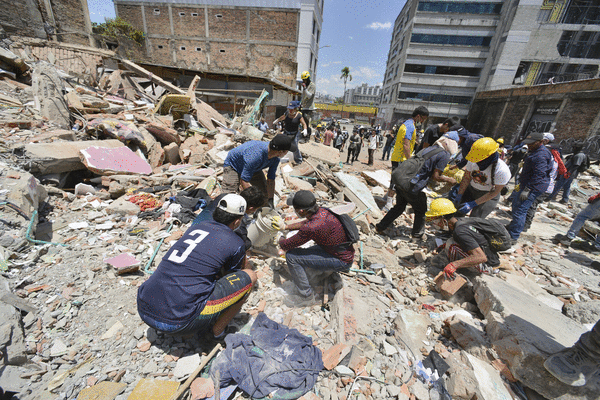
The death toll from Colombia’s earthquake rose to 265 as President Abelardo de la Espriella moved to declare an economic emergency to confront the fallout from the strongest tremor to strike the country in 47 years.
The 7.4-magnitude quake that struck Aug. 10 was the second strongest recorded in Colombian territory in the past century. Fatalities reached 265, with nearly 3,500 injured and 500 missing, De la Espriella said from the presidential palace in Bogota.
The economic emergency decree grants his administration temporary authority to issue economic and tax decrees without congressional approval. The official declaration needs approval of the full cabinet.
“This tragedy has triggered a crisis with a devastating impact on our country, and it comes at a difficult time, amid the most severe fiscal crisis in our republican history,” De la Espriella said.
The decree will allow for the creation of a fund meant to reconstruct hospitals, schools and highways, among other goals, he said. The government also plans to offer subsidies for public services and housing.
With the scale of the destruction still emerging, De la Espriella’s government is under pressure to coordinate an expanding relief effort and deliver assistance to Colombia’s most isolated communities, while containing the economic fallout from the disaster.
The destruction stretches across a broad swath of western Colombia, with some of the most isolated communities among the most affected. Choco, one of the country’s poorest regions, has reported collapsed buildings in its capital of Quibdo and extensive damage in Bajo Baudo, where preliminary estimates indicate 1,500 homes were affected.
In Valle del Cauca, the municipality of El Cairo suffered destruction to an estimated 80% of its residential infrastructure. Damage to hospitals and other health facilities across the affected region has also complicated the emergency response.
International assistance, meanwhile, is beginning to reach Colombia. The U.S. mobilized urban technical teams from Virginia and California to support Colombia’s search-and-rescue efforts. Aid and members of Mexico’s Topos Aztecas rescue group arrived in Cali, while the U.S. has announced $15.5 million for emergency shelter and food. China and other governments have also offered assistance.
Venezuela’s acting President Delcy Rodríguez said Tuesday that rescue personnel were ready to travel to Colombia but were awaiting authorization from the Colombian government. El Salvador’s President Nayib Bukele said Colombia had requested supplies rather than personnel because its own rescue teams, medical workers and emergency units were already deployed.
The handling of foreign rescue offers has also prompted questions over which teams Colombia is willing to accept. Disaster agency director David Tamayo said the government would receive search-and-rescue teams from Israel, Ecuador, El Salvador and the U.S. because they meet international protocols, are self-sufficient and arrive with their own equipment.
Coffee exports partially resumed Wednesday after roadblocks along key highways largely halted shipments through Buenaventura, the port that handles about 60% of Colombia’s coffee exports. Some airports in the affected region remain restricted to humanitarian and government flights.
Rescue operations continued across the hardest-hit areas after workers late Tuesday pulled a 32-year-old woman alive from the rubble of a hotel in Pereira more than 30 hours after the earthquake. Crews have repeatedly halted machinery at collapsed buildings to listen for signs of survivors.
Ministers have scrapped other engagements as the administration focuses on rescue operations. Nearly all cabinet members who had been scheduled to participate in a gathering this week in Cartagena organized by ANDI, the nation’s biggest business group, canceled their appearances, according to local radio reports.
The government’s security agenda continued to advance, however, with US Defense Secretary Pete Hegseth saying Wednesday that Colombia had authorized joint military operations with the U.S. against drug gangs.
____
(With assistance from Katherine Pennacchio.)
©2026 Bloomberg L.P. Visit bloomberg.com. Distributed by Tribune Content Agency, LLC.



Comments