Trump again asks Supreme Court to save USPS mail ballot plan after second lower court loss
Published in News & Features
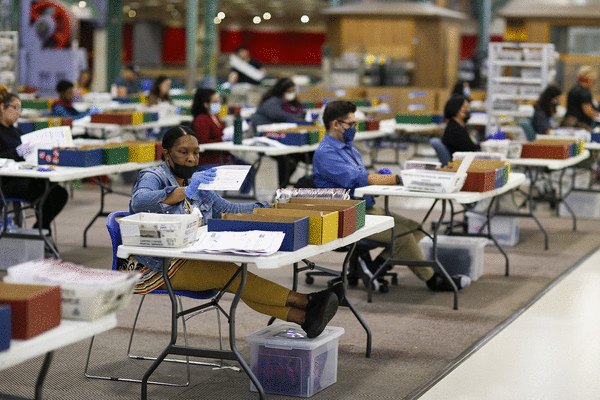
The Trump administration again on Wednesday asked the U.S. Supreme Court to intervene — and fast — to save President Donald Trump’s plan for the U.S. Postal Service to place new nationwide limits on mail voting ahead of the November midterms.
It did so after a lower court judge blocked the Postal Service plan from moving forward for a second time on Tuesday.
Solicitor Gen. D. John Sauer wrote to the high court that if it does not act quickly to lift both of the lower court’s “erroneous” rulings blocking the plan, those orders “will effectively run out the clock on the government’s ability to implement” the changes in time for the November election, “thereby causing irreparable harm to the federal government, the public, and election integrity.”
Sauer’s latest argument was filed in an emergency case already before the Supreme Court, in which the Trump administration is challenging a June decision blocking the Postal Service’s rule changes by U.S. District Judge Indira Talwani.
Talwani, an appointee of President Barack Obama, ruled in favor of California and 22 other states that had challenged the new rules as coming far too late in the election year to be implemented without causing significant disruptions and harming voters. That decision, which was upheld by an appellate court in July, had barred the new measures from being implemented in the states that sued, but not elsewhere.
However, Sauer filed his latest argument in response to a second ruling by Talwani in a separate case Tuesday, in which she sided with the League of Women Voters and other voting rights groups to block the Postal Service plans from moving forward nationwide.
“That it is now less than 90 days before the November 3, 2026, midterm elections underscores the critical need for an injunction to prevent Defendants from changing election rules on the eve of the election,” Talwani wrote.
The court battle follows an executive order Trump issued in March, in which he called on the Postal Service and the Department of Homeland Security to ensure “citizenship verification and integrity in federal elections” by compiling their own state-by-state lists of citizens who are eligible to vote and then using those lists to restrict who may vote by mail in each state.
The order said the Postal Service “shall not transmit mail-in or absentee ballots from any individual unless those individuals have been enrolled on a State-specific list.”
The order was immediately slammed by Democratic attorneys general and independent voting rights groups as a ploy by the Trump administration to get its hands on state voter rolls, which it has failed to secure in separate legal challenges, and severely limit mail voting, which Trump has without evidence alleged is a major source of voter fraud.
California Attorney General Rob Bonta helped lead the states’ lawsuit challenging Trump’s order, and has praised Talwani’s orders blocking it from taking effect. Bonta has said the law is clear that states control elections, not the federal government, and that Trump’s order is an illegal and dangerous power grab ahead of a pivotal election in which the president’s party is poised to lose power.
Bonta did not immediately respond to a request for comment on Sauer’s latest filing Wednesday.
The Trump administration’s appeal to the Supreme Court is limited in scope, in that it hinges on a technical argument that the challenges to the new rules are premature — and that the Postal Service should be allowed to continue preparing for the new rules to be implemented while the legal battle over their legality continues.
Sauer reiterated that argument in his filing Wednesday, asking the high court to not only issue its order soon, but to make clear in it that not one but both of Talwani’s orders are premature.
He wrote that courts cannot block the implementation of an executive order “that merely instructs agencies to pursue a proposed policy in a manner that is consistent with law,” particularly before those agencies “actually take concrete actions that injure” the groups suing to block the order.
Therefore, Sauer wrote, it would be “prudent” for the high court to make clear that it was halting Talwani’s first order “based on the uncertainty concerning the government’s future actions, not anything specific to the individual plaintiffs” — or, in other words, on grounds that would apply to her second order, too.
He wrote that it was “critical” that the court “act promptly.”
The states have asked the high court to block Trump’s order, which they said would deny mail ballots to “many of the millions of voters who rely on mail voting — especially voters with disabilities and those in rural areas.”
The League of Women Voters hailed Talwani’s order Tuesday as a win for voters and for the U.S. Constitution, which it said makes clear the president does not have the authority to rewrite election rules.
“Millions of Americans, including seniors, military voters, voters with disabilities, rural voters, and citizens living overseas, rely on voting by mail to participate in our democracy,” said Marcia Johnson, the group’s chief of activation and justice. “Today’s decision reaffirms that the rules governing our democracy must be set by the Constitution and the law, not by executive overreach.”
When the high court will rule is unclear, though the emergency nature of the appeal calls for a prompt response.
©2026 Los Angeles Times. Visit at latimes.com. Distributed by Tribune Content Agency, LLC.



Comments