'Waiting for any sign of life': Colombia reels after quake
Published in News & Features
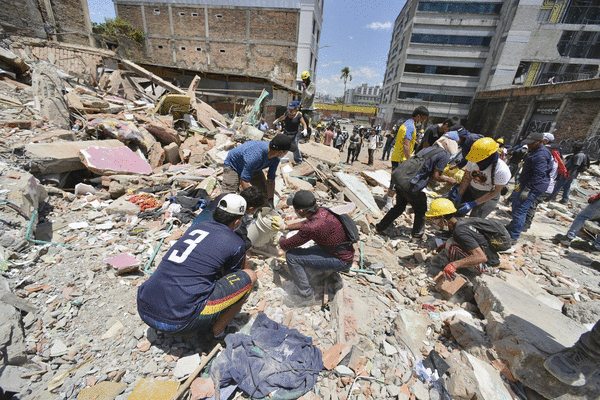
From a mountain of rubble in downtown Pereira, Colombian rescue workers called for silence to listen for sounds of life beneath their feet.
In a plaza full of families who slept outside after Monday’s devastating earthquake, voices dropped to whispers, machinery went silent and the frantic activity of dozens of volunteers paused. Some onlookers closed their eyes and muttered prayers that another survivor would be found with the help of audio equipment trained on busted concrete and twisted metal.
This routine plays out several times an hour on sites across the historic center of this city of 500,000 people in a coffee-growing region in western Colombia. It’s among the places hardest hit by the 7.4-magnitude quake.
Late Tuesday evening, in another part of the city, a woman who had been trapped under the rubble of a hotel for more than 30 hours was pulled out alive amid cheers from onlookers. The 32-year-old was put into an ambulance and rushed away for treatment.
“We’re waiting for any sign of life, always keeping our hopes up, that they’ll find someone alive,” said Isabella Montoya, a 21-year-old medical student who was volunteering at the central plaza. The day before, she helped take care of victims during her shift at the emergency ward of a local hospital.
President Abelardo de la Espriella arrived Tuesday morning, on a mission to reassure Colombians that he is on top of the catastrophe that hit during the first week of his four-year term. The response is a key early test for the government he leads after a narrow election victory on the back of promises to fight crime and reinvigorate economic growth. Colombians have a history of turning on leaders seen as slow, out of touch or poor at communicating after a natural disaster. For now, the jury is still out.
After he toured the wreckage in Pereira, De la Espriella pledged a three-month suspension of utility bills for affected residents in the province as well as financial support for temporary housing. And several Pereira locals praised the speed with which heavy equipment and rescue workers had arrived, even if they were outnumbered by volunteers.
However, families sleeping outside in a nearby park complained that they have yet to receive any assistance from the state. Electricity was spotty in much of the city and traffic lights were out in places. Streets are full of debris in areas that haven’t yet been cleared.
The death toll from Monday’s earthquake has climbed to 190, according to Asocapitales, an association of Colombian capital cities.
In Pereira, much of the damage was concentrated in impoverished and poorly built neighborhoods in the city center, which in recent years has become home to many Venezuelan immigrants like Carolina Rojas who fled the poverty in their homeland for a chance at a new life in Colombia.
Rojas was paying $6 a night to stay in one of the buildings that collapsed. She estimates that 10 or 11 people there died. She got out just in time because she heard the building superintendent shouting, and spent the night sleeping in a park with her two-year-old daughter and an older child.
“I ran outside with my daughter, and I thank God, because if I had waited two or three minutes I wouldn’t be here to tell the story,” she said. “When I turned around, the building had collapsed.”
Near the wreckage of Rojas’ home, a woman sifted through the ruins looking for scrap metal to sell. “Do you want to die today?” a policewoman rebuked her, pointing at the surrounding buildings at risk of collapse.
The quake is likely to amplify the nation’s fiscal strains, complicating De la Espriella’s efforts to deliver on promises to curb rising budget deficits with an ambitious austerity drive. Finance minister Miguel Gomez told lawmakers that the government plans to declare an economic emergency to free up funding and bolster its response to the massive earthquake. That would give De la Espriella temporary authority to issue economic and tax decrees without the need for congressional approval.
Colombians are also bracing for wider economic damage from the quake, with coffee exports mostly suspended thanks to disrupted operations at the nation’s main coffee export port and roadblocks along key highways. Arabica coffee futures in New York whipsawed on the news as traders tried to gauge the long-term impact.
Elsewhere in Colombia, Cali’s international airport has resumed operations, while runways in Pereira, Buenaventura, Cartago and Manizales were available for humanitarian and government flights but remain restricted for commercial operations, the Transport Ministry said Tuesday.
The U.S. State Department announced Monday that it would send $15.5 million to Colombia for emergency shelter, food, protection and earthquake assessments. Brazil’s Luiz Inácio Lula da Silva, Mexico’s Claudia Sheinbaum, Ecuador’s Daniel Noboa and other foreign leaders also pledged to help in the immediate aftermath of the quake.
De la Espriella says his government has the necessary resources and funding to respond to the tragedy, and he’s announced that the government will provide temporary rental subsidies to families whose homes were damaged.
In Manizales, about 30 miles (50 kilometers) northeast of Pereira, the city of 470,000 saw at least five people killed, 2,000 displaced and 60 buildings partially or completely collapsed. The mayor said a squad of structural engineers was going building-by-building to assess the damage.
On Tuesday afternoon, De la Espriella pledged to “do whatever needs to be done” to restore the city’s Cathedral Basilica of Our Lady of the Rosary after one of its towers collapsed in the earthquake. The roughly century-old building is the tallest cathedral in the country and one of the city’s most recognizable landmarks.
Beyond the government response, offers of free assistance have gone viral in WhatsApp groups. They range from psychologists and social workers seeking to help people cope with the trauma to civil engineers specializing in structural assessments.
Among them is Camila Villada, 28, a civil engineer pursuing a master’s degree in structural engineering at the National University of Colombia’s Manizales campus. She has been helping inspect damaged buildings.
“It hurts so much to see people who have lost their homes, and I want to contribute,” said Villada, whose own family was forced to leave their home because of damage from the earthquake. “Word spread quickly, and my WhatsApp has been overwhelmed with messages.”
—With assistance from Oscar Medina.
©2026 Bloomberg L.P. Visit bloomberg.com. Distributed by Tribune Content Agency, LLC.






Comments