Colombia earthquake toll hits 254 as 72-hour rescue window narrows
Published in News & Features
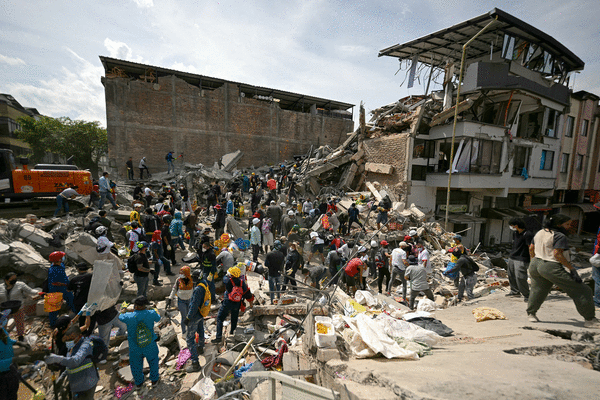
The death toll from the powerful magnitude 7.4 earthquake that devastated western Colombia has risen to at least 254, according to the latest local and aggregated reports, as rescuers raced against time Wednesday to find people still alive beneath collapsed buildings.
More than 48 hours have passed since the earthquake struck Monday morning, pushing rescue operations deeper into the critical first 72 hours after a disaster, when the chances of finding survivors generally diminish as time passes. Crews in some of the hardest-hit cities continued digging through rubble Wednesday, hoping to locate trapped residents before that window narrowed further.
The toll, which is expected to rise as rescue operations continue and authorities reach more remote areas, includes roughly 101 deaths in Pereira and 95 in Cali, two of the cities hardest hit by the earthquake. More than 2,500 people have been reported injured, while thousands remain unaccounted for.
President Abelardo de la Espriella declared three days of national mourning Wednesday for the victims of what authorities have described as the most devastating earthquake to strike Colombia this century. National flags will fly at half-staff at public buildings and Colombian diplomatic missions abroad during the mourning period.
“The national government, on behalf of the Colombian people, expresses its profound sorrow over the deaths of those who lost their lives as a result of the seismic event that occurred on August 10, 2026, in the national territory, and stands in solidarity with the families and friends of these people,” the presidential decree said.
The magnitude 7.4 earthquake struck at 7:34 a.m. Monday, with its epicenter near San José del Palmar in the western department of Chocó. Valle del Cauca, Risaralda and Caldas were also among the areas suffering extensive damage.
The rapidly changing casualty figures reflect the difficulty authorities have faced in establishing a nationwide toll while rescue operations continue. Earlier counts released by the president and associations representing Colombian cities ranged from 111 to 181 deaths, while regional authorities later placed the toll near 240.
Search operations remained concentrated on collapsed structures in Pereira and Cali, where rescuers have been working around the clock. With the 72-hour mark approaching Thursday morning, the urgency was increasing for crews trying to reach people who may have survived for more than two days beneath collapsed concrete and debris.
The scale of the destruction extended far beyond the collapsed buildings.
According to a government assessment, 8,357 homes were damaged and 48 buildings collapsed. Another 807 educational facilities and 85 health centers sustained damage, along with 377 community centers.
Authorities also reported damage to 74 roads, 16 aqueducts and the runway of one airport.
De la Espriella has been touring affected regions as his government attempts to assess the full extent of the disaster, which struck just three days after he took office.
In Pereira, one of the most heavily damaged cities, an earlier government assessment released Tuesday reported 79 deaths and 278 injuries, along with 37 people missing. Sixty-six buildings had collapsed, 60 schools were affected and 14 bridges and roads had sustained damage, according to that assessment.
More recent local reports have placed Pereira’s death toll above 100, underscoring how quickly casualty figures have changed as rescuers recover victims and authorities reconcile information from different jurisdictions.
International assistance was expanding Wednesday, with foreign rescue teams joining Colombian crews at a particularly urgent stage of the search.
The United States said it had mobilized urban search-and-rescue teams from Fairfax County, Virginia, and Los Angeles County, following a request from De la Espriella’s government.
“At the request of President Abelardo de la Espriella’s administration, the Department of State has mobilized technical Urban Search and Rescue teams from Fairfax County, Virginia, and Los Angeles County, California, to support Colombia’s search and rescue efforts,” the State Department posted on X.
Washington had previously announced the deployment of a disaster response team to assist the Colombian government with critical operations and coordination, as well as $15.5 million in assistance for food, protection and damage assessments.
The State Department said the United States is prepared to provide additional assistance as authorities continued evaluating the country’s needs.
Mexico also sent experienced rescuers. Members of the Mexican rescue brigade Los Topos arrived in Cali on Wednesday to assist in searches through collapsed structures.
The team, led by Héctor Méndez, traveled to Colombia from Venezuela, where its members had spent 41 days assisting with rescue and recovery operations following the devastating earthquakes that struck that country in June. Cali Mayor Alejandro Eder received the rescuers upon their arrival.
Colombia was also preparing to receive international assistance from Ecuador, El Salvador and Peru.
The International Federation of Red Cross and Red Crescent Societies, meanwhile, launched a $30 million emergency appeal Wednesday to expand the Colombian Red Cross response.
The federation said the money would be used to strengthen local response capabilities and provide assistance to approximately 24,000 people over the next 24 months.
The federation had already released about $1.2 million from its Disaster Response Emergency Fund shortly after the earthquake.
“We are reaching a very critical moment in the operation. Colombian Red Cross teams have been working tirelessly,” Loyce Pace, the federation’s regional director for the Americas, said in a statement.
The initial Red Cross operation will prioritize Chocó, Risaralda, Caldas and Valle del Cauca, the four departments where some of the greatest humanitarian needs have been identified.
The earthquake has presented particular challenges in communities where damaged roads, disrupted communications and other infrastructure problems have complicated rescue efforts.
Those difficulties have also contributed to uncertainty over the number of people still missing. Citizen tracking efforts and other aggregated reports list thousands of people as unaccounted for, but authorities have not established a definitive national figure.
The government’s infrastructure assessment showed the disaster affecting not only homes but schools, medical facilities, roads, water systems and community buildings, raising the prospect of a recovery extending well beyond the immediate search-and-rescue operation.
©2026 Miami Herald. Visit at miamiherald.com. Distributed by Tribune Content Agency, LLC.






Comments