Iranian factions squabble over war aims with Khamenei absent
Published in News & Features
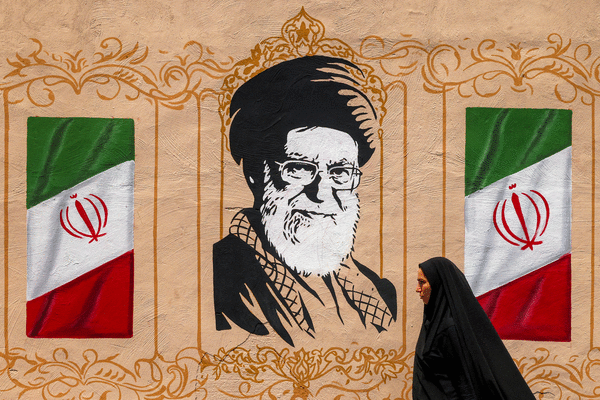
When Iran’s President Masoud Pezeshkian told state TV last week that he found it “very difficult” to reach the country’s Supreme Leader, it sparked fresh speculation about the whereabouts of Mojtaba Khamenei who hasn’t been seen in public since taking over as the country’s ultimate authority in March. By Monday, Pezeshkian told the official broadcaster that the two had in fact recently held a meeting lasting “seven or eight hours.”
“It was a very good meeting,” Pezeshkian told a reporter on the sidelines of a summit of the heads of political factions and politicians in Tehran, adding that the two discussed how to tackle worsening living standards in Iran as well as sharing that Khamenei’s most pressing concern was “unity and cohesion” in the country.
The statement came after weeks of bitter public infighting in Tehran over the conduct of the war, with calls from hardliners for Pezeshkian to resign over his support for Iran's beleaguered peace deal with the U.S., and days after the under-pressure president said in a lengthy TV interview that he isn’t going to budge.
Khamenei was hurt in the same Israeli airstrike on Feb. 28 that killed his father and predecessor, Ayatollah Ali Khamenei. It was the opening salvo in the U.S.-Israel war on Iran.
The extent of his injuries are unknown — Pezeshkian said on Monday that the Supreme Leader was in “perfect health.” But Khamenei’s absence from public life has left a vacuum in which disputes between political factions — a mainstay of Iranian life — have become more pronounced and seeped into the open.
His father, in power for almost 40 years, often played the role of referee in internal squabbles. As the ultimate decision maker on all matters of state, his approval was critical to getting ideas adopted as official state policy including plans like the 2015 nuclear deal with the West that was strongly opposed by hawkish hardliners. He also managed feuds between conservatives and hardliners, including one between former President Mahmoud Ahmadinejad and Ali Larijani, the security chief killed in a March airstrike in Tehran.
It’s not clear that his son has that same authority yet.
Mojtaba Khamenei “does not make public appearances, is not easily accessible, and reportedly communicates with senior officials through intermediaries. As a result, it’s much more difficult for him to provide clear and decisive leadership or quickly resolve disagreements within the political establishment,” said Arman Mahmoudian, research fellow at the University of South Florida.
The factionalism is seen as a fixture of the political landscape in Iran. Some view it as cosmetic but the war has exposed political tensions in louder and more brazen ways with public spats over the direction of the conflict.
Officials, including Khamenei, have repeatedly pushed for unity, not just within Iran's population — heavily scarred and traumatized by the impacts of both the deadly state crackdown on protests in January and the scale of U.S.-Israeli bombardments that followed a month later — but across the political system itself.
“There’s always been one group that says we need a strategic agreement with the U.S. and there is a group that wants an endless war with the U.S.,” said Saeed Laylaz, an economist and former adviser to Pezeshkian. “The leadership has changed and isn’t publicly seen. This has opened the space for some people to step forward and speak.”
The online battlefield
The forum for those people has been social media and state TV where an information battle is being waged between pragmatists like Pezeshkian and the Foreign Minister Abbas Araghchi — who hardline lawmakers want to impeach — and ultra conservative clerics and politicians who are against engagement with the U.S.
The pragmatists — who in Iran's political system are often associated with moderate conservativism or reformism — see negotiations with the West as inevitable, the only way to reduce economic isolation, improve living standards and bring investment into the country. Hardliners think that it diminishes the founding principles of the Islamic Revolution of 1979 and that repeated efforts to talk to the administration of President Donald Trump in particular, have only led Iran to be attacked by Israel and the U.S.
Pezeshkian, who is in charge of the country’s economic decisions, and other pragmatic moderates want to end the war and agree broad sanctions relief. They calculate that would bring immediate help to Iranians for whom the war has multiplied a raft of existing economic woes from rampant inflation to unemployment, and potentially offset the risks of another uprising like the one that was crushed in January and is still being prosecuted often using judicial executions.
The hardliners — from within politics and the senior clergy — appear to be fueling much of the infighting. They oppose diplomatic engagement with the Trump administration and question whether the Iranian economy, which has been devastated by years of international isolation, even needs U.S. sanctions relief.
One of them, the ultra Conservative cleric Mohammad Bagher Kharazi, who made an unsuccessful bid to stand in Iran’s 2013 presidential election, attacked Pezeshkian in July calling him “trash” and challenged the legitimacy of his presidency. Pezeshkian replaced the late Ebrahim Raisi in a snap election after he was killed in a 2024 helicopter crash.
In a video posted on Instagram last month which cannot be verified, Kharazi, who claims to have been friends with Mojtaba Khamenei for 40 years, said that the Islamic Republic was “no longer effective” and Iranians needed an “Islamic state” rather than a system that offered presidential and parliamentary elections.
Kharazi then threatened to “besiege all the ministries” in Tehran claiming to have 250,000 supporters to help him.
Saeed Jalili, a former nuclear negotiator for Iran who is a leading member of an ultraconservative faction known as Paydari, has also heavily criticized Iran’s diplomats and the president. In a speech at Khamenei’s funeral in July he called on the country’s leaders to make avenging his death their top priority and admonished them for prioritizing negotiated sanctions removal with the U.S.
It's not just hardline clerics who are wading into the open court of Iranian politics. Former President Hassan Rouhani — who was effectively sidelined by the late Khamenei after the nuclear deal that he championed unraveled under U.S. pressure — has also released video statements, in an effort to revive his political profile. They ranged from attacks on Israel and the U.S., who he said had miscalculated the strength of the Iranian people, to criticizing hardliners as “a minority who believe that escalating this war will hasten the coming of the Mahdi.”
Divisions in Iran’s theocracy have “been a defining feature of the Islamic Republic’s foreign policymaking since the 1979 Revolution,” said the the University of South Florida’s Mahmoudian. “What’s different this time is not the existence of these competing factions, but the degree to which their disagreements have become visible — and perhaps more intense than in previous crises.”
In a sign that the new Supreme Leader may be exerting some of his father's control, the Kharazi videos appeared to have been deleted from his Instagram page by Tuesday and Iran's judiciary said he'd been summoned to court.
Over confidence
The day before Pezeshkian spoke of his lengthy meeting, a statement, said to be from Khamenei, was read out by an anchor on Iranian state TV news. It announced that he’d personally appointed a veteran of the Islamic Revolutionary Guard Corps — the powerful military force that has been at the forefront of the war strategy — and conservative hardliner, Mohsen Rezaee, as leader of the Supreme National Security Council, the country’s most important security job.
Khamenei then went on to announce and confirm a list of top military appointments, most of them in the IRGC which itself praised Rezaee’s appointment, highlighting his role in coordinating Iran’s security, diplomatic and economic policies. On Tuesday the front page of the state-run Hamshahri newspaper, Iran’s biggest by circulation, featured a composite image centering Khamenei, standing upright and flanked by his latest military and security appointees.
The reshuffle reflects a doubling down of the hardline elements that have led strategy on the battlefield since the war began.
An adviser to the new IRGC chief told state TV late on Tuesday that the new team marks a pivot to a more “offensive” military doctrine focused on operations abroad. “Whenever the conditions are favorable and the order is issued, we must be able to take the operation into enemy territory,” Mohammad Reza Naqdi said.
The revamp also suggests a stronger coalescence around the IRGC and its strategic response to Trump’s war. The strategy appears so far to have worked and enabled the Islamic Republic not only to survive and the regime to remain in control, but also to establish an effective deterrent with its leverage over the Strait of Hormuz.
“The more hardline elements are confident,” said Dina Esfandiary, Middle East Geoeconomics Lead at Bloomberg Economics. “They feel they are ahead and they have come to understand that the language of bullying works with Trump, so it’s all part of them coalescing around this idea and consolidating themselves further.”
“The system also seems to be in agreement on the way forward, even Araghchi’s statements are communicating a tougher line on the Strait,” she added. In recent weeks the foreign minister has pushed back firmly against both his hardline domestic critics and U.S. threats, promoting a tough military position over the Strait of Hormuz.
For now both sides in the war have hardened their positions with Trump saying earlier this week that while he was “low keying it” in terms of military strikes on Iran, he wanted to give his Hormuz naval blockade time to inflict more economic pain while imposing new demands for compensation from Tehran, something that will be firmly rejected by the Islamic Republic. It leaves the sides deadlocked, for now, with no clear pathway to peace.
Laylaz said that the louder factionalism in the wake of the war was “mostly noise”. The decision-makers among the main institutions and figures in charge of the government — including the IRGC, Araghchi, Pezeshkian and Mohammad Bagher Ghalibaf — have so far acted with broad consensus and “are taking things forward.”
That view is echoed by Ali Vaez, Deputy Program Director for the Middle East and North Africa at the International Crisis Group. “There’s clearly greater cohesion around the strategy, but that shouldn’t be mistaken for confidence that it will ultimately succeed.”
“For now, Tehran believes that holding its ground and imposing costs has forced Washington to adjust its objectives; the danger is that short-term vindication hardens into long-term overconfidence,” added Vaez.
©2026 Bloomberg L.P. Visit bloomberg.com. Distributed by Tribune Content Agency, LLC.






Comments