SC legislature passes budget, but what will happen with lawmaker earmarks?
Published in News & Features
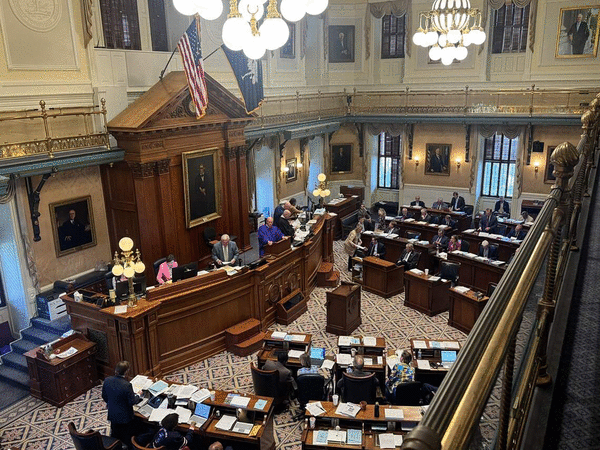
A more than $15 billion spending plan is on its way to the governor’s desk 89 days after the General Assembly was supposed to be done with its work for the year.
But a plan to separately provide money for member-initiated community investment projects, commonly referred to as earmarks, fell apart.
Lawmakers on Tuesday gave their final approval to a $15.7 billion general fund budget that includes a property tax cut for seniors, raising state employee salaries by 2% and increasing the minimum starting teacher pay to $50,500. Each cell on the state’s minimum teacher salary schedule goes up by $2,000.
South Carolina state government has been operating under a continuing resolution since July 1 because the legislature was unable to finalize a spending plan before the start of the new fiscal year.
The governor has until Monday to sign or issue any vetoes on the budget.
Budget writers set aside $377.7 million for lawmaker projects in a separate piece of legislation. They gave themselves a Sept. 30 deadline to allocate the money, but lawmakers would have had to come back in the fall to approve a supplemental spending bill, which risks the possibility of negative headlines on certain projects less than two months before the November election.
Budget negotiators had agreed to have a joint committee decide how much money each earmark received. That went out the window as budget writers tried to resolve earmark funding before Tuesday’s session.
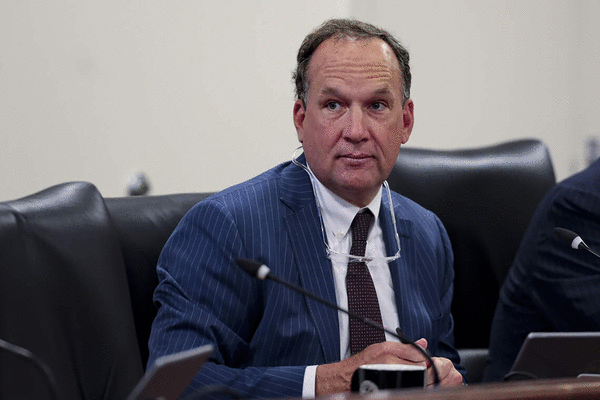
House members, who are up for reelection this year, did not want to be back in Columbia when they could be in their districts campaigning, House Ways and Means Chairman Bruce Bannister said. State senators are not up for reelection this year.
“There’s really not enough time to get through all the projects and have some new debate where we put a bill in and have basically an appropriations debate between now and the election,” Bannister said. “So we’re better just to punt it to next year if we couldn’t reach some kind of resolution on the projects.”
According to state Sen. Tom Davis, R-Beaufort, who was one of three senators negotiating a final spending bill, the House offered Tuesday to bring their earmarks down to $225 million, down from the $315 million the House initially proposed. The Senate proposed $130 million in earmarks.
The Senate wanted the House to bring the earmarks to less than $200 million after the House would not agree to having $130 million for each chamber. Eventually Senate budget negotiators offered to agree to $175 million worth of House member initiated projects.
“Our goal, we told them our original goal was parity,” said Senate Minority Leader Brad Hutto, who also worked on the conference committee on the budget.
But both chambers during Tuesday’s session took shots at one another in how lawmaker sponsored projects receive funding.
The Senate wanted the House to drop its earmarks to $175 million, without the upper chamber reducing its earmarks.
"The Senate made up a number that they said we had to comply with, with no rationale behind it other than they just didn’t like our number, and that’s not negotiating good faith,” Bannister said. “That’s just picking new rules to enforce in the middle of the process, after it’s too late for us to take that into account.”
But senators said they kept offering a higher amount to try to get the House to eventually come down from their $315 million.
“We kept saying more. They but they never said less. I mean, I don’t know, that, to me looked like good faith the other side, but I don’t want to ascribe bad faith to anybody. I think we’re working together to try and reach a compromise,” Hutto said.
Despite the disagreement over earmarks, the budget compromise was approved by both chambers.
Money for teacher pay is particularly noteworthy as school is starting this month.
Seniors in the state will see property tax relief as the senior homestead exemption goes up to $75,000 from $50,000. That will cost the state $81 million a year.
The plan adds $102.6 million more annually for Medicaid, $53 million more for Medicare premiums for elderly and disabled recipients, and $34 million for administration of the state’s SNAP program.
Lawmakers also set aside $35 million to provide additional assistance to farmers.
Budget writers also included $32 million to settle the Captain Sam’s Spit litigation.
Lawmakers also included a reward for members of the General Assembly starting in December. The monthly allowance for lawmakers’ in-district expenses is increasing to $2,500 a month from $1,000 a month. It equates to an $18,000 a year increase for lawmakers. Lawmakers tried to place the raise in the budget last year, but it was struck down by the state Supreme Court because the raise kicked in before an election in the middle of a term.
The budget includes $35.8 million for the state’s traditional four-year colleges and MUSC for them to keep tuition rates the same for in-state residents.
©2026 The State. Visit at thestate.com. Distributed by Tribune Content Agency, LLC.






Comments