FBI probe into Argentina soccer funds clouds new Miami-area sports complex
Published in News & Features
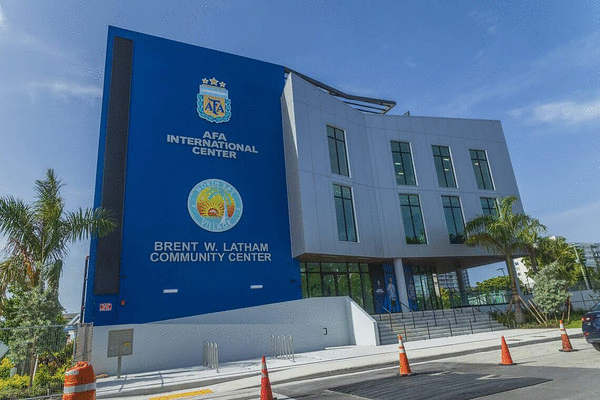

MIAMI – When the head of Argentina’s national soccer federation, Claudio Tapia, announced plans in 2022 to build a sports complex in North Bay Village, he described it as a global example of a partnership between a local government and a sporting entity.
But now, with the FBI investgating whether Tapia personally benefited from potentially illicit money flowing through the Argentine soccer federation’s business affiliates in South Florida, some residents of the small island community off Miami Beach are raising questions about the finances behind the sports complex — now worth around $24 million — that opened right before the start of the 2026 World Cup.
In interviews with the Miami Herald as well as discussions on public forums like Facebook, they claim that the project’s implementation was not transparent and that contrary to how it was initially publicized, access to the grounds has become restricted.
A Herald review of village council meetings and enacted proposals, records of the public-private partnership and legal filings in Miami-Dade and federal courts, found the village did little due diligence on the firms and figures that finally invested in the project. The village’s approval process was also at times rushed and fraught with disagreements.
A bank owned by one of the primary investors, Roberto Dominguez, is reportedly being investigated by Argentine authorities for potentially violating the country’s foreign exchange rate controls while moving funds for the soccer federation, according to Argentine media.
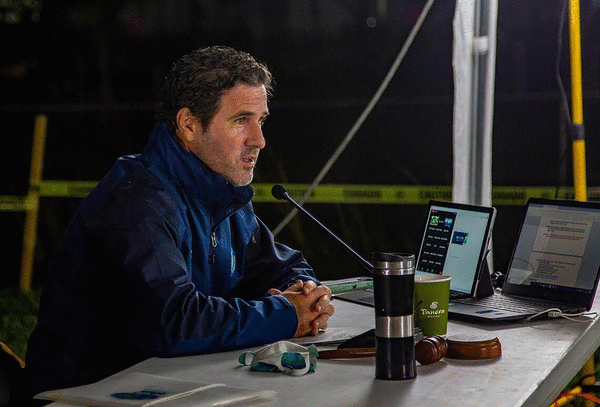
And the Florida State Ethics Board found that Brent Latham, mayor of North Bay Village at the time — who championed the project and after whom the complex is named — may have violated conflicts of interest regulations for accepting gifts from the Argentine soccer association while negotiating the deal.
The FBI’s investigation recently escalated with the federal grand jury in Miami issuing subpoenas for records and testimony related to Tapia, the Herald has learned. Whether federal prosecutors and investigators are also probing the development of the soccer complex is unknown.
The Argentine soccer federation did not respond to the Herald’s questions about the project’s financing. Tapia has previously denied any wrongdoing.
North Bay Village did not respond to the Herald’s requests for comment. Neither did it answer what kind of due diligence it did on Dominguez and other private investors.
“I was satisfied that we had done the due diligence that we typically do for this sort of project,” Latham told the Herald. “I am not aware of anything at all that indicates that any of the money that was contributed to this project was in any way not properly invested.”
He said that his ethics violation was because he was not aware that the state’s ethics rule slightly differed from that of Miami-Dade County’s and that it was a misunderstanding on his part.
“I did my best, as I always do, to try and follow the rules,” he said.
Project Football
Village records state that in October 2021, the Argentina Football Association, or AFA, sent North Bay Village an unsolicited proposal for a sporting complex that now includes five synthetic-turf soccer fields, a community center, a dog park and a new police station.
Students of the village’s Treasure Island Elementary School — which owns some sections of the complex — would be able to use the soccer fields during school hours. At other times, the fields’ use would be split between the Argentine soccer academy, public rentals and free public use. The Argentina national team would occasionally use them for training.
In 2024, North Bay Village and AFA replaced their agreement with a new one stating that the site would be developed not by the Argentine soccer federation directly, but by Project Football, a Miami firm. The reason for this change is unclear.
North Bay Village did not answer the Herald’s questions about what kind of due diligence it did on Project Football when the village amended the agreement for the sports complex. The village said that it had no documentation related to any such check performed on Project Football.
Corporate records list Dominguez as one of Project Football’s leaders. Dominguez is the president of Banco de Servicios y Transacciones (BST), an Argentine bank focused on serving medium-sized businesses.
BST, according to local news reports in the South American country, is at the center of a federal probe in Argentina for allegedly illicit money transfers and manipulating the country’s foreign exchange controls.
Another company owned by Dominguez is part of a network of firms that participated in unusual monetary transactions going through South Florida.
In 2022 and 2023, that Dominguez-owned firm transferred a total of $6 million to a Miami company called TourProdEnter, according to a Herald review of banking records. Why AFA wanted the funds to be sent to Miami instead of receiving them itself is unclear.
The Herald has previously reported on how TourProdEnter stands at the center of the network of companies the FBI is now investigating for potentially breaking U.S. laws.
Dominguez’s attorneys and Project Football declined to comment for this story despite several requests.
Further questions
A Miami-Dade civil case also raises questions about whether the Argentine federation’s October 2021 proposal to build a soccer complex in North Bay Village was truly unsolicited.
That case, filed in 2023 by a company that once held a franchising contract with AFA to organize and manage its soccer academies, alleges that then mayor Latham had met with Horacio Gennari, an Argentine businessman with a “direct connection” to Tapia, to discuss a potential partnership between AFA and North Bay Village in March, 2021 — months before official records state that the soccer federation sent its proposal.
The suit also states that in the summer of 2022, AFA declined to approve the company’s proposal to build a soccer academy in Pembroke Pines with little explanation. Latham, Gennari and Tapia “strived to cancel” the company’s other projects, entered into “secret agreements” between AFA and North Bay and ensured that AFA unilaterally ended its franchise contract with the firm, the suit states.
The company dismissed the suit in September 2024. No details were provided.
Latham acknowledged meeting with AFA officials in the months leading up to the soccer entity submitting its proposal and said that he has been transparent about it.
Sebastian Garcia, the attorney who brought the lawsuit on the company’s behalf, did not respond to the Herald’s requests for comment. Horacio Gennari also did not comment.
In separate civil federal cases, Guillermo Tofoni, the CEO of the firm that sued Latham and Gennari, alleged that AFA leaders like Tapia had used Miami shell companies to route its millions of dollars in revenues through South Florida shell companies for their personal benefit.
The Herald has previously reported that the FBI had questioned Tofoni in June about how AFA structured its international commercial agreements as part of its probe into the soccer federation’s finances.
One of the companies Tofoni discusses in the federal cases is a Palm Beach firm that lists among its executives Argentina-born South Florida resident Gustavo Usandizaga, who had consulted and lobbied with North Bay on behalf of AFA. The Palm Beach company was not involved with the North Bay Vilage project, Usandizaga told the Herald, but he declined to provide any details about the firm’s business or owner.
He told the Herald that his involvement with AFA was limited to the period between November 2023 and March 2024 during which time he attended several meetings with North Bay Village officials.
Usandizaga said he felt that Latham was “very pushy” and aggressive in his approach to the deal and that he advised AFA to not make any hasty decisions.
Usandizaga was contacted by the soccer federation because, as a real estate developer, he had experience working with local governments, he said. One of his clients had connected him with AFA but he declined to name the client.
He said that he has not been contacted by law enforcement officers.
Banking records reviewed by the Herald also show another company — part of the network of firms under scrutiny from U.S. federal investigators — sent at least $25,000 to River Sea Finance Organization, a Miami firm that is Project Football’s approved subsidiary for the North Bay Village project.
Mariano Pastor, a real estate developer listed on River Sea’s corporate records and one of the investors, said that he was brought on to the project by Dominguez but only after the project had already been approved by North Bay Village.
He at first denied any knowledge or relationship with the other company that has drawn scrutiny from investigators. When the Herald presented him with a copy of the details of the transaction, he said it was a “partial contribution toward the expenses of the groundbreaking event held to mark the commencement of the North Bay Village project.”
Pastor said he has not been contacted by any law enforcement official.
From Florida to London
While North Bay Village was in the middle of negotiating with AFA in 2022, Latham took a trip to England paid for by the Argentine organization. During the trip, he attended a match between Italy and Argentina at the historic Wembley Stadium in London.
The state ethics commission said in a press release in 2023 that there was probable cause that Latham had violated regulations when he accepted the trip but decided to take no action because its investigation had found that Latham “received inaccurate guidance from his agency’s legal counsel before taking the trip.”
The investigative report, however, states that two of the five village commissioners were not present at the meeting in which Latham received the village’s permission to go to England and the attorney he consulted with said that Latham had asked him about the county’s ethics rules and not the state’s.
There was also some friction between North Bay Village and the Miami-Dade School District regarding the development’s use of grounds that are owned by Treasure Island Elementary.
In a Sept. 14, 2022, letter obtained by the Herald, the school district wrote to North Bay expressing “deep concern and displeasure” with the village for including school property in its plans for the sports complex with no consultation.
The school district warned that any commercial use of school property needed approval from the school board, even if it had a prior joint-use agreement with North Bay Village and if the village went ahead with its plans without the board’s approval, it would be deemed a material breach of the agreement.
The village and AFA eventually decided to break up the agreement into two parts — one for North Bay Village-owned property and the other for the land that belonged to the school district — and negotiate separately for them.
The measure passed but was opposed by then council member Rachel Streitfeld, who stated in a village commission meeting on Sept. 15, 2022, that she was not comfortable negotiating in a piece-meal fashion.
“This to me is superfluous; it feels like bullying,” she said in the meeting. “I don’t feel that you all [AFA] are behaving like partners.”
Streitfeld, who is now mayor of North Bay Village and who attended the facility’s inauguration on June 4 this year, did not respond to the Herald’s requests for comment.
Norberto Spangaro, an Argentine community advocate in South Florida who has followed the saga of the soccer complex’s development, told the Herald that the issue is not the sports complex itself but the source of the funds.
“Cities have an obligation to know whom they are hiring, and they should understand the financial standing of those assuming financial responsibilities,” he said.
“North Bay Village has never done that.”
©2026 Miami Herald. Visit at miamiherald.com. Distributed by Tribune Content Agency, LLC.






Comments