Ebola response turns to Merck vaccine, Gilead drug as Congo outbreak worsens
Published in News & Features
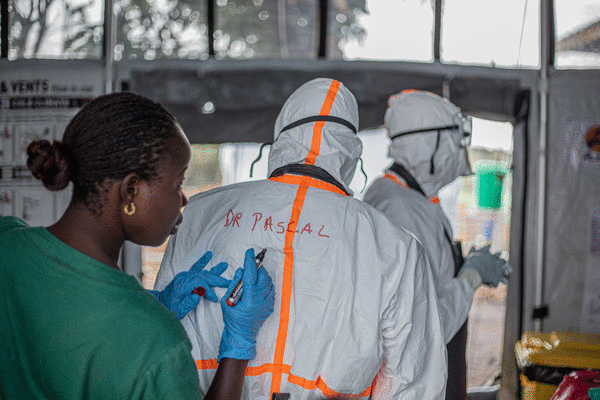
Merck & Co.’s Ebola vaccine and an antiviral drug from Gilead Sciences Inc. are set for wider use in eastern Democratic Republic of Congo to blunt the fastest-growing Ebola outbreak on record.
The Africa Centres for Disease Control and Prevention and Congolese officials plan to expand access to both products across two provinces as the epidemic outpaces conventional control measures. Almost 4,000 confirmed cases and more than 1,800 deaths have been reported since the outbreak was declared 12 weeks ago.
Neither Ervebo, Merck’s licenced Ebola vaccine, nor Gilead’s remdesivir has been proven effective against Bundibugyo, the rare strain driving the epidemic. But emerging data from Congo and experience treating Ebola patients in Uganda provide enough evidence to justify broader use while formal studies continue, Jean Kaseya, Africa CDC’s director-general, told reporters Thursday.
Kaseya cited observational data showing no deaths among Bundibugyo patients who had previously received Ervebo. “We saw zero death among people who are vaccinated,” he said. “All deaths that we have with Bundibugyo today are those who are not vaccinated. It means there is a level of protection.”
The observations don’t yet show that Ervebo, which targets Zaire Ebola, protects against Bundibugyo. Africa CDC is fast-tracking studies to determine whether the immune response generated by the vaccine offers any protection against infection, severe disease or death. A small cohort study could begin within about two weeks after receiving ethical clearance.
Africa CDC has already authorized Ervebo’s use in Ituri and North Kivu, home to an estimated 12-15 million.
Gavi, the Vaccine Alliance, has committed $40 million to make the vaccine — priced at about $98 a dose — available from a global stockpile of 500,000 doses if it’s recommended for use against Bundibugyo, said Shanelle Hall, an Africa CDC adviser. The agency is also working with Merck, the Wellcome Trust and Singapore-based Hilleman Laboratories on ways to increase production, potentially including manufacturing in Africa, and improve the vaccine’s heat stability.
Meantime, Kaseya said Africa CDC is assessing a “massive” procurement of remdesivir to treat Ebola patients in Ituri, North Kivu and Kisangani, the central Congolese city where cases were reported last month.
Drug supply
Africa CDC is discussing advance-purchase agreements with two Egyptian manufacturers to secure supplies of remdesivir, Hall said. The manufacturers first need to procure the drug’s active ingredient and could produce finished doses within about three weeks after receiving it.
Uganda’s experience using remdesivir during its Bundibugyo outbreak — where case-fatality rate was about 10%, compared with 45% in Congo — prompted Africa CDC to adopt the drug despite the lack of evidence from randomized controlled trials that it reduces deaths. “We decided to use this approach in DRC,” Kaseya said.
Remdesivir is being evaluated in a randomized, controlled clinical trial at three sites in Congo, with 68 patients enrolled. Preliminary results are expected after the first 100 participants complete 28 days of follow-up, said Placide Mbala Kingebeni, director of research, clinical trials and innovation at Africa CDC.
Outside trial sites, the drug would be provided under a compassionate-use protocol that also collects safety data, Mbala Kingebeni said.
The decision comes as conventional contact tracing struggles to keep pace with widespread community transmission. Responders are identifying about 10 contacts for every confirmed infection, compared with 41 during Uganda’s outbreak and 57 during Congo’s 2018-2020 epidemic. About 17,000 contacts are currently listed, versus the 160,000 to 200,000 Africa CDC estimates should be identified based on experience from previous outbreaks.
That’s prompted authorities to shift toward door-to-door case finding in the hardest-hit areas, effectively treating entire cities as potentially exposed. More than 70% of new infections are being detected in the community, Kaseya said, while about 60% of confirmed deaths have occurred outside treatment centers.
Ebola has also reached at least five displacement camps in Ituri, infecting 19 people and killing five, according to the United Nation’s refugee agency. About 270,000 people are living in camps across the province, Kaseya said.
Africa CDC is also bolstering diagnostic capacity as part of the outbreak response. Officials said laboratory capacity has grown from a single testing site at the start of the outbreak to 19 laboratories capable of processing about 3,000 samples a day, cutting turnaround times from days or weeks to about 24 hours.
Sign up here for the daily Next Africa newsletter and subscribe to the Next Africa podcast on Apple, Spotify or anywhere you listen.
©2026 Bloomberg L.P. Visit bloomberg.com. Distributed by Tribune Content Agency, LLC.





Comments