Iran seeks to bar US ships in Hormuz as deal with Oman advances
Published in News & Features
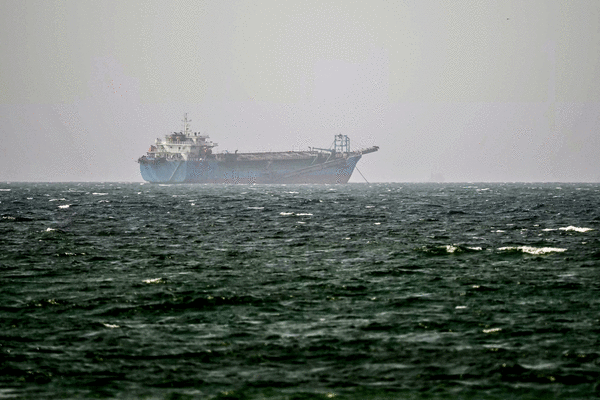
Iran will seek to bar U.S. and Israeli ships from the Strait of Hormuz and require compensation from hostile countries before they’re allowed to use it, according to local media reports on a proposed Iran-Oman deal to manage the crucial waterway.
The agreement has become key to expectations for a reopening of Hormuz and a resumption of energy flows that have been throttled since the U.S. and Israel attacked Iran in February. The text is now under review in Iran’s parliament, the semi-official Fars news agency said. Fars reported other details including a proposed ban on any Israel-related cargo, and a fee structure covering services like insurance and environmental costs.
Both U.S. and Iranian officials have been signaling in recent days that some kind of accord on Hormuz is close. President Donald Trump, who stepped back from his most recent threats to resume military attacks on Iran, said so again late Wednesday. Still, many previous claims of an imminent deal have proven unfounded, and it’s not clear if the Iran-Oman proposals will be enough to get traffic flowing again. Oil prices climbed on the reports.
The U.S. has insisted on free transit through Hormuz, and broadly called for a return to the pre-war status quo. Any temporary routes through the strait won’t be subject to approvals, permissions, tolls or charges, a U.S. official said Thursday in response to reports on the latest proposals.
Tehran says a full reopening would require the lifting of the American maritime blockade. And Washington hasn’t signaled whether it’s ready to go back to the terms it accepted under the last effort to reopen the strait, a June agreement that broke down within weeks. Those included waiving oil sanctions on Iran and unfreezing some of its frozen financial assets.
Oil prices rose on Thursday, with Brent crude above $82 a barrel, amid concern that the reported Iran-Oman plan may fall short of a wider resumption of energy flows from the Persian Gulf. Prices are still down significantly since Trump said at the weekend he’d called off a major military attack.
Fars, citing an informed source at Iran’s Foreign Ministry, said the draft agreement with Oman foresees Iranian management over the entry of vessels into Hormuz, with the exit being overseen jointly by both countries. They envisage transit through a “central corridor,” with traffic via the two other routes that are currently in limited use to cease within a “specified timeframe,” the agency reported.
Hormuz shipping, which moved freely before the war, has become the key sticking point in the months-long deadlock between the U.S. and Iran, even as the fighting has eased. An accord on that point would relieve mounting pressure on the global economy from higher energy costs, and potentially open the way to talks on other issues like Iran’s nuclear program.
Other potential obstacles to a durable peace deal have emerged as the war spread across the region.
Those include clashes between Saudi Arabia and the Houthis, an Iran-backed militia that controls much of Yemen. The Yemeni group said it launched a “large-scale” attack against Saudi-aligned troops in the country’s central region on Thursday, claiming to have killed and injured hundreds. There was no immediate comment from Riyadh.
The Houthis and a Saudi-led coalition in Yemen have observed a ceasefire since 2022, but hostilities have erupted in recent weeks, including in the Red Sea.
The conflict between Israel and Iran-backed Hezbollah in Lebanon also shows signs of flaring up again. Israel said it bombed the south of the country on Wednesday after two Israeli soldiers were killed there. The June truce agreement between the U.S. and Iran required a ceasefire in Lebanon too.
Any new deal on the Strait of Hormuz would have to be approved by Iran’s Supreme Leader Mojtaba Khamenei, who has been in hiding since being injured in the initial U.S.-Israeli attacks in February. It’s unclear if he’s given his consent yet and Iranian officials have said that communicating with him takes time.
President Masoud Pezeshkian said in a televised interview on Wednesday that communication with Khamenei is “very difficult at the moment.”
On the U.S. side, after Trump called off what he said was going to be a massive new attack on Iran, the Washington Post reported that a shortage of key missiles and air-defense systems was among the reasons. According to the newspaper, Trump lashed out at Defense Secretary Pete Hegseth on the sidelines of a Cabinet meeting last week, saying he had been misled about weapons stocks.
“The U.S. has massive amounts of ‘munitions,’”, Trump said in a Truth Social post on Thursday, denying that the country is running low.
In Hormuz, visible traffic through the strait has been limited, though a few millions of barrels a day have continued to cross the waterway even in recent weeks.
Middle Eastern producers have ferried cargoes out of the Gulf as part of a shuttle program involving help from the U.S. military and vessels turning off their transponders. Some, such as Saudi Arabia and the United Arab Emirates, are managing to bypass the strait by piping a significant amount of their oil to ports outside the Persian Gulf.
—With assistance from Meghashyam Mali.
___
©2026 Bloomberg L.P. Visit bloomberg.com. Distributed by Tribune Content Agency, LLC.






Comments