TPS ends for 350,000 Haitians: Federal judge lifts stay after Supreme Court ruling
Published in News & Features
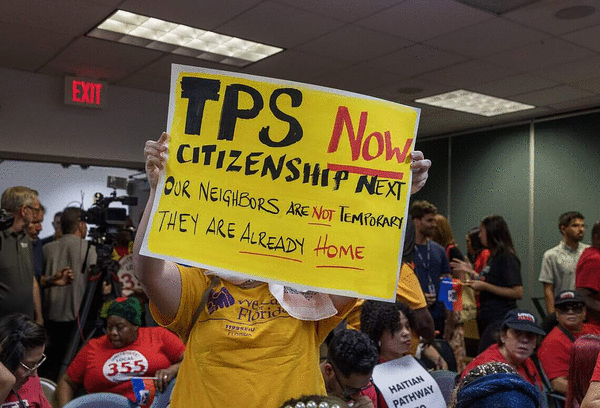
Hundreds of thousands of Haitian immigrants shielded from deportation lost that official protection Wednesday when a federal judge in Washington, D.C., lifted her stay that had blocked the Trump administration from carrying out its policy to end it.
U.S. District Judge Ana C. Reyes was forced to undo her stay preserving temporary protected status for Haitian immigrants in Florida and other states when the Supreme Court ruled in June that the administration’s decision ending the protections was not subject to judicial review.
The judge had been awaiting the official Supreme Court mandate, which was sent on Monday, July 27, to the federal appeals court in Washington before being forwarded on Tuesday to her. With her lifting of the stay, about 350,000 Haitian immigrants with TPS in the United States now lose their protection against deportation.
In South Florida, the impact was already being felt as Haitians lost their work authorizations last week and were forced to quit their jobs in workplaces like nursing homes, where they cared for the state’s aging population and the disabled, at Fort Lauderdale-Hollywood International Airport where dozens were employed as cleaners, and at local supermarkets as cashiers.
While immigrants account for 64% of all home health aides in Florida, 7% of foreign-born caregivers are from Haiti, the Florida Immigrant Coalition, an alliance of groups fighting for the rights of immigrants in Florida, said in a fact sheet detailing the economic impact.
Studies estimate that Haitians accounted for roughly 120,000 of Florida’s TPS holders, whose loss in the labor force is estimated at as much $4 billion to the state’s gross domestic product. Employers would incur close to $1 billion in turnover costs nationally for recruiting and training replacements for TPS workers, according to Tess Petit, the executive director of the immigrant coalition.
Another effect: The U.S. citizen children of immigrants who had TPS, and whose parents are detained or deported, may face family separation or possible foster care placement.
Haiti was first designated for TPS in 2010 after the country’s devastating earthquake killed more than 300,000 people and displaced 1.5 million others. In the years since, worsening conditions — including political instability, gang violence and recurring humanitarian crises — led to the repeated extensions and redesignation of the humanitarian program.
Dread over the impending end of TPS has been hanging over the Haitian community in South Florida, where many fear Immigration and Customs Enforcement raids are imminent.
In Springfield, Ohio, home to a sizable Haitian community, Haitians were receiving letters to appear in person for ICE check-ins and being outfitted with ankle bracelets.
“Many immigrants have spent years working, paying taxes, raising families and contributing to communities across our country,” Springfield Mayor Rob Rue said. ”Under the current legal framework, there is no opportunity for a permanent legislative solution for many of these individuals. That responsibility belongs to Congress.”
Rue said the city has not received any information yet from ICE regarding any planned enforcement operations.
“Lasting solutions require leadership,” he said. “I hope Congress will seize this opportunity to modernize our immigration system in a way that upholds the rule of law, strengthens our economy and reflects the values that have long made the United States strong.”
Last week, the Department of Homeland Security acted as if TPS had ended on July 27 when the Supreme Court issued its mandate to the lower courts. With TPS work authorizations expired, the agency, in a post on X, told Haitians that their “free trial of America has ended.
“Your Temporary Protected Status protections have expired,” the DHS post said. “Enforcement will be carried out. You can wait for DHS to deport you or you leave now.”
The message was followed by two choices in boxes: “Leave Now” or “Wait for Deportation.”
Lawyers for the Haitian immigrants who filed the initial lawsuit in Washington against the Trump administration said they were “still evaluating the effects of the Supreme Court’s ruling” and would inform Judge Reyes about filing an amended lawsuit. In February, Reyes had paused the administration’s decision ending TPS for the Haitian immigrants, setting the stage for the high court’s 6-3 ruling overturning both her and a federal appeals court.
However, the justices left open a narrow window for the Haitian immigrants to continue challenging the administration’s decision on constitutional grounds, based on their initial claim that the termination of TPS was rooted in racial discrimination in violation of the 14th Amendment’s Equal Protection Clause.
Despite the high-court ruling, Justice Department lawyers urged Reyes to put discovery, or evidence, in the remaining case on hold, but the judge refused to do so in her order on Wednesday — signaling that she’s ready to move forward on the Haitians’ discrimination claim.
But even as the Haitian immigrants’ TPS case moves through the federal court in Washington, many of them could still be deported by ICE to Haiti, a country collapsing from deadly gang violence, political chaos and extreme poverty and hunger.
Some advocates for the Haitian immigrants have been quietly lobbying the Trump administration to provide deportation protections to Haiti through a program known as Deferred Enforced Deportation.
During his first term in office, President Donald Trump issued deferred deportation to thousands of Liberians living in the U.S. after he terminated the West African nation’s TPS designation. The president later extended the wind-down period by a year.
_____
©2026 Miami Herald. Visit miamiherald.com. Distributed by Tribune Content Agency, LLC.






Comments