Cuba opens pharmacies, gas stations, law firms to private enterprise under state watch
Published in News & Features
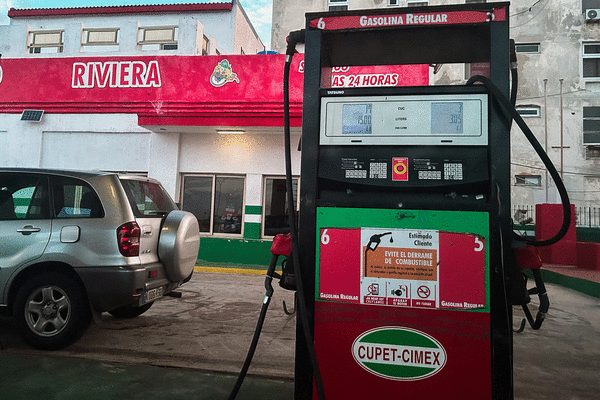
The Cuban government has announced it is opening up banking, pharmacies, gas stations, elder-care homes, port terminals and — almost unnoticed — the practice of law and architecture to private companies for the first time in six decades.
Prime Minister Manuel Marrero signed the new decree that takes effect Tuesday. In 2024, when the economy had already been in crisis for several years, the government issued a decree listing 125 commercial activities prohibited to private enterprises, non-agricultural cooperatives and the self-employed.
Of those 125 prohibitions, officials now say 46 have disappeared entirely, and 35 have had their operating conditions relaxed.
But nearly every new opening comes attached to a license or an administrative concession that the state alone grants, under rules the ministries involved still have to write. The government still maintains control of sectors it sees as central to its grip on power, including healthcare, education, telecommunications and the media. Anything related to public security is also forbidden, along with independent unions and professional associations.
The decree replaces a single blanket list of prohibited activities with four tiers: absolute prohibition, activities reserved to the state, activities barred only to the self-employed, and activities that any private actor may perform once licensed.
The expansion of the private sector is one of the key measures in a package of 176 economic changes the Cuban government announced last month amid increased pressure from the Trump administration to make economic and political reforms.
The reform, which tries to mirror similar market openings in China and Vietnam under the Communist Party, comes amid the worst economic crisis in Cuba’s contemporary history and increased U.S. sanctions, making experts doubt they could be successful unless they go hand in hand with democratization and a normalization of relations with the United States.
Speaking to the National Assembly last week, Cuban leader Miguel Díaz-Canel insisted the package was not a concession to Washington. The transformations, he said, “do not respond to any demand arising from the limited process of talks carried out in this period. They are the result of a sovereign decision by Cuba.”
What’s new
One of the most consequential changes for ordinary Cubans will be allowing privately run pharmacies to fill the gap left by empty state shelves. The news has caused a stir on the island, where Cubans have been paying for medicines on the black market for years after the government reduced the production and import of medicines amid the economic crisis. While some welcomed the news, others who do not receive remittances from abroad or have other sources of dollars fear they won’t be able to afford medications.
While previewing the changes, Cristina Lara Bastanzuri, a top Health Ministry official, told reporters that private pharmacies will need premises with proper storage conditions — not, she specified, “the porch of a house” — qualified pharmacy staff and will be able to dispense only medicines carrying valid Cuban health registrations. Subsidized state pharmacies, she said, will keep their prices and their staff.
Medical and dental care itself remains closed off to the private sector, even though paying for crowns, fillings and medical procedures under the table has become routine in the public health system. Only foreigners and Cubans with second nationalities have access to better care, through well-equipped state-run clinics that charge in dollars.
The decree also authorizes private elder-care residences, whether day-care or permanent, capped at 60 people each, with 10% of capacity reserved for “vulnerable people” assigned by the Health Ministry at state-set rates. But the homes can’t have a doctor of their own on staff, and a family physician working for the state will be required to visit them once a month. Alberto Fernández Seco, who heads the health ministry’s department for the elderly, social assistance and mental health, defended the model, saying, “This is social, not medical assistance.”
Another change: allowing the private sector to take over trash collection, following years of the government being unable to provide reliable service. Trash in Havana has become such a significant problem that residents often set it on fire on the streets. The toxic fumes are creating health issues, Cuban independent journalist Yoani Sanchez has reported.
Also allowed with government licenses or concession are:
—Operation of gas stations — which has already been happening under the radar — requiring a concession by the government or forming an economic association or joint venture with the government.
—Renewable generation and sale of electricity.
—Direct commercial import of electric vehicles, motorcycles and mopeds with a tax exemption, on condition shipments arrive with a charging station. Danna Álvarez, a top Transport Ministry official, also announced that private management of bus and rail terminals, port piers and port terminals will be allowed if they are not deemed of government interest.
—Wholesale commerce. Yosvany Pupo Otero, first deputy minister of domestic commerce, said wholesaling is no longer conditioned on contracting with state entities and no longer has to be a company’s principal activity, two conditions imposed in previous years that private wholesalers had complained about most. The self-employed remain excluded from wholesaling.
—Manufacturing and assembly of vehicles and motorcycles. Pharmaceutical manufacturing is also authorized but only in partnership with state industry.
—Banking and financial services also appear to have been authorized, since they were removed from the list of prohibited activities.
Marrero told the National Assembly that the government approved the regulatory framework for authorizing private exchange houses under a Central Bank license, and that the first one is ready to begin operating as a pilot project. But he did not provide any other details.
A quiet opening: professions
Buried in a list of activity codes, decree 160 moves “regulated professional and technical activities” — such as law, architecture, engineering, accounting, auditing, management consultancy, advertising and veterinary services — into the tier of activities requiring government authorization.
Architects had asked for exactly this in a 2021 open letter to the government, and were refused.
Auge, a consulting firm that advises Cuban entrepreneurs, was the first to flag the change. The firm interpreted the move to mean that lawyers would be able to form a company to offer legal advice once the Ministry of Justice sets the rules. But it is difficult to assess the scope of the measure without the regulations to implement it.
Private legal practices would end a monopoly in place for decades, under which Cuban attorneys had to belong to the state-linked National Organization of Collective Law Firms. Cuban independent news outlet 14ymedio cautioned that the practical effect may be narrow. With judges and prosecutors subordinate to the Communist Party, fair-trial guarantees would remain limited even with private practice, and independent lawyers’ groups have repeatedly been denied registration.
Journalism, news agencies, newspapers, book and magazine publishing, radio and television remain barred to private enterprise. So do formal teaching with official certification, private academies, tobacco manufacturing, oil refining, telecommunications, insurance and pension funds. Language classes, tutoring and music classes are allowed only to individual self-employed workers who hire no employees.
Self-employed workers emerge as the most restricted sector in the new hierarchy — barred from wholesaling, vehicle assembly, gas stations, security-system installation and pharmacy services.
‘Not moving toward privatization’
While rolling out the changes expanding the activities that private enterprises will now be allowed to engage in, a top government official stressed the changes were not what they appear.
“We are not moving toward the privatization of the economy,” Lázara Mercedes López Acea, president of the National Institute of Non-State Economic Actors, told reporters at a press conference. “The socialist state enterprise keeps its central role, while non-state actors are given more room.”
She put the number of approved private enterprises at more than 15,600, and projected close to 16,000 by the end of August.
Cuban leaders have been ambivalent towards the opening, insisting Cuba is not embracing capitalism while defending the changes as necessary both economically and to save “the revolution.” Díaz-Canel in particular has been responding to pushback from ideological hardliners within the government and the Party, and to pushback from a population concerned about shock therapy measures.
In an interview with Russian state television channel RT, Díaz-Canel spoke of the “pain” of implementing capitalist practices bringing inequality. “Of course it hurts,” he said, “because it goes against the concepts that shaped us, that we were educated in.”
He returned to the same theme two days later in the closing the National Assembly session on July 30.
“We are not going to install predatory capitalism,” he said, “nor a massive privatization of national assets, as some fear.”
_____
©2026 Miami Herald. Visit miamiherald.com. Distributed by Tribune Content Agency, LLC.





Comments