Autopsy of Monterey-area shark attack victim Erica Fox shows single crushing bite
Published in News & Features
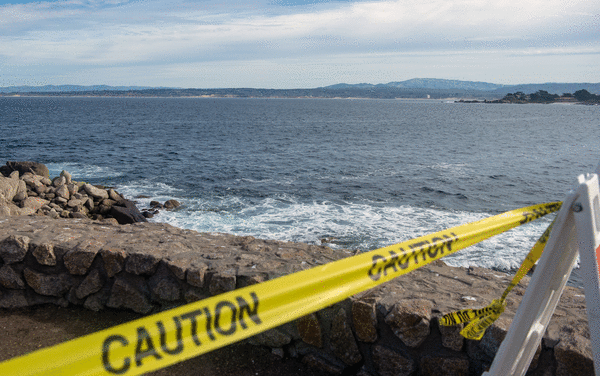
SAN JOSE, Calif. — An autopsy report released late Wednesday shows Erica Fox, a swimmer seen in the mouth of a shark near Monterey in December, suffered a single crushing bite to her legs and torso.
The force of the bite, which left a semicircle of tooth wounds from Fox’s knees to her abdomen, broke her pelvis in several places, the report said. She also had a gaping wound 10 inches long and five inches wide from the side of her right hip to her abdomen. A major artery in her midsection had been cut open.
Fox, a 55-year-old triathlete, was reported missing in December, after she failed to return to shore with the swim group she co-founded, the Kelp Krawlers. She had been far ahead of more than a dozen swimmers returning to Lovers Point beach in Pacific Grove.
The U.S. Coast Guard said a driver at a stop sign on his way to work called 911 to report seeing a shark burst from the water about 100 yards off Lovers Point with what he believed to be a human protruding from its mouth. The man said the shark submerged and did not resurface. A second witness also reported seeing a shark breach the water in that area.
Fox’s body was found six days later north of Santa Cruz near Wilder Ranch State Park, on the shore.
The office of the Santa Cruz County Coroner determined Fox died from “sharp and blunt force injuries and submersion in water due to a shark attack,” according to the autopsy report.
Her wetsuit and swimsuit were ripped open in areas corresponding to her wounds, the report said.
The report did not reveal the width of the bite. Fox, 5-foot-7-inches tall, suffered deep injuries to her right knee and both thighs, with the semicircular array of wounds continuing to her left side and cutting across to the right side of her abdomen, the report said.
Experts said at the time of the attack that the rocky coastline near Lovers Point attracts sea lions, and seals frequent the waters offshore. Both are primary prey for white sharks. Large white sharks, which can reach nearly 21 feet in length, migrate from offshore in the Pacific to the coast in October to bulk up on seals and sea lions, typically remaining through January.
Chris Lowe, a professor of marine biology and director of the Shark Lab at California State University Long Beach, said Thursday that he believes a large adult great white shark, likely about 16 feet long, killed Fox.
As with most white shark fatalities, Lowe said, it is noteworthy there was only one bite.
“The only explanation we can come up with in cases like this is that the shark made a mistake,” he said. “It mistook a person for a seal or a sea lion.”
He said that authorities told him after the attack that there was no evidence of defensive wounds — bites or scrapes to Fox’s hands.
“This was a big shark,” he said. “I think she was probably knocked unconscious immediately. It was a horrible trauma.”
Lowe noted that the area off Lovers Point quickly shifts from shallow to deep water.
“Sharks are looking up for seals, and they have some area to build up speed as they rush from below,” he said.
Shark attacks are extremely rare.
There have been 17 fatal shark attacks statewide since 1950, and 236 total attacks, according to the California Department of Fish and Wildlife. Over those 76 years, the most incidents, 27, have occurred in San Diego County, followed by San Mateo County with 22, Santa Barbara with 21, and Marin, Humboldt and Monterey with 19 each, and Santa Cruz County with 17.
“Think about how many people we see in the ocean all the time and yet there are very few bites,” Lowe said. “If you look at the number of boating accidents, the number of people who drown in rip currents, the number of people who are hit by boats and die, those are far higher than we see from shark bites. People get freaked out by the fact that there is an animal out there that can cause them harm. But the chances of getting attacked are far less than 1 in a million.”
Fox’s death marked the third shark-related incident at Lovers Point since June 2022, when another Kelp Krawler, Steve Bruemmer, was bitten and seriously injured while swimming. Two months later, a paddleboarder and his dog were thrown from their board but unhurt when a shark bit it from below in the same area.
Fox was a co-founder of the Kelp Krawlers swim club that waded into the waters at the Lovers Point beach every Sunday morning for a mile-long loop along the coastline swimming among the kelp and starfish.
She enjoyed the open ocean so much that told her husband, Jean-Francois Vanreusal, “I’m a fish!” She competed in the Escape from Alcatraz swim 19 times and was often on the podium receiving a medal, he said in a December interview while she was still missing.
She knew swimming in the wild was a risk, he said, “but a minimal risk.”
“The only comfort I find is that Erica was every Sunday here, excited to go in the water,” Vanreusal said. “She really passed in the place she loved.”
Lowe said after the accident he spoke with members of the Kelp Krawlers and told them that to minimize risk in the Lovers Point area, they could swim in shallower water, closer to the beach.
Members of the Kelp Krawlers were not immediately available Thursday morning. In the wake of the attack, club member Lisa Jensen told this news organization that the group’s senior swimmers, like Fox, think of themselves as swimming in sharks’ home.
“You are far more likely to die in a car accident or even a plane accident than in a shark attack,” Jensen said at the time. “We love the ocean.”
Jensen described Fox as “an incredibly cheerful, bubbly, funny, joyful, kind human being,” who, as a swimmer, was “always out leading the pack.”
_____
©2026 MediaNews Group, Inc. Visit at mercurynews.com. Distributed by Tribune Content Agency, LLC.






Comments