US launches new wave of strikes on Iran as war escalates
Published in News & Features
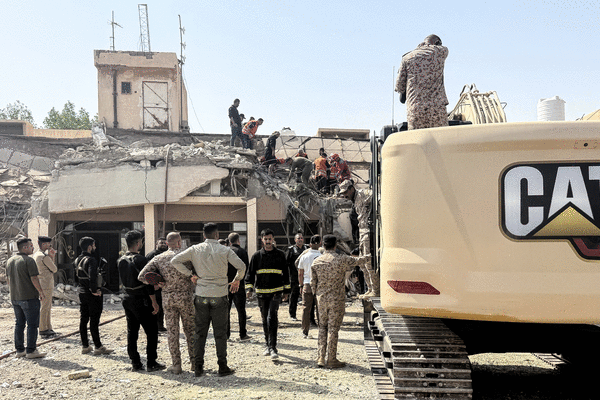
The U.S. launched a new wave of strikes against Iran in response to attacks on military bases in the Middle East, escalating a conflict that has spread across the region.
“U.S. forces began launching strikes against Iran at 8 p.m. ET today,” U.S. Central Command said in a post on X. “The strikes are a powerful response to yesterday’s attempted Iranian attacks on U.S. forces based in the Middle East.”
The U.S. and Iran had paused an exchange of strikes at the end of last week in an effort to further diplomatic talks and bring an end to the months-long war. Yet that lull ended Tuesday night when Iran’s Islamic Revolutionary Guard Corps carried out a surprise assault, firing multiple ballistic missiles at a U.S. military base in Jordan.
U.S. officials said all of the incoming missiles were intercepted, but the attack sent oil prices soaring as markets feared a return to all-out war.
“We’re going to be hitting them very hard because it’s our turn to hit them,” President Donald Trump told reporters at the White House on Wednesday afternoon. “They know what’s coming. They’re asking us not to do it.”
The resumption of hostilities came just hours after Trump had claimed Washington and Tehran were making progress in discussions and that he preferred a deal with Iran rather than ordering more strikes. Trump struck a fiery tone on Wednesday morning after Iran’s overnight attacks, telling a Fox News reporter in a phone interview that he intended to hit back “hard.”
Instead of winding down, the Iran war appears to be expanding.
The U.S. and Saudi Arabia struck Iran-backed militias in Iraq on Tuesday, after Riyadh said it had countered drones launched by Iraqi groups targeting its oil facilities. Iran-backed Houthi militants in Yemen have also attacked vessels in the Red Sea.
On Wednesday, fires broke out aboard two liquefied natural gas vessels at the Egyptian port of Damietta, with a security firm saying the vessels had been struck by drones.
Oil prices had eased during the brief detente but rose again earlier Wednesday after Trump’s threats. Crude was little changed after the U.S. said it launched a fresh wave of strikes. Brent traded near $90 a barrel after rallying almost 8% in the previous session.
The latest U.S. response threatens to unravel recent efforts to prevent the Middle East conflict from broadening and offered a stark demonstration of how both sides are ready to resort to force. Trump has repeatedly claimed that the U.S. and Iran were close to a deal even as Tehran has denied it was engaged in active talks with Washington.
A prolonged conflict also poses political risks for Trump, whose Republican Party faces an uphill fight to retain control of Congress in November midterm elections. The election will largely hinge on the economy, with voters giving Trump poor marks on his handling of the issue.
The war brought a sharp increase in gas prices as shipping through the energy-crucial Strait of Hormuz was effectively blocked. The strait remains largely closed with few ships passing through.
Meanwhile, Centcom said earlier Wednesday that U.S. forces “continue to strictly enforce the U.S. blockade against Iran.”
Qatar, meanwhile, has sent its first shipment of liquefied natural gas through the Strait of Hormuz since one of its tankers was attacked in the waterway more than three weeks ago.
The move indicates that QatarEnergy may be resuming shipments through the strait after pausing journeys when the Al Rekayyat gas carrier was struck on July 7.
_____
(With assistance from John Harney, Meghashyam Mali, Jon Herskovitz, Stephen Stapczynski and Kanoko Matsuyama.)
_____
©2026 Bloomberg L.P. Visit bloomberg.com. Distributed by Tribune Content Agency, LLC.






Comments