Haitians express 'profound fear' as temporary protected status deadline nears
Published in News & Features
As the Friday expiration date for temporary protected status looms, members of Sacramento’s Haitian community have expressed fear and uncertainty.
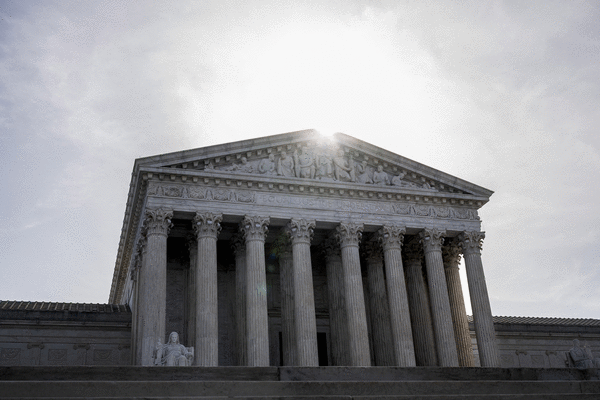
The U.S. government grants TPS to immigrants who cannot safely return to their home countries for reasons such as political unrest or natural disaster. The Supreme Court’s June 25 ruling in Mullin v. Doe limited these protections, saying courts do not have the authority to challenge the Trump administration’s decision to rescind TPS for Haitian and Syrian individuals.
For 350,000 Haitian and 6,000 Syrian immigrants nationally, the TPS deadline marks the beginning of a purgatorial wait — many plan to stay in the U.S. past Friday, hoping they are not summoned to immigration court and forced to return to their countries of origin.
Sacramento’s tight-knit Haitian community is small but has grown in recent years, according to Volma Volcy. Volcy, a Haitian American and the chief of staff of the Sacramento Central Labor Council, has led rallies to protest the presence of Immigration and Customs Enforcement in Haitian American and other local immigrant communities.
“I know a ton of people who are going to be impacted by (TPS termination),” Volcy said. “Some people have been in this country since 2010. They have families here, they have their children. These people don’t know Haiti or what it is like today. Sending them back to a country like Haiti right now…is almost like a death sentence.”
Haiti experienced widespread public unrest after a devastating 2010 earthquake, which killed more than 100,000 and set off a period of deepened economic crisis. Several years later, violent protests culminated in the assassination of Haitian President Jovenel Moïse in 2021. The country has not had a stable leader since, and gangs have attempted to fill the political vacuum.
Community organizer: Fear is pervasive
Alcénat Honorat, a Haitian American community organizer with the Haitian Association of Sacramento and Surrounding Areas, said that almost every Haitian he knows is personally affected by the TPS deadline or fears for family members facing deportation.
“I went [to Haiti] two years ago after 11 years of absence,” Honorat said. “I can tell you this is not the country I left. Nothing could have prepared me for what I saw…I had never been so scared in my life.”
Honorat, who moved to the U.S. 20 years ago to study civil engineering at California Polytechnic State University, San Luis Obispo, said that many of his friends and community members with TPS either fled the country or decided to go into hiding.
“The stress of not knowing what’s going to happen over the last two years has been so significant that I know three people who decided to just leave,” Honorat said. “But most people don’t have that option. It’s a matter of waiting to see what happens, hoping they can stay in hiding for a while and ride the wave.”
Blake Nordahl, a professor of immigration law at University of the Pacific’s McGeorge School of Law, said TPS places immigrants in “legal limbo.” Unlike those with asylum or refugee status, individuals with TPS have no clear pathway to permanent residency or citizenship, according to Nordahl.
While not every Haitian individual with TPS will be immediately summoned to immigration court, Nordahl said, the deadline will mark the cancellation of work permits. According to Nordahl, this will mark an economic “squeeze” in which Haitians, many of whom have worked in the U.S. for over five years, are prevented from earning income.
“Not everyone is going to be sent to immigration court the very next day, but they’re losing their permissions to work,” Nordahl said. “(Haitians’) work permits will expire, or their employers are getting letters from the federal government saying that they need to terminate these individuals. They’re being squeezed. It will certainly be an economic challenge.”
There’s potential economic impact
Volcy said he believes that removing Haitians from the workforce will also have a negative effect on the U.S. economy.
“It doesn’t make a whole ton of sense to (remove) a sector of people that does a lot of work that…Americans really won’t touch,” Volcy said. “When you go to a restaurant, they’re the ones who are cleaning those dishes. They’re the ones who are mopping the floors. They are the ones who are staying with the elderly and babysitting for families who can’t afford childcare.”
Giselle Garcia, a program director at immigration defense non-profit NorCal Resist, said she has seen “profound fear” among Haitian individuals with TPS. These individuals often seek assistance from NorCal resist, which provides legal aid to immigrants and helps those with TPS apply for work authorization.
“Our folks are saying, ‘I’m checking my mail all the time to see if I get a notice telling me to go to immigration court,’ ” Garcia said. “These families are facing extreme anxiety and fear because a lot of them have been here for many years with work authorization. They’ve created a life for themselves here, and now it’s under threat, and there’s no real plan forward.”
Jims Porter, external affairs director for Sacramento-based immigration non-profit Opening Doors, said the uncertainty caused by Mullin v. Doe has had widespread effects on the Sacramento community.
“There’s a ripple effect of these policies, so it doesn’t just touch immigrants and immigrant-serving organizations,” Porter said. “It touches every corner of our community. We’re hearing from food banks who are seeing an uptick in demand and don’t have the resources needed. We’re hearing from healthcare providers that people are scared to go out and go to their appointments. … The need (for legal aid), which was already far over what the immigrant legal aid sector could really (provide), has ballooned so significantly that the problem is infinitely greater.”
Congress considers action
Garcia said NorCal Resist aims to raise awareness of the humanitarian consequences of TPS termination and hopes Congress will soon take legislative action to provide relief for affected individuals.
“We hope that Congress can legislate pathways so that the folks who were impacted by (Mullin v. Doe) won’t have to live in limbo until there’s either ICE enforcement against them or they’re placed in removal proceedings,” Garcia said.
California Attorney General Rob Bonta reflected this sentiment in a Wednesday letter, calling on Congress to prolong TPS with a coalition of 19 other attorneys general. The letter urged the Senate to approve House Resolution 1689, which the House of Representatives passed on April 16. H.R. 1689 would extend TPS for Haitians until April 20, 2029, require judicial oversight of executive decisions regarding TPS and provide TPS holders with a path to legal residency.
“Forcing Haitian TPS holders to uproot themselves, some of whom have been here for more than a decade, to return to a country that has faced repeated natural, economic and political crises goes against the very purpose of TPS, which protects individuals already in the United States who cannot safely return to their home country,” the letter reads.
____
©2026 The Sacramento Bee. Visit at sacbee.com. Distributed by Tribune Content Agency, LLC.






Comments