Trump shelves 20% fee for Hormuz cargo after Gulf pressure
Published in News & Features
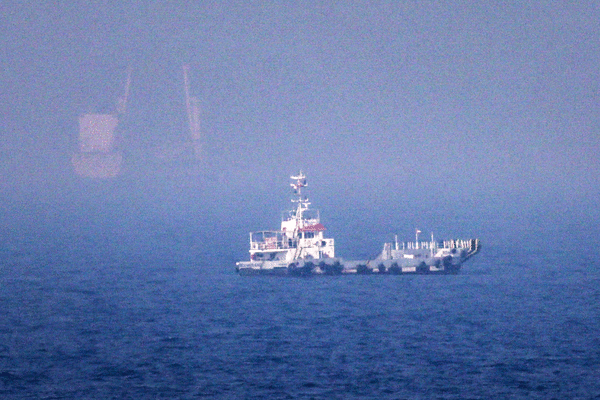
President Donald Trump backed away from his plan to impose a 20% charge on cargo shipments through the Strait of Hormuz after U.S. allies in the Gulf urged him to drop it.
Trump announced the decision on Tuesday, just one day after rolling out the fee, saying that the expected revenue would be replaced by forthcoming direct investments in the U.S. from Gulf states. He did not specify a dollar amount or which countries would participate.
“I have decided to replace the 20% United States Reimbursement Fee with Trade and Investment Deals that the various Gulf States will be making into the United States,” Trump posted on social media.
Asked by reporters later why he dropped the plan, Trump said he spoke to representatives from Saudi Arabia, Qatar, Bahrain, Kuwait and the United Arab Emirates, who urged him to “do it a different way” with financial commitments to America.
“I don’t like the concept of a fee,” Trump said. “They’re going to be making massive investments into the United States, and I like that much better.”
It’s unclear if any Gulf states have made new financial pledges. At least one regional government has said it has not agreed to increase its existing commitments in exchange for waiving the transit fee through the strait, according to a person familiar with the matter.
Oil pared gains after Trump’s post and then rebounded. Brent crude traded about 2% above Monday’s close near $85 a barrel by 11:49 a.m. New York time.
The reversal illustrated the bind Trump is in, as hostilities with Iran resume and Tehran refuses to loosen its grip on the crucial waterway. Oil prices surged on Monday when the president first announced his proposal for a so-called “reimbursement” for facilitating shipping in the strait, threatening a rebound in gasoline costs for Americans ahead of November’s midterm elections.
After Trump initially announced the 20% fee, at least one Gulf Cooperation Council member state had reached out to the U.S. government to clarify Trump’s comments on the plan, according to a person familiar with the matter. One more person said Gulf states were still united in wanting to ensure no tolls or fees are imposed on ships traveling through the strait.
A Gulf energy official said after Trump’s announcement Monday of the fee that there was concern that it would encourage others, including China, to do the same in waterways across the world.
Traders, analysts and industry stakeholders had dismissed the idea as unworkable and unlikely to be fully implemented, since it would be so difficult to administer and poisonous to allies around the globe.
“I think it’s patently ridiculous and totally irrelevant. It’s Trump nonsense,” Jay Hatfield, chief executive officer at Infrastructure Capital Management, said before Trump’s retreat.
If imposed, the charge may have amounted to a roughly $30 million cost for full supertankers carrying oil — far higher than the tolls Iran has charged, according to people familiar with the matter.
“The figure itself seems entirely arbitrary and, if imposed, would amount to an extortionate charge,” John Calabrese, a senior fellow at the Middle East Institute, said before the president changed course. “More fundamentally, the proposal treats freedom of navigation less as an international principle to be upheld than as a service to be sold.”
Any fees — whether imposed by Iran or the U.S. — would directly affect American allies worldwide, including crude-producing Gulf countries as well as Asian nations dependent on those supplies. They could set a precedent for similar levies in other waterways, even though international law prohibits coastal states from assessing tolls on passing ships.
New charges also would run counter to Trump’s goal of combating inflation ahead of midterm elections, which are expected to be shaped by voters’ cost-of-living concerns. A 20% fee on oil cargoes, assessed on crude priced at $78 per barrel, would likely translate to an additional 37 cents in the cost of every gallon of gasoline, according to analysis by ClearView Energy Partners, a Washington-based consulting firm.
While Trump appeared to shelve the idea Tuesday, it might not go away completely. He has floated the possibility of U.S.-collected fees since early April — with the late Senator Lindsey Graham also voicing support last month. That suggests he might still have some appetite to seek reimbursement for U.S. naval activity in the strait.
Top White House economic adviser Kevin Hassett told reporters before Trump’s announcement that fees were just one plan under consideration for the administration to receive financial compensation from shippers using the strait.
“President Trump has been looking into ways to help them share the cost more. And this is one idea,” he said.
_____
With assistance from Devika Krishna Kumar, Sonya Dymova, Courtney Subramanian and Zainab Fattah.
_____
©2026 Bloomberg L.P. Visit bloomberg.com. Distributed by Tribune Content Agency, LLC.





Comments