Islamic Center hoping for security funding following deadly shooting
Published in News & Features
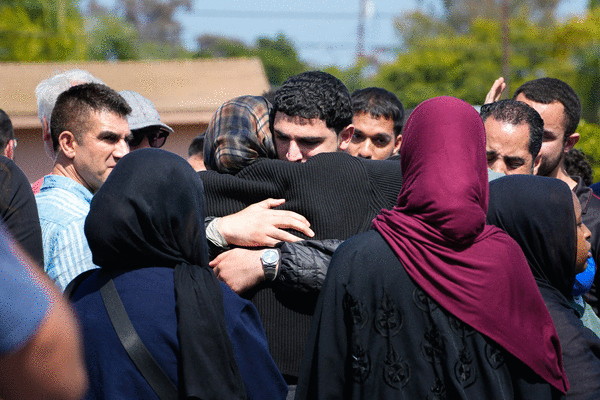
The story is beginning to fade from the headlines. The fear, though, continues.
Monday will mark eight weeks since authorities say two teens, apparently radicalized by hate online, stormed the Islamic Center of San Diego and killed three congregants, including a security guard who engaged them in a gunfight. About 140 people were at the site that morning, including many young children attending school.
The center is doing what it can to move forward, bolstering security and caring for the well-being of the community it serves. But they hope to find money to help.
The need is there. While adults have returned to the Islamic Center in Clairemont for daily prayers and other events, a planned summer camp for children was canceled. “Some of the families still don’t feel their kids will be safe,” Taha Hassane, an imam at the Islamic Center, said Thursday.
“So many families were really directly affected by the shooting here at the Islamic Center, especially the families of the kids — we’re talking about kindergartners and first- and second-grade kids,” Hassane said.
Hassane said he met with state officials as recently as last week as he continues to lobby for money for security enhancements as well as counseling, mental health and wellness services for the community.
Ten days after the shooting, state officials announced $80 million from the California Nonprofit Security Grant Program would go to help bolster security measures at 343 nonprofits throughout the state, including 36 in San Diego, at high risk of violent attacks based on ideology or mission. A spokesperson for the state’s Office of Emergency Services said the program “is a vital funding resource available for nonprofit organizations at a time when hate‑motivated incidents and targeted violence are rising across California and the nation.”
That money came from the fiscal year 2025 budget, and applications for that funding were in the works months before the May 18 shooting. About two-thirds of the recipients announced in May were faith-based groups, including churches, synagogues and mosques. None of the local mosques was selected.
Last month, Islamic Center leadership, backed by a handful of local politicians, sent a letter to the governor and other elected state officials to ask for $20 million to strengthen security for the more than 20 mosques and Islamic facilities countywide — many of which Hassane said have seen an increase in threats since the shooting.
Signing the letter along with Hassane were state Sens. Akilah Weber Pierson and Catherine Blakespear, Assemblymember Chris Ward, county Supervisor Monica Montgomery Steppe, and City Councilmembers Sean Elo Rivera and Kent Lee.
The letter Hassane and others sent last month noted that only about 6% of this year’s grant recipients were readily identifiable as Muslim-serving organizations. About a quarter appear to be Christian groups, and more than a third appear to be Jewish, the letter notes.
The budget for this fiscal year, which started July 1, includes another $80 million in funding for the same security grant for nonprofits. The Union Tribune reached out to the governor’s office and the Office of Emergency Services regarding the center’s request for emergency funding. State officials pointed to the grant funding and said all eligible nonprofits are invited to apply when that process opens later this year.
Tazheen Nizam, executive director of the San Diego Council on American Islamic Relations, said an estimated 125,000 Muslims live in the region, and she is hoping the state will provide immediate help to the local mosques.
“We as people under threat do not have the luxury of waiting for this application process,” she said. “While you are waiting for this long process … you are still a target. You are under threat.”
Nizam said she also wants to see “a real investment in dismantling this hate” and pointed to “significant investments” by authorities to combat hate targeted at other communities. “These models do exist,” she said.
She noted that the suspected shooters were young — one was a high school senior, the other was a year past graduation — and said schools can also play a role in providing a more inclusive environment, even by as simply as noting the start of Ramadan and explaining to students that some of their classmates may be fasting.
“We do need to be mindful and inclusive,” she said.
In the immediate aftermath of the attack, the U.S. Immigration Policy Center at UC San Diego fielded a survey of 312 Muslim adults in San Diego County. Officials behind the survey said knowledge of the shooting was “universal” — every respondent said they were already aware of the attack.
The survey also found that 88% of the respondents felt less safe in the community, and 74% worried more about their personal safety because they are Muslim. Nearly two-thirds said they had, within the last year, experienced discrimination.
A San Diego police spokesperson said Friday that since the shooting, the department has seen increased reporting of suspicious activity — “school-related threats, violence, terrorism, or other types of potential threats,” she said — across the board, not just at the Islamic Center. She said that such incidents often bring heightened public awareness of potential threats.
Exactly one month after the attack, people spotted a man driving back and forth by the Clairemont mosque. San Diego police stopped him and saw a Nazi flag and what police said was a “suspicious canister” inside the vehicle. The canister was later deemed not to be dangerous, San Diego police said, and the driver was taken to a hospital for a mental health evaluation. Still, Hassane said, the incident reignited trauma.
_____
©2026 The San Diego Union-Tribune. Visit sandiegouniontribune.com. Distributed by Tribune Content Agency, LLC.





Comments