Trump restarts Iran blockade as US plans 20% Hormuz charge
Published in News & Features
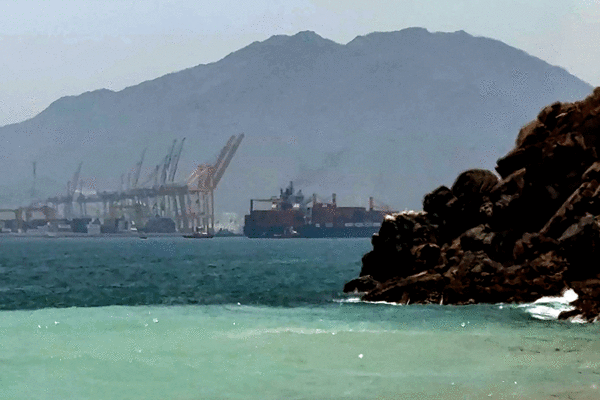
President Donald Trump reinstated the U.S. blockade of Iranian ships transiting the Strait of Hormuz and demanded a 20% reimbursement on all other cargo shipped through the waterway.
Trump’s announcement Monday, in which he asserted the U.S. would become the waterway’s “GUARDIAN,” intensifies an ongoing spat between Washington and Tehran over the status of the crucial shipping passage at the center of the two nations’ revived conflict.
U.S. military forces will resume blockading traffic to and from Iranian ports and coastal areas beginning July 14 at 4 p.m. New York time, Central Command said in a statement. Trump also said the U.S. would keep up attacks on Iran, saying in a radio interview that “we’re going to hit them very hard tonight, and we’re going to hit them hard tomorrow.”
Oil prices extended gains in post settlement trading, with Brent crude rising about 10% and trading near $83.63 a barrel by 4:15 p.m. New York time, while stocks and bonds fell.
The president posted earlier on social media that the strait “will remain OPEN, with or without Iran.” While Iran’s ships would be blocked from entering or leaving, other nations’ vessels could cross. But the U.S. “as a matter of FAIRNESS, will be reimbursed, at the rate of 20% on all cargo shipped,” the president wrote.
The White House did not provide other details on Trump’s fee proposal, including how it would be administered or whether it had been communicated to U.S. allies in the Gulf.
More than 10 people involved in shipping markets, including a handful whose ships have passed through Hormuz in recent weeks, said they were blindsided by the announcement of a potential fee on cargoes crossing the waterway. They said it was too early to know what the plan might look like in practice and how it would shape their decisions about transit.
A reinstatement of the blockade on Iranian ports may prompt the Islamic Republic to step up attacks on ships seeking to transit the Strait of Hormuz, which would continue a pattern of tit-for-tat strikes over the past week. Transits through the strait sank to their lowest level in a month on Sunday, according to ship tracking data compiled by Bloomberg.
Iran sees any challenge to its authority in the strait as a breach of the interim peace agreement it struck with the U.S. The deal provided for toll-free commercial shipping during a 60-day negotiating window and required Tehran to “make arrangements” to ensure the safe passage of vessels. The country has continued to insist that ships must obtain permission and follow approved routes.
Earlier on Monday, Iran’s government said the agreement with the U.S. has “undoubtedly entered a crisis phase” and that it won’t abide by its terms as long as the other party violates commitments. Iranian Foreign Minister Abbas Araghchi mocked Trump’s toll proposal.
“Iran has always been the GUARDIAN of the Strait and will remain so FOREVER,” he posted on X. “20% is of course too much. We will be fair.”
“At least rhetorically, Trump appears to be trying to play the Iranians at their own game,” said Holly Dagres, a senior fellow at the Washington Institute for Near East Policy. “Rest assured, the Iranians won’t be giving up the strait that easily.”
Trump’s latest declaration underscores his precarious position a little over three weeks after he signed the memorandum of understanding. The deal clinched a ceasefire and for a time uncorked the bottleneck in the strait, which brought down oil prices and promised to lower gasoline costs ahead of November’s U.S. midterm elections.
But with armed hostilities resuming and Iran reasserting its claim over the strait, Trump is now looking for a way to reclaim leverage.
Price risk
However, any new fee threatens to raise fuel costs. A 20% charge would work out to about $32 million for a fully-loaded very large crude carrier at current oil prices. That’s far higher than the tolls that have been charged by Iran, which have previously been described as reaching $2 million by people familiar with the situation.
The Strait of Hormuz is a critical conduit for energy and other commodities, having provided passage for about a fifth of the world’s oil flows before the U.S. and Israel began strikes on Iran in late February. Iran’s efforts to close the waterway during the war pushed up energy prices globally and created political blowback for Trump.
Trump celebrated the interim peace pact by touting the potential impact on gasoline prices and the economy, an acknowledgment to just how eager he is to put the conflict behind him.
Other countries and industries reliant on traffic through the narrow waterway have insisted it should be free to access, without tolls or maritime service charges. Several U.S. officials, including Secretary of State Marco Rubio, and Trump, previously said the strait should remain open for all.
Trump, however, telegraphed a change of heart earlier Monday, saying on Fox News that the U.S. should be compensated for helping to keep traffic moving through the strait. Other countries “made all the money” previously, he alleged. Insisting on that could anger Gulf allies that export energy through Hormuz.
“We guarded it for nothing, and now we’re going to guard it, and we’re going to get paid for guarding it — a lot of money.” Trump said. “But we just want to be reimbursed for doing all of this, for putting our people in danger.”
Trump has repeatedly sent conflicting signals about his plans for the strait and has in the past suggested the U.S. should receive some financial benefit from it. Earlier in the conflict, Trump floated the idea that Iran and the U.S. would both receive compensation from shippers using the strait.
Plan roadblocks
Trump’s plan would amount to a herculean task that could invite blowback from U.S. industries and allies, while potentially defying international law if not applied narrowly to escorted ships.
Under international law, ships generally are guaranteed a right of transit passage through waterbodies used for international navigation, and coastal states aren’t allowed to charge vessels for the opportunity. There can, however, be charges for some “specific services” rendered to individual ships.
A spokesperson for The International Maritime Organization, the United Nations’ shipping watchdog, reiterated that the body “stands firmly against charging fees for passage through straits used for international navigation.”
In recent weeks, U.S. forces have mounted an operation to escort oil tankers and commercial ships through the strait, with air power and naval forces helping to encourage traffic on a southern route, further from Iran’s shores, even as Tehran asserted control over the waterway.
Yet analysts have said that an even more intensive military operation involving ground troops would be necessary for the U.S. to maintain control of the strait, an action Trump has thus far been unwilling to take.
Other Trump administration moves to insulate shipping in the strait amid the war have yet to fully materialize. In March, Trump ordered the U.S. International Development Finance Corporation to provide political risk insurance and guarantees for maritime trade through the region.
While the DFC later announced a $40 billion reinsurance facility with the support of private partners, it’s unclear whether it has provided any coverage yet.
_____
With assistance from Devika Krishna Kumar, Sonya Dymova, Alex Longley, Prejula Prem and Hadriana Lowenkron.
_____
©2026 Bloomberg L.P. Visit bloomberg.com. Distributed by Tribune Content Agency, LLC.





Comments