Judge to bring US Attorney Boutros to court over Tren de Aragua case
Published in News & Features
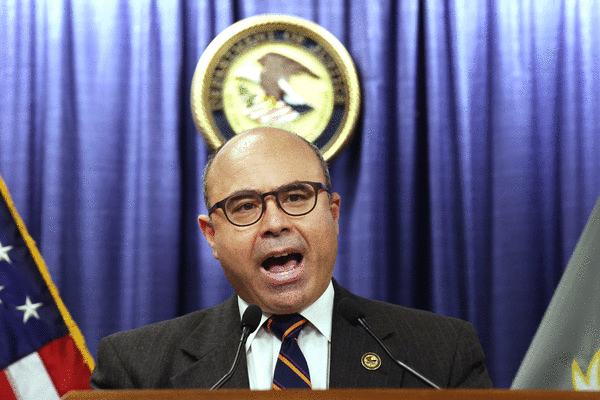
CHICAGO — A federal magistrate judge on Wednesday refused to cancel a hearing where U.S. Attorney Andrew Boutros potentially would have to explain why he publicly discussed murder and kidnapping charges against three reputed members of the Tren de Aragua gang even though the court’s order sealing the case was in effect and one of the defendants was still at large.
Last week, U.S. Magistrate Judge Laura McNally ordered Boutros to attend a hearing at 10 a.m. Thursday to get to the bottom of “potential violations” of her sealing order.
In a 14-page filing Wednesday, Boutros asked that the hearing be canceled, arguing he “believed in good faith” that the case would be unsealed by the time he spoke about it at a July 1 news conference in Washington, D.C., where Acting AG Todd Blanche and FBI Director Kash Patel were discussing ongoing national efforts against the notorious Venezuelan gang.
Boutros cited “carveout language” in McNally’s sealing order saying it did not prevent “law enforcement personnel from disclosing the Complaint, Affidavit, and Arrest Warrants as necessary to facilitate the enforcement of criminal law.”
“In the instant matter, the U.S. Attorney reasonably believed that disclosure of the arrests and charges of TdA members helped facilitate the government’s enforcement of criminal law both in and outside of this district,” the motion stated.
Boutros also said McNally’s inquiry could invoke “separation of powers, deliberative process, pre-decisional, and interagency privilege concerns” if it went forward.
Less than an hour after Boutros requested the hearing be canceled, however, McNally posted a terse minute order saying “The motion is denied.”
To accommodate what is expected to be a larger than normal crowd, McNally has also moved the hearing to a ceremonial courtroom on the 25th Floor.
The dust-up is the latest in a series where federal judges at the Dirksen U.S. Courthouse have called the credibility of the U.S. attorney’s office into question, beginning with the collapse of the Broadview Six case in late May.
The issue with McNally began on June 29, when she signed a criminal complaint and arrest warrants charging Josue Pacheco Torres, Kleiver Monasterio Briceno, and Julian Pachano with kidnapping resulting in death and kidnapping conspiracy.
According to the complaint, the defendants, all “high-ranking members” of Tren de Aragua, kidnapped a man as he walked near a South Side park on May 18, tied him up and brought him to a vacant Englewood apartment, where they shot him multiple times and left his body in a bathtub.
At the time, prosecutors asked McNally — and she agreed — to seal the complaint until further notice, as two of the defendants were not in custody. Prosecutors also cited boilerplate concerns about the destruction of evidence should the investigation go public too soon.
The next day, as one defendant remained at large, Boutros flew out to a last-minute news conference with Blanche and Patel. Before it began, he asked an assistant U.S. attorney on the case to redact the third defendant from the complaint and ask that it be unsealed immediately, according to his motion. That prosecutor went up to McNally’s chambers to hand deliver the complaint with proposed redactions, but no formal motion was filed.
When Boutros entered the press event, he “believed in good faith that the case was being unsealed or had been unsealed in light of the government’s communications with and physical presence in chambers, which the government had described as time sensitive, as well as his past experience with the unsealing of criminal complaints at the government’s request,” he stated in the motion.
McNally, though, said in a docket order that she was busy with other matters at the time, and that the seal remained in place. At about 1:25 p.m. that day, prosecutors emailed a written motion to unseal, but it was never filed on the docket and was not taken up until July 2, when the first of the three defendants appeared in court.
In his motion, Boutros said he “recognizes the last-minute nature of the unsealing request and certainly appreciates that the court had other matters on its schedule that day.”
_____
©2026 Chicago Tribune. Visit chicagotribune.com. Distributed by Tribune Content Agency, LLC.




Comments