US military launches strikes on Iran for second straight day
Published in News & Features
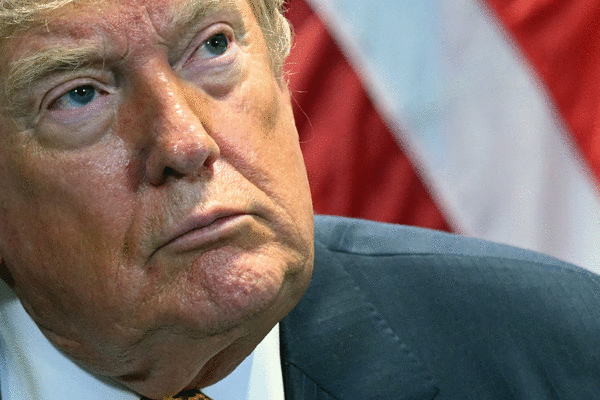
WASHINGTON — The U.S. military said it has struck Iran for the second straight day, an escalation of violence that threatens to strain an already fragile ceasefire.
“At the direction of the commander in chief, U.S. Central Command forces have started conducting additional strikes against Iran to further degrade their ability to threaten freedom of navigation in the Strait of Hormuz,” Centcom said in a social media post, citing attacks on vessels in the waterway. “The United States is holding Iran accountable for recent unjustified aggression against commercial shipping and civilian crews freely navigating a vital international waterway.”
The attacks came just hours after President Donald Trump at the NATO summit in Turkey said the U.S. would probably target Iran again. The U.S. launched attacks on Tuesday and revoked a waiver that allowed Tehran to sell oil globally, a response to attacks on ships in the Strait of Hormuz that the administration blamed on the Islamic Republic.
Trump on the flight back to Washington, told reporters that “they hit, we hit back much harder.”
Asked if a full-scale military campaign would resume, Trump said, “I don’t know,” but it would be won “very quickly.”
He added that while the Iranians wanted to reach an agreement, “I just don’t know if they’re worthy of making a deal. I don’t know that they’re going to honor the deal.”
When asked why Iran would attack commercial vessels if its leaders desired an accord, the president replied, “they’re a little bit out of control, but they want to make a deal badly.”
An Iranian adviser to the country’s supreme leader said in a post on X earlier Wednesday that Tehran would deliver an “immediate response” to the U.S. after Trump’s threat. Iran’s Islamic Revolutionary Guard Corps said it had hit military bases in Kuwait and Bahrain after the Tuesday attacks.
Both sides have accused each other of violating a memorandum of understanding that established a short-term truce and set in motion a 60-day period for talks on a broader peace deal.
Trump also has threatened to resume a blockade of Iranian ports and said the U.S. could escalate its military campaign by bombing infrastructure targets like desalination and power plants. The president earlier Wednesday said he thought the ceasefire between the U.S. and Iran was “over,” in comments that spooked financial and energy markets. Oil jumped after Trump’s remarks about the truce, which sent stocks and bonds lower.
Trump also said he would not stop negotiators from continuing to engage and, when asked if he thought the war would resume, said “I don’t think it’s going to start again.”
The latest outburst of violence, though, casts further uncertainty over the prospect for continued negotiations. Talks between the U.S. and Iran are currently suspended as Iran conducts a weeklong mass funeral for the late Supreme Leader Ali Khamenei, who was assassinated on the first day of the conflict in late February.
Issues to be resolved in discussions include management of the strait and the release of billions of dollars of frozen funds to the Islamic Republic, with talks around Iran’s nuclear program to follow. Little headway has been made on any of those topics.
_____
(With assistance from John Harney.)
_____
©2026 Bloomberg L.P. Visit bloomberg.com. Distributed by Tribune Content Agency, LLC.





Comments