Chicago Mayor Brandon Johnson says aldermen's provisions in budget $130 million short
Published in News & Features
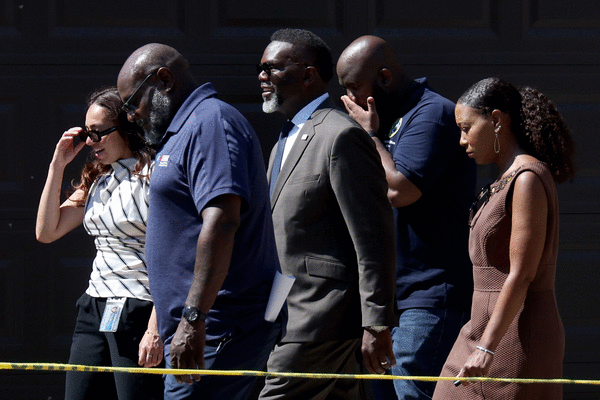
CHICAGO — Mayor Brandon Johnson took an early jab at budget opponents Tuesday, revealing a set of revenues backed by what he dubbed the “corporate caucus” in this year’s budget have so far come up $130 million short.
The mayor’s midyear budget report showed the city was about 1.5% — or $32 million — under budget on revenues through the end of May in the main fund that pays for day-to-day operations. That’s a small fraction of the city’s overall $16.6 billion budget. But he focused on shortcomings in proposals from the opposition bloc in the City Council. In a statement Tuesday, they pointed the finger back at Johnson’s administration for dragging its feet to implement its proposals.
Still to come is a broader announcement of the city’s expected 2027 deficit. The mayor’s budget task force pegged the city’s structural shortfall at about $680 million.
Speaking at a City Hall news conference, Johnson said the expected gap stems mostly from a controversial $89 million debt sale measure — along with plans to tax ads on bridges, light poles and augmented reality games on city-owned property — all netting nothing so far this year. He was quick to paint the news as more proof he’s been vindicated in last fall’s historic budget fight, when a majority of aldermen passed a spending plan over the mayor’s objections.
“I want to say this clearly: There were other options,” Johnson said. “We did not need to cede to big money interests and fall back on the tired practice of balancing budgets on the backs of working people.”
What’s less clear is how his administration will seek to fill that hole as the clock ticks toward the 2027 budget cycle — and an election that will see the mayor’s office and all 50 aldermanic seats on the ballot. The freshman mayor said he’s “working hard to avoid layoffs and cutting services” but made clear he will use his bully pulpit to blame aldermen should it come to that.
In a statement released after Johnson’s news conference by the office of Far Northwest Side Ald. Samantha Nugent, the council opposition accused the mayor’s budget and finance team of sabotaging this year’s budget.
“Instead of executing the financially sound budget that City Council passed last year, Mayor Johnson and his administration have spent six months slow-walking the implementation of new revenues and efficiencies designed to close our budget deficit and prevent this administration from creating excuses to raise taxes on businesses, jobs, and working families and skip the remainder of our advance pension payment,” the coalition wrote. “Chicagoans deserve transparency and the truth from the mayor instead of attempts to shift blame away from the failures of his administration.”
The final $16.6 billion spending plan entailed selling $1 billion in long-outstanding money owed to the city for pennies on the dollar, which Johnson derided as an immoral solution after aldermen rejected his corporate head tax proposal. Though he ultimately did not veto the final budget either, he insisted on Tuesday that his finance team has tried to facilitate the sale of city-owned vehicular debt, but no buyers have stepped up.
The plan to raise $6 million from augmented reality and $29 million from advertising on bridges and light poles has also made no money thus far, Johnson said. All three ideas were introduced by his council foes, who triumphed over him but have since complained his administration is hamstringing efforts to implement their plan.
Though Johnson denies that, in the end the projected $32 million gap is a drop in the bucket compared with the upcoming deficit that will surely entail tough fiscal choices. Besides layoffs, those options have in the past included raising property taxes or shorting the advance pension payment — all political lightning rods in recent fights with the council.
Johnson dodged a question on whether he would again skip the automatic inflation-adjusted hike for property taxes this time, instead pivoting to hints of another head tax or similar levy on businesses or the wealthy: “Corporations that continue to benefit from Trump’s cuts to all the other services that we rely upon, asking them to put more skin in the game, that’s a reasonable expectation.”
No Chicago mayor in modern history has ever muscled through a property tax hike in their final budget before reelection. Johnson has not yet declared his campaign for the 2027 mayor’s race, but he has dropped hints in recent weeks that he is preparing to defend his seat from an increasingly crowded field of rivals.
And based on his continued sharp rhetoric against the moderates who sank his last budget — some of whom he will have to woo over in order to get to 26 out of 50 votes — the upcoming budget battle is shaping up to be a lot like the last.
“The progressive movement is alive and well,” Johnson said. “We just have a few obstinate individuals that are more aligned with the interests of corporations, that are ultimately stalling what could be a full-out revolution in this city. And the people of Chicago want it.”
Lastly, the mayor noted this year’s higher-than-expected revenues came from taxes he introduced in his original budget proposal.
Those measures include hiking fees on personal property leases like cloud-based software, fresh charges on ride-share trips and new taxes on online sports betting and social media ads. According to the midyear budget report that runs through May 31, those taxes are all performing above budget or outpacing projections.
On the spending side, “no department has exceeded its overtime appropriation,” while other efficiencies related to city vehicles, contracting and real estate “are tracking at or ahead of budget across most workstreams,” the report says.
Online sports betting revenues are so far 68.7% above projections, according to the report, already bringing in $14.8 million out of a $26.2 million expected by the end of the year. The social media tax is outpacing its annual budgeted total of $31 million by 25%, the report says. The lease tax, charged on services like car rentals and cloud computing software, is performing 11% better than expected, so far bringing in $402 million, while ground transportation taxes are also slightly ahead, pulling in about $3 million more than expected by the end of May.
Smaller new or adjusted revenue streams — on liquor and checkout bags — are underperforming by about 37% and 10%, respectively.
The legalization of video gambling terminals has also been a major sticking point between Johnson and the aldermanic opposition, with the 2026 package relying on revenue from the new machines to plug in $6.8 million. That battle is also pending, as Bally’s casino is now threatening legal action over the proliferation of those kiosks.
____
©2026 Chicago Tribune. Visit at chicagotribune.com. Distributed by Tribune Content Agency, LLC.





Comments