Americans drive into July 4 holiday with gas prices still stinging
Published in News & Features
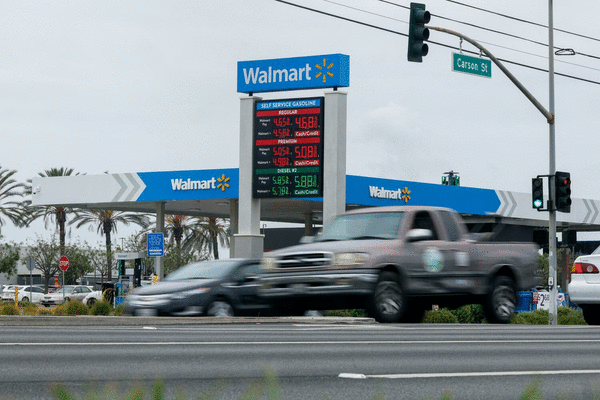
Americans hit the peak of the summer driving season this July 4 holiday weekend wincing at the cost of gasoline, still running nearly a dollar a gallon higher than before the war with Iran despite falling sharply in recent weeks.
At a Shell station in Southern California with a giant U.S. flag flying overhead, Luis Velasquez added just a single gallon of gas to his white Toyota Camry, enough to ensure he could cover the 23-mile commute home from the Santa Monica hospital where he works as a senior custodian.
Before the war, the 58-year-old Velasquez said he spent about $45 each week on fuel, but that rose to $65 after the war started. He was buying the bare minimum on Tuesday “because it’s a lot cheaper at home.” Prices have come down, he acknowledged, but “it’s still expensive, everything is expensive.”
In fact, U.S. drivers are on pace for the third-most expensive Fourth of July on record at the pumps – only behind 2022 and 2008, according to the American Automobile Association. Rather than staying home, many of them are offsetting higher travel costs by taking shorter vacations, choosing closer destinations or cutting back on extras like eating out or buying souvenirs, AAA said.
A record-setting 61.4 million people are expected to hit the road during the Independence Day holiday period, AAA forecasts. It’s the second-biggest driving period of the year after Thanksgiving.
There’s little doubt that the pain at the pumps could have been worse. The average national gasoline price eased in June from a high of over $4.56 a gallon, with the price of crude oil retreating toward prewar levels as flows recovered out of the Persian Gulf following talks between Iran and the U.S. Still, at about $3.84 a gallon, prices are far off their prewar levels of less than $3 a gallon.
With just four months to go before the midterm elections, that could be a problem for Trump and Republican leaders in Washington hoping to keep control of Congress in November. Two-thirds of Americans say high gasoline prices are causing financial hardship for their households, according to a Gallup poll taken June 1-15. Nearly half of Americans say they have changed their summer travel plans as a result.
“Nothing really moves the needle as much as gas prices,” said Jordan Cole, 31, who was filling up at a QuikTrip south of Atlanta. At the same station, truck technician Marcus Lampkin put $26 into his fuel-efficient Kia — an amount he said gets him about three-quarters of a tank now after being enough to fill up before the war. He blamed Trump for initiating a conflict that pushed prices higher, saying, “We have no business being over there.”
Consumers are hyperaware of gas price movements and they are an important driver of voter sentiment, said Laurel Harbridge-Yong, a political science professor at Northwestern University who studies the impact of fuel costs on presidential approval.
“When you think about your grocery bill, it’s maybe slowly inching up, but you don’t have the same visceral reaction that you do of, ‘Wow, a month ago I could fill up my tank for $40 and now it’s $60,’” Harbridge-Yong said.
Still, U.S. consumer confidence edged up in June as gasoline prices fell, helping assuage some of the anxiety Americans have expressed about the economy in recent months. Trump repeatedly vowed that gas prices would “drop like a rock” once the Middle East conflict ended, and he has started to accuse stations of not lowering their prices fast enough to meet his expectations.
“Gasoline Retailers must get their Prices down, IMMEDIATELY!,” Trump said in a June 29 social media post. “If Retailers don’t do this, big problems lie ahead! Start targeting around the $2.50 a Gallon number.”
Brent Rosenthal, a 71-year-old retired attorney who was filling his Lexus hybrid along Interstate 71 north of Columbus, Ohio, said he doesn’t expect that to happen anytime soon.
“I don’t think they’ll go down to what they were prewar,” said Rosenthal, who said he used to be a conservative but now leans more progressive. “I just don’t believe a word that Trump says.”
Energy analysts agree that higher prices will linger. Retail gasoline prices typically take longer to fall than crude oil, with some branded retailers still locked into supply contracts at high prices and others recovering lost profits from when costs surged. The gasoline supply picture in the U.S. is also unusually tight, with considerably less automotive fuel on hand entering July after refiners focused more on jet fuel and diesel. That said, gasoline supplies could rebalance faster than expected as refining capacity comes back online and imports pick up.
For now, though, relatively high demand, combined with a tight supply picture, is helping keep prices higher, according to Susan Bell, senior vice president of downstream research at Rystad Energy.
That means other supply shocks, like refinery disruptions, will have a comparatively outsized impact on prices, according to Thomas Weinandy, principal research economist for Upside, an app that provides cash back on gas purchases.
“Drivers may see lower prices going into the holiday, but the market remains especially vulnerable to sudden spikes,” Weinandy said.
While many drivers are frustrated at the cost of filling up, it doesn’t mean they all disapprove of the war that sent prices soaring.
Brian Smith of Fairborn, Ohio, said it had been costing him more than $105 to top up the tank of his Ram 1500 pickup truck just a few weeks ago. It’s since fallen to about $84. Smith said he welcomes the lower prices and thinks the war in the Middle East was worth the higher fuel costs if it prevents Iran from getting and using a nuclear weapon.
“I can’t imagine that the whole world isn’t thankful for it because we just couldn’t let it happen,” the 67-year-old Smith, who works in machinery sales, said. “Unfortunately, we’ve got bad players in this world, and I’ve agreed with Trump from the standpoint that the best defense is having a good offense.”
Not everyone is worried about fuel costs.
Across the street from the Santa Monica Shell station, Ed Kershaw, a 26-year-old marketing manager at a gold investing company, plugged his Tesla into a bank of superchargers. Kershaw said he doesn’t pay much attention to gas prices, or even electricity rates, because he has free charging for life grandfathered into his 2014 model.
But he still frets about the cost of living.
“I’m thinking about paying for groceries, I’m thinking about paying my utilities and my rent, but gas prices are luckily not something I have to worry about,” Kershaw said.
In the car-dependent U.S., though, scaling back on driving often isn’t an option, or at least isn’t an easy choice to make.
Liz Smith filled up on Monday on the way back to Colorado from a road trip to Maine. The 44-year-old mother of four said she's noticed that gas prices have come down since she started the trip a month ago. But it costs more than $100 to fill up her Chevrolet Suburban, and she considered not even making the trip when gas prices were over $4 a gallon.
“We thought about not going because it was so expensive,” Smith said at a BP station in Sunbury, Ohio. “But it’s more expensive to fly, and I think it’s just like, you only live once, take the trip.”
©2026 Bloomberg L.P. Visit bloomberg.com. Distributed by Tribune Content Agency, LLC.






Comments