Facing setbacks and resistance, Trump presses bid to reshape elections on multiple fronts
Published in News & Features
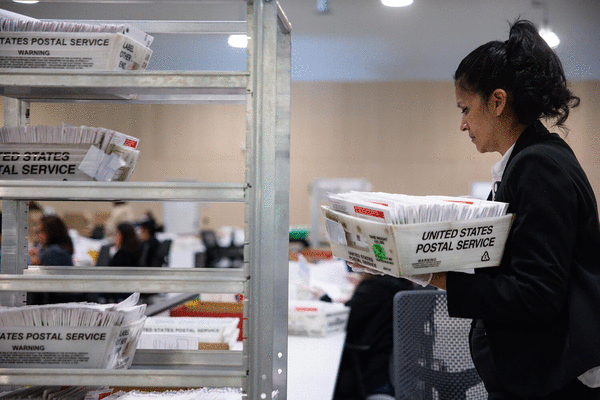
WASHINGTON — President Donald Trump has spent months waging an unusually aggressive campaign to reshape how states run elections, leveraging federal agencies in ways no previous president has attempted.
He has pushed the Department of Homeland Security to compile a list of citizens in each state to help determine voter eligibility. He is seeking to give the Postal Service a role in deciding who can receive mail ballots. He has threatened to withhold federal funding from states unless they phase out electronic voting machines. And he is pressuring Republican lawmakers to overhaul voting laws, claiming without evidence that elections are being rigged.
The efforts have run into resistance in court and within his own party. They have also left postal workers and local election officials bracing for an election cycle marked by deepening doubts about election integrity, and uncertainty about how the federal government may challenge the post-election results.
"It's an unprecedented power grab to reshape how our elections work so that he and his allies can maintain and expand power," said Eric Kashdan, director of federal advocacy at the Campaign Legal Center, a nonpartisan government ethics organization.
The White House defends the effort as fulfilling a campaign promise, and argues the administration is "lawfully enacting the agenda President Trump was elected to enact."
One of Trump's defining efforts to assert some federal control over state elections has been his insistence on passing the SAVE America Act, which would require voters to provide proof of citizenship when they register, require Americans to show identification when casting a ballot and require states to send voter data to the Department of Homeland Security.
His relentless push for the measure has prompted him to derail a bipartisan housing bill and threaten to forgo signing any piece of legislation unless the voting measure is approved. He says he considers the matter a "national emergency." Despite the pressure campaign, Senate Republican leaders maintain there is not enough support to pass the measure.
The political stakes ahead of the midterms have been laid out more bluntly by House Speaker Mike Johnson (R-La.), whose chamber has approved the SAVE America Act. Last month, Johnson warned conservatives gathered at the Faith & Freedom Coalition that if Democrats win back control of the House, they will "go after the president's family, the Cabinet, his donors, friends," and supporters.
"I run the protection program," Johnson said. "I will take care of you."
Setbacks in court
The administration's ambitions have hit numerous snags in court in the last month, with judges reaffirming in many cases that the Constitution gives states — not the federal government — primary authority over elections.
In one case, U.S. District Judge Sparkle L. Sooknanan, who was appointed by President Biden, went further.
She said a federal immigration database the Department of Homeland Security was compiling to determine voter eligibility violated privacy laws. She added that the database has resulted in states actively removing U.S. citizens from voter rolls based on inaccurate information.
"All in all, the federal government has knowingly trampled on the privacy rights of American citizens in a manner that threatens the sacred right to vote," Sooknanan wrote. "This Court cannot stand idly by while that happens."
James Percival, the general counsel for Homeland Security, said the ruling was the latest example of "how hard the Left will fight to stop us from solving problems they insist do not exist."
The Supreme Court's conservative majority this week also dealt a blow to the GOP and upheld state laws that allow for counting mail ballots that are postmarked by election day but arrive late.
The decision left Trump fuming. He said it was a "a little bit surprising" to see the court's decision, claiming without evidence that the result will inevitably give "people more time to vote illegally."
Democrats, in turn, saw the ruling as a necessary check on the Trump administration's efforts.
"While we continue to see unprecedented efforts to interfere with elections from the Trump administration, it is a relief to see federal courts make clear that these attacks on mail and absentee voting are clearly illegal and unconstitutional," Sen. Alex Padilla (D-Los Angeles) said in a statement after the ruling.
Trump is still eyeing changes to voting by mail. In March, he issued an executive order that seeks to limit who can receive mail ballots. Under the proposed rule, the Postal Service would not deliver mail ballots to states that don't turn over sensitive voter data to the federal government, Postmaster General David Steiner told a Senate panel last month.
The admission drew immediate condemnation from Democratic lawmakers. They argued the regulation is an illegal attempt to coerce states into handing over their voter rolls.
"Please push back on being a pawn in this authoritarian playbook," Sen. Elissa Slotkin (D-Mich.) told Steiner. "The Postal Service is one of the most important institutions in our country. Don't taint it with the obsession of this one man."
A day after that back-and-forth, U.S. District Court Judge Indira Talwani, who was nominated by President Obama, blocked those plans — at least for now.
"The Constitution does not grant the President any specific powers over elections," the judge wrote, while adding that the Postal Service does not have the legal authority to determine who can vote by mail and how.
The White House said Wednesday that the administration remains confident the executive order will be in place by the November election.
Taken together, the administration's efforts are unprecedented, UCLA law professor Rick Hasen said. That's because the Constitution puts control over elections in the hands of the states and grants Congress the ability to pass laws, he said.
"The president really only has authority through federal statutes that have already been passed," Hasen said. "It's not surprising that many courts have struck down or stopped him from doing things to try to interfere with how elections are being run."
Postal workers waiting for clarity
The legal setback for the Postal Service proposed rule was welcome news to the union representing postal workers.
"We believe that what we're being asked to do is in violation of the oath that we took," said Jonathan Smith, the president of the American Postal Workers Union, which represents more than 200,000 postal workers.
Following the ruling, the union called on the agency to abandon the rule, arguing it "will crush mailers' trust in the Postal Service" and undermine "one of the most important functions the Postal Service and postal workers perform in service of the United States and its remarkable democracy."
In several states, the union has run ads promoting mail voting as safe and a needed option for Americans. The ads were planned before Trump signed his executive order in March seeking to limit who can receive mail ballots, Smith said.
Now, the ads are taking a different meaning. Smith argued that "sometimes God works in mysterious ways."
"The ad was then and is now intended as a piece to educate America about how good vote by mail is, how much it has been working out," Smith said. "It's an educational piece, not a response to the White House."
Ahead of the election, Smith said postal workers are waiting for clarity on how their duties may change. But right now, he says, there isn't much.
Orange County Registrar Bob Page said his office is monitoring any changes to existing federal and state election laws to ensure any changes, if needed, are implemented without disruptions. But he acknowledged the timing crunch could create some hurdles the closer the election gets.
"In many ways, any change to how California voters cast their ballots made between now and election day would create a challenge and may even be disruptive," Page said.
He said many counties have ordered outgoing and return ballot envelopes for the election to ensure envelopes for more than 23 million California voters are ready to use by the Oct. 5 mailing deadline. Any change to how ballots should be prepared or mailed could present an issue.
"Our office has received calls from voters asking about potential changes to vote-by-mail procedures usually tied to media coverage about proposed changes," he said. "We inform these voters that our procedures have not changed because the law has not changed and that we will mail their 2026 General Election ballots by Oct. 5."
L.A. County prepares for possible voting changes
In Los Angeles County, election officials are also in a battle to bring clarity to the process as the administration ushers in a series of proposed changes to the election.
Dean Logan, the head of the Los Angeles County registrar-recorder/county clerk's office, said his office is fighting to contain a wave of election misinformation, including some that is amplified by the White House.
"It's not something that we've seen happen before, and certainly not at the level we've seen," Logan said.
Rather than respond to every claim, Logan says his office picks its battles, intervening only when a falsehood appears likely to reach a wide audience. Even then, the office tries to avoid engagement with whoever is spreading it.
If the administration imposes a new rule closer to the election, Logan said his office is ready to follow the law.
"It's really been about finding this balance of staying alert and prepared for the possibility [of change] but also not getting sucked into the political distraction," he said.
Last month, Trump claimed without evidence that Democrats have cheated to win California's primary elections, and boasted about federal prosecutors in Los Angeles investigating the matter.
Trump has also continued to claim Democrats are trying to rig or cheat in the upcoming election, remarks that have faced rebukes from members of his own party.
"I think it is ironic that we control the House, Senate, Supreme Court and the White House and we are yelling election fraud. I mean, we won all the damn elections," Rep. Thomas Massie, R-Ky., told reporters last month.
At the national level, Senate Democrats have said they plan to send election observers to polling places on behalf of Congress in reaction to Trump's efforts.
"We are not waiting for chaos to arrive," Senate Minority Leader Chuck Schumer, D-N.Y., said last month. "We are preparing now."
—Times staff writer Justine McDaniel contributed to this report from Washington.
©2026 Los Angeles Times. Visit at latimes.com. Distributed by Tribune Content Agency, LLC.




Comments