Harrowing 911 call details Orlando woman's fatal alligator attack
Published in News & Features
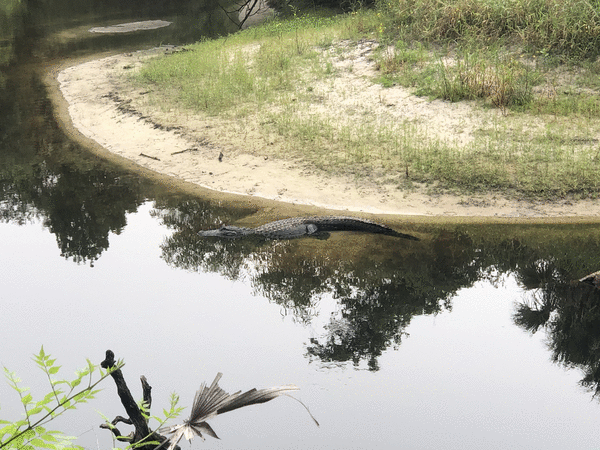
ORLANDO, Fla. — Brittany Clark was a “beautiful, unforgettable soul” who fought to survive after an alligator attacked her while she cooled off from a hike in the Econlockhatchee River on Sunday, according a friend with her that afternoon.
Clark, 31, of Orlando died later that day from injuries suffered in the attack, witnessed by her boyfriend and her friend Jayden Hernandez. Hernandez shared memories of her friend and details of the attack in a public Facebook post on Wednesday.
The three were hiking the Little Big Econ State Forest in Seminole County when the they decided to step off the main trail and swim in the river at a spot that was a favorite of Clark’s.
After they entered the shallow, murky water around 1:30 p.m., they saw bubbles — and even joked that it might be an alligator — but they felt safe, Hernandez wrote. Minutes later, an alligator attacked, biting off one of Clark’s arms and leaving the other barely attached, she told 911 operators.
The moments just after the attack were captured in a harrowing nearly 12-minute-long 911 call as the boyfriend and then Hernandez frantically pleaded for help from dispatchers trying to direct rescuers to their location.
“Please hurry, that’s my best friend…please, please, please,” Hernandez can be heard saying on the call as someone, presumably Clark, can be heard speaking, screaming and groaning in the background. “She needs help now,” Hernandez said, describing her friend’s injuries as “horrible.”
Clark’s boyfriend attended to her, telling her she was okay and that he had a towel to help try and stop the blooding.
At one point, they feared the alligator was returning, someone screamed in panic and then the two others carried Clark up the riverbank, according to the 911 call.
“They need to hurry,” Hernandez told the operator several minutes later. “She’s going to die.”
Clark would die from her injuries on the way to the hospital, according to officials from the Florida Fish and Wildlife Conservation Commission. Agents recovered and killed a 13-foot-alligator from the scene and a 12-foot-long alligator nearby. They will use DNA analysis to determine which one fatally bit Clark.
While still on the phone with 911 operators, Hernandez later left Clark and the boyfriend to try and flag down first responders. She could hear them blowing whistles but could not initially see them. She hurriedly searched around the wooded area for several minutes before she reached them.
“I hear a siren! Come on! This way, this way, this way!” she told operators. “They’re here, they’re here, they’re here!”
Hernandez wrote on Facebook that she will never be able to forget the details of the attack. She called Clark “pure gold,” a friend who would always listen to her and taught her how to live. She commended her for her strength after the attack.
“Anybody else would not have even made it out,” she wrote. “She was so strong and I always looked up to her and will forever. I just want my best friend.”
Clark’s aunt has set up a GoFundMe page to help return her remains to her parents in California, which has already raised more than it’s $5,000 goal. The aunt described Clark as an “amazing person and a fun-loving soul” and said the family was grateful for any help.
“Even if you cannot donate, please pray for our family as we navigate through this tragic journey,” she wrote.
Frank Mazzotti, a professor at the University of Florida who studies human-alligator conflict, said fatal alligator attacks in Florida are relatively rare.
But it is currently the end of alligator mating season, he said, which along with higher temperatures makes alligators more active and defensive, increasing the chances they may interact with humans who enter their territory.
Mazzotti cautioned people to remain vigilant and be aware of their surroundings when they frequent places where alligators might reside.
“They’re just not in natural areas. They’re in canals. They’re in ponds. They’re in stormwater ponds in people’s neighborhoods,” he said, “and so really can be in any body of water. … If you see an alligator, get out of the water.”
FWC officials also noted that water levels where the attack occurred were lower than usual due to a statewide drought.
In 2025, FWC recorded 13 unprovoked alligator attacks statewide, with two being fatal. One of the deaths was of a woman attacked while canoeing in Lake Kissimmee when she passed over a gator in the water.
----------
©2026 Orlando Sentinel. Visit at orlandosentinel.com. Distributed by Tribune Content Agency, LLC.






Comments