With no fanfare, Stoneman Douglas Public Safety Commission ends its mandated run
Published in News & Features
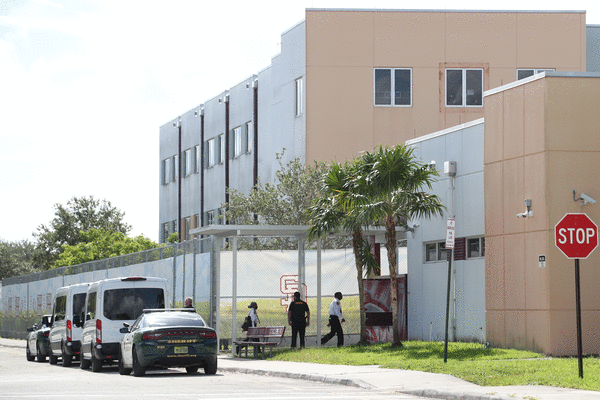
The mass shooting at Marjory Stoneman Douglas High School in Parkland, Florida, on Feb. 14, 2018, was more than a crime. It was a call to action, to a bipartisan determination to protect those among the most vulnerable — our schoolchildren — and to do it in a way that makes meaningful change and holds power accountable for its failures.
The state of Florida rose to the occasion by forming the Marjory Stoneman Douglas Public Safety Commission, a statewide group of parents, educators and law enforcement experts whose mission was to determine what went wrong and to set it right.
The commission’s mandate expired Tuesday.
“Every recommendation and the laws that came from them was written to prevent someone else from having to endure what our families experienced,” said Tony Montalto, president of Stand With Parkland, one of several civic groups with missions that grew out of the rubble of the tragedy.
Montalto’s daughter, Gina, was among the first victims of the gunman’s rampage through the Parkland high school’s 1200 building, which has since been demolished.
In all, gunman Nikolas Cruz shot 34 people, 17 of them fatally. The 17 were students Montalto, 14; Alyssa Alhadeff, 14; Martin Duque Anguiano, 14; Nicholas Dworet, 17; Jaime Guttenberg, 14; Luke Hoyer, 15; Cara Loughran, 14; Joaquin Oliver, 17; Alaina Petty, 14; Meadow Pollack, 18; Helena Ramsay, 17; Alex Schachter, 14; Carmen Schentrup, 16; and Peter Wang, 15, and staff members Scott Beigel, 35; Aaron Feis, 37; and Chris Hixon, 49.
The shooting was credited with persuading the state to pass a number of gun restrictions, including placing an age limit of 21 on the purchase of firearms, a law that was recently ruled unconstitutional by Florida’s Fourth Circuit Court of Appeal because it discriminates against law-abiding adults age 18 to 20.
The state also passed “red flag” laws empowering the state to confiscate guns belonging to people determined to be at risk of violence because of mental health or other issues.
State law also now requires every school to have at least one armed police officer or guardian on campus. And Alyssa’s Law, named in Alhadeff’s honor, requires schools to be equipped with a silent panic alarm to alert law enforcement of an emergency situation.
The gunman pleaded guilty to 17 counts of murder and 17 counts of attempted murder and was sentenced to life in prison.
“Ending the Commission does not mean its mission has been completed,” Tony Montalto said. “Students, parents, and educators need to be involved and still deserve experts asking tough questions, identifying vulnerabilities, and holding systems accountable. Complacency is the greatest risk we face.”
_____
©2026 South Florida Sun-Sentinel. Visit sun-sentinel.com. Distributed by Tribune Content Agency, LLC.






Comments