Chicago Police Superintendent Larry Snelling to retire after nearly 3 years leading department
Published in News & Features
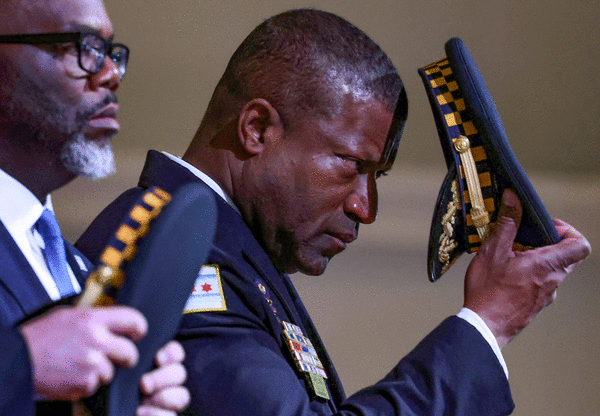
CHICAGO — After nearly three years at the helm of the country’s second-largest police department, Chicago Police Superintendent Larry Snelling will retire on July 15.
“During the past three years, I have had the privilege to lead this department through the 2024 Democratic National Convention and a record-low reduction in shootings, homicides and violent crime,” Snelling said in a statement released Wednesday afternoon. “While this happened during my tenure as Superintendent, the hard and courageous work of the members of the Chicago Police Department should be given the credit. Though I am proud of what we have achieved, there is more to be done, and I am confident that we created a foundation for further progress.”
Snelling, 57, ascended to the top of the Chicago Police Department in August 2023 after nearly three decades with the department, mostly as an instructor in the police academy. His tenure as superintendent was marked by a continuing decline in overall city gun violence, an increase in compliance with a federal consent decree, a global spotlight brought by the 2024 Democratic National Convention and the chaos that the department was foisted into during a federal immigration crackdown last year.
Snelling was born February 1969 and raised in the Englewood neighborhood on the South Side. He joined CPD in 1992, initially working as a patrol officer in several South Side districts before becoming a sergeant at the department’s police academy.
In 2020, he was promoted to lead the Englewood (7th) District as commander. That summer, amid nationwide protests and looting in the wake of George Floyd’s killing, a police shooting in Englewood left the community on edge. Youthful protesters converged outside the Englewood District station to decry the shooting as Snelling and his officers stood watch outside. Soon, scores of neighborhood residents confronted and chided the protesters, forcing them to move their rally a few blocks away.
The decision to let community members peacefully handle that conflict earned Snelling respect in the neighborhood. After serving as commander, Snelling was promoted to Chief of the Bureau of Counterterrorism.
Prior to Snelling’s ascension, CPD was led by David Brown, the former chief of police in Dallas. After Brown resigned in March 2023, the department was headed on an interim basis by former CPD Chief of Patrol Fred Waller.
Since he was nominated to become superintendent in August 2023, Snelling has sought to foster a collaborative approach to crime reduction — though that philosophy was challenged during the height of “Operation Midway Blitz” last year.
CPD officers, barred under state law from assisting federal immigration enforcement, responded to dozens of confrontations between federal agents and furious neighbors over the course of the blitz, sometimes getting tear-gassed alongside protesting residents. The department’s handling of the response, though, was at times criticized by community members who accused CPD officers of providing cover and assistance to federal immigration officials.
Snelling told the Tribune last September that no federal law enforcement had shared details with him of the immigration crackdown.
“It’s important for me to make sure that we have some level of communication (with the federal government), because without that communication we’re going to continue to be in the dark,” Snelling previously told the Tribune. “And as the head of the Chicago Police Department, the last thing I need to be is in the dark. The last thing our department needs to be is in the dark.”
The superintendent also reiterated that a person’s immigration status has no bearing on whether or not CPD officers respond to a 911 call. Citywide, but especially in Little Village, calls to the city’s 911 center plummeted during “Operation Midway Blitz,” records show.
“When someone calls for emergency services, someone is hurt, we’re CPD, we’re going to show up. That’s our job,” Snelling said. “Our job is to keep everybody safe: ourselves, our residents and anyone who’s visiting this city.”
“So does that include federal agents? Yes, we have to make sure that when we get a call of violence, we have to restore the peace,” he added.
In November 2025, Snelling contacted his counterparts with U.S. Customs and Border Protection and the use of tear gas was curtailed.
In April, Snelling fielded questions from the public for the first time in regard to CPD’s role during “Operation Midway Blitz.” The superintendent said the actions by the federal government were impossible to predict, and he credited his officers for not letting matters get worse.
“We talk about the Welcoming City Ordinance, we talk about the TRUST Act, and I’m not sure everyone is well-versed on what it is,” Snelling said. “But I can guarantee you, when those were written, no one wrote the ordinance and the law with this type of immigration enforcement in mind. I do not believe, under any circumstances, that anyone writing those policies, those orders, those laws, believed that we would see what we saw this past fall.”
“Our officers showed up to keep down violence,” Snelling added, eliciting scoffs and boos from the audience.
The city’s entrenched gun violence did continue to decline under Snelling’s leadership of CPD. But several high-profile shootings and the persistent “teen takeovers” in the downtown area and along the lakefront challenged the perception of decreasing crime.
In the first half of 2026, though, shootings have crept back up, especially in Area 1, which covers most of the South Side from 79th Street to Cermak Road.
Referencing his own upbringing in Englewood, Snelling previously called for a clear-eyed examination of the factors that often lead the city’s youth down a path to violence.
“We’ve forgotten about our victims and we’ve forgotten about our children,” Snelling said in 2023. “Our children have become victims, and not just victims of crime, (but) victims of being ignored. And until we step up and we start looking out for our children in these communities, they grow up to become the next statistic.”
He urged the city not to “ignore” its children.
“Because when you have a 14-, 15-, 16-year-old shooter, you can’t blame the 14-, 15-, 16-year-old,” Snelling said. “We have to start looking back to see where this child was failed. This goes beyond us.”
His 18 years at the police academy made him CPD’s foremost authority on use-of-force, the use of firearms and report writing. According to his resume, Snelling is certified to teach courses on active shooter scenarios, the use of Tasers, firearms and batons, as well as personal fitness. Aside from teaching police procedures, he’s also a certified CrossFit instructor. (Snelling became a grandfather in recent years and said his grandson can already do push-ups.)
As a result of his expertise, Snelling has been called to testify as an expert witness in more than two dozen civil and criminal cases involving police officers.
Among those was the 2018 criminal trial of three CPD officers who were accused of conspiring to cover up the fatal shooting of 17-year-old Laquan McDonald four years earlier. Those three officers were ultimately acquitted in a bench trial.
Snelling also testified in the police board proceedings of four officers who faced administrative charges also stemming from the 2014 McDonald shooting on the Southwest Side. All four were eventually fired.
Snelling’s affinity for rigorous training was on display during the four days of the 2024 Democratic National Convention, when thousands of delegates flocked to the United Center and scores of demonstrators zigzagged the surrounding streets.
Maggie Hickey, the independent monitor for the consent decree, gave the department high marks for how officers handled the 2024 Democratic National Convention, observing “notable successes” during protests like “demonstrated de-escalation tactics, coordinated responses, limited uses of force, officer-wellness preparations and consistent leadership.”
Snelling, who spent much of the convention personally walking the streets of the West Loop neighborhood with protesters and patrolmen, said for his part: “Can we stop talking about 1968? — 2024 is the new standard, and the men and women of the Chicago Police Department set that new standard out in the field.”
Snelling oversaw the nearly 12,000-person department during a time of relative labor peace. Shortly after Snelling was confirmed as superintendent in September 2023, the City Council approved a new collective bargaining agreement with the Fraternal Order of Police that provided officers with a 20% pay raise over four years.
Moreover, the contract allowed for the most serious cases of alleged police misconduct to be heard and decided by a third-party arbitrator instead of the Chicago Police Board if an officer so desired. That contract provision has led to a prolonged, and still ongoing, legal fight over the future of internal CPD discipline.
Still, Snelling repeatedly called for accountability for officers found to have committed misconduct, and at one point even filed a lawsuit against the police board to overturn a decision that allowed an officer to remain with the department after Snelling wanted him fired. The police board remains, effectively, frozen, though CPD internal affairs and the Civilian Office of Police Accountability, COPA, continue their investigations.
For much of his tenure, though, Snelling’s relationship with COPA, the agency tasked with investigating police misconduct and use of force, was strained. In February 2024, he issued a public and unusually blunt critique of the agency, accusing its investigators of leaning on “personal opinions and speculation.”
“When we speculate, when we add our personal opinions, then those penalties become punitive and unfair and unfair to the officers,” Snelling said. “What we’re seeing are egregious penalties for extremely minor infractions. Now, oftentimes when I go through these reports, I agree that the infraction should have been sustained, but a 30-day (or) 90-day suspension is egregious.”
Throughout his time leading the department, Snelling repeatedly pledged to make CPD as open and transparent as possible, and he rarely shied away from public disagreements.
Speaking at the City Club of Chicago in 2024, Snelling said: “I like a good fight, I’m just going to be honest with you. It keeps you on your toes.”
_____
©2026 Chicago Tribune. Visit at chicagotribune.com. Distributed by Tribune Content Agency, LLC.




Comments