Venezuela quake death toll nears 1,000 as hundreds more remain missing
Published in News & Features
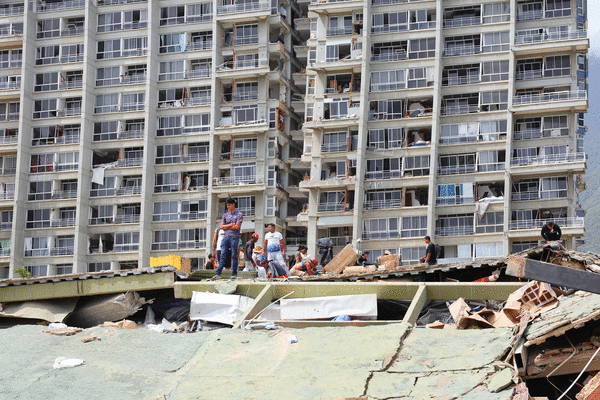
The death toll from the devastating double earthquake that struck Venezuela’s northern coast climbed to at least 920 people Friday, with 3,660 injured, as rescue crews intensified their search through collapsed buildings amid growing fears that the number of missing could be far higher than first thought.
The latest official figures mark a sharp increase from earlier casualty reports, underscoring the scale of destruction caused by the Wednesday’s twin earthquakes, which measured 7.2 and 7.5 in magnitude and struck just 39 seconds apart.
Venezuelan authorities have not released an updated nationwide figure for missing people. But according to figures received by the United Nations Office for the Coordination of Humanitarian Affairs and cited by EFE, the number of people still unaccounted for could reach 50,000, though the estimate remains unconfirmed and has not been directly attributed to the U.N.
The potential number of missing reflects continuing communications failures, widespread infrastructure collapse and chaotic rescue conditions in some of the hardest-hit urban centers, where families are desperately searching for loved ones.
The destruction has been particularly severe in Caracas and the neighboring coastal state of La Guaira, where hundreds of buildings have collapsed or suffered major structural damage, including residential towers, apartment complexes, shopping centers and public infrastructure.
According to the International Organization for Migration, up to 6.76 million people may have been affected by the earthquakes, including 2 million in Caracas.
The government said at least 2,927 families have been displaced, 383 buildings were severely damaged or destroyed, and eight hospitals have been affected, some badly enough to require evacuation. In La Guaira, officials reported more than 100 building collapses, reinforcing its status as the epicenter of the disaster.
The scale of destruction has prompted increasingly dire assessments from international experts. The U.S. Geological Survey has warned that the final death toll could climb into the thousands, particularly if rescuers are unable to reach survivors trapped beneath heavily damaged urban structures in time.
A website created by Venezuelan opposition leaders to help families locate missing relatives listed more than 50,000 people as unaccounted for by Friday afternoon, though that figure does not represent confirmed disappearances.
La Guaira militarized as crisis deepens
Interim President Delcy Rodríguez announced Friday the militarization of La Guaira, the coastal state adjacent to Caracas and home to Maiquetía International Airport, as authorities attempt to stabilize the region hardest hit by the disaster.
“Our Bolivarian National Armed Forces and all of its branches are deployed across La Guaira to address this emergency affecting our people,” Rodríguez said.
She said road-clearing operations have improved access across the state, allowing rescue teams, emergency personnel and military units to move more freely while delivering critical supplies such as food and water.
Rodríguez also said around 300 aftershocks have been recorded since Wednesday afternoon, keeping residents and rescue crews on edge as already damaged structures remain vulnerable to further collapse.
La Guaira was formally declared a disaster zone on Thursday.
Officials say some of the worst devastation is concentrated in Catia La Mar, Caraballeda and Playa Grande, where entire blocks have suffered catastrophic structural failure.
More than 100 heavy machinery units have been mobilized to remove debris and reach victims trapped beneath collapsed structures, while authorities said 11,500 security personnel have been deployed to support rescue, recovery and public safety operations.
Rodríguez visited La Guaira on Thursday alongside Interior Minister Diosdado Cabello and National Assembly President Jorge Rodríguez, touring some of the hardest-hit areas amid growing frustration over limited official information regarding casualties and damage assessments.
Hundreds sleep outdoors fearing more collapses
In Catia La Mar, one of the hardest-hit cities, hundreds of residents are spending nights outdoors, too afraid to return to damaged buildings.
Families have set up makeshift camps on sidewalks, plazas, sports courts and road medians, sleeping on mattresses, sheets, folding chairs and in improvised tents.
Many say they fear both additional aftershocks and the collapse of buildings already weakened by the initial quakes.
Scenes of improvised encampments have become common across parts of La Guaira and Caracas, where electricity outages, water shortages and structural instability continue to disrupt daily life.
Emergency crews are still searching through damaged residential towers, apartment blocks and commercial buildings in La Guaira, Caracas, Miranda and Carabobo, where some of the worst structural failures have been reported.
International rescue effort expands
The international response has continued to grow rapidly.
According to humanitarian officials, 30 urban search-and-rescue teams from foreign countries are now involved in operations, totaling approximately 1,600 rescue personnel and 100 search dogs.
Some teams are already working in affected zones, while others are expected to arrive in the coming hours and days.
The United Nations said rescue teams have been sent by Switzerland, the United States, the Netherlands, France, Qatar, the Czech Republic, Germany, Jordan, the United Kingdom, Spain, Chile, Colombia, Ecuador, Italy, El Salvador and Mexico.
The United States remains one of the largest contributors to the response, deploying nearly 200 personnel, including specialized rescue teams, military logistics experts and disaster-response specialists.
Washington has also committed $150 million in emergency aid, including $100 million for U.N.-coordinated relief operations and $50 million in bilateral assistance to humanitarian organizations operating inside Venezuela.
A key challenge remains logistics.
The United States has launched a massive government-wide response, but before aid can flow in at full scale, officials say one critical obstacle must be overcome: repairing Venezuela’s heavily damaged airports so large military cargo planes can land.
Because Maiquetía International Airport suffered severe structural damage, restoring air access remains essential to scaling up aid deliveries.
According to the State Department, U.S. personnel have deployed a specialized airfield management and assessment team to inspect, clear and certify damaged runways so they can safely receive heavy military transport aircraft carrying humanitarian supplies, rescue equipment and medical resources.
“Securing a long-term landing area for large aircraft is a critical component of the long-term success of any large-scale disaster response,” a State Department spokesperson said.
While repairs continue, the United States initially relied on MV-22 Osprey tilt-rotor aircraft to transport rescue personnel and emergency supplies into affected areas. The first American response teams arrived Thursday night aboard Osprey aircraft, while the first C-17 Globemaster cargo planes landed early Friday carrying additional personnel, medical supplies and communications equipment.
“The large volume of U.S. supplies and number of response personnel — totaling close to 200 — has required heavy-lift aircraft, including the C-17 Globemaster,” the spokesperson said.
©2026 Miami Herald. Visit at miamiherald.com. Distributed by Tribune Content Agency, LLC.






Comments