Mistrial declared in trial of man accused of starting Palisades fire, in stunning rebuke to feds
Published in News & Features
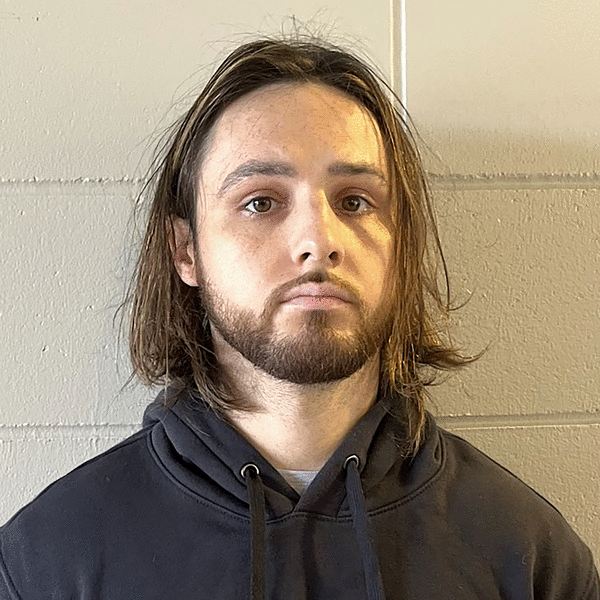
LOS ANGELES — A mistrial was declared Friday in the federal trial of a 30-year-old former Uber driver accused of setting what would become the deadliest wildfire in Los Angeles history.
Jonathan Rinderknecht was on trial for destruction of property by means of fire, arson affecting property used in interstate commerce and timber set afire. But on Friday, the 13th day of trial, U.S. District Judge Anne Hwang declared a mistrial after the jurors said they were unable to reach a verdict on any of the felony charges, with a final vote of 10 to 2 for acquittal.
“The court finds there’s a manifest necessity to declare a mistrial in this case due to a jury deadlock,” Hwang said.
It’s unclear whether prosecutors will retry Rinderknecht.
Jurors first indicated that they were at an impasse on Thursday afternoon, after deliberating for more than 13 hours. The jury had initially indicated they’d reached a unanimous verdict, but in a follow up note said they were at “a standstill” and “unsure how to proceed.”
During the trial, prosecutors called more than 30 witnesses, who painted a picture of a man spiraling mentally and seeking vengeance against the wealthy when he hiked to a clearing overlooking Pacific Palisades and used a lighter to set the Lachman fire last New Year’s Day.
Prosecutors said the Lachman Fire smoldered underground for a week before exploding into the deadly Palisades fire. Firefighters had thought they had extinguished the initial blaze and packed their equipment out on Jan. 2. The secondary inferno erupted on Jan. 7. 2025, killed 12 people, destroyed 6,500 structures across the Palisades and Malibu and cost billions in damage and insurance claims.
During the trial, Rinderknecht’s defense attorney called several witnesses in an attempt to undercut the prosecution’s theory of the fire. A Palisades resident said he saw several teens leaving the hill behind his house after the fire started, acting “boastful.” A Los Angeles firefighter testified that he saw flashes of light and heard loud noises that sounded like fireworks around midnight near the neighborhood closest to where the blaze sparked. A defense expert told jurors the most likely cause of the blaze was fireworks and cast doubt on exactly where it originated.
“The government must prove beyond a reasonable doubt that the lighter ignited the fire, because that’s what they claim happened here,” Haney told the jury in his closing argument Tuesday. “They don’t have any evidence at all that Jonathan started a fire on that hill with a lighter.”
After the jury appeared deadlocked Thursday afternoon, Asst. U.S. Atty. Mark Williams asked the judge Friday morning to give an Allen charge, urging the jurors to continue deliberating. Defense attorney Steve Haney moved for a mistrial, saying that “forcing continued deliberations through some instructive method … it has the potential to be coercive.”
Hwang said she agreed with him regarding the Allen charge, but declined to grant a mistrial without further inquiry with the jury.
“Given the length of this trial, they haven’t deliberated for an inordinate amount of time at this point,” Williams argued. “There’s no indication at this point that they cannot deliberate and continue to discuss the issues.”
Hwang disagreed.
“In this case, the jury has deliberated for 13 hours over the course of two days, the notes are unequivocal and clear,” Hwang said. “The foreperson stated that people are “Dead-set, unwavering and unwilling to change their opinion.’”
She added: “The real concern I have is based on the language of the notes themselves and the clarity with which the jurors have indicated that they are unwavering and dead-set and unwilling to change their opinions. The language of having them return to deliberations risks coercion at that point.”
Hwang called the jurors in for questioning after 9 am. One of them was crying.
“Is it your considered opinion that the jury is unable to agree on a verdict on any of the three counts,” judge asked the foreperson.
“Yes,” he said
“Is there anything at all that the court can do to assist the jury in its deliberations?”
“No,” he said.
Is there a reasonable probability that the jury can reach a unanimous verdict on any of the three counts if sent back to the jury room for further deliberations?
No,” he said.
©2026 Los Angeles Times. Visit at latimes.com. Distributed by Tribune Content Agency, LLC.



Comments