Cuba rushes to pass Chinese-style reforms in last-ditch effort to survive US pressure
Published in News & Features
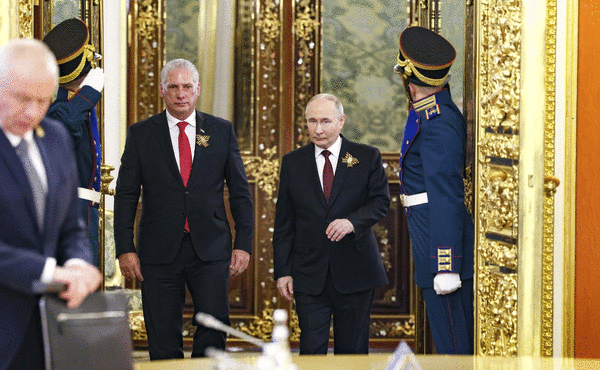
With an unusual tone of urgency, Cuban leader Miguel Díaz-Canel defended Chinese-style reforms he said must be implemented without delay, including allowing foreign investment in the country’s private sector and liberalizing the communist country’s centrally planned economy.
In an urgent meeting on Wednesday, the Communist Party’s Central Committee approved 176 measures that Díaz-Canel said were intended to address the country’s severe economic crisis, resist U.S. sanctions, and continue advancing in the “construction of socialism.”
In a speech published Thursday on state media, Díaz-Canel expanded on the measures he teased in remarks to reporters last week that he described as an “emergency economic and social agenda.”
“Reality imposes urgent and necessary changes upon us,” he said. “And when the life of the people becomes so hard, the primary duty of the Communist Party and the revolutionary government is not to better explain the crisis, but to change whatever must be changed to overcome it.”
The measures include reducing the size of the government, granting greater autonomy to state enterprises, liberalizing import and export activities, expanding the scope of what private enterprises are allowed to do and opening the tourism sector to “all actors” in the economy, among others.
He also announced that the government will authorize direct foreign investment in the national private sector “with clear rules on ownership, repatriation, reinvestment and dispute resolution.”
In 2022, the Biden administration authorized an American company to finance and invest in a private business in Cuba, but the Cuban government never approved it.
The Cuban government, which carries a large debt with the Paris Club, Spanish companies, and several other creditors, will also “pursue a debt-for-assets swap process” without permanently transferring ownership, Díaz-Canel said.
The Cuban leader said the measures had been inspired by reforms in China and Vietnam. Similarly to what happens in those two Asian nations ruled by communist governments, the Cuban government will expand the lease of farmland, but the state will continue owning the land.
Overall, he said, the government will give up central economic planning and assume a regulatory role instead.
Some of Díaz-Canel’s statements were remarkable simply for confirming that Cuban leaders knew their economic policies did not work and yet had resisted reforms. For example, he said the government will eliminate price caps because they “failed to curb inflation. They often led to the disappearance of products, a shift toward the black market, higher prices, lower tax revenue, and an impossible race between real prices and administrative decisions that were always too late or remained static.”
In other moments, Díaz-Canel, who had doubled down on his calls on the Cuban population to resist U.S. pressure in the name of sovereignty and the revolution, dropped the rhetoric to say that “resistance alone is not enough” and that “there is no sovereignty with an empty plate.”
“There are obstacles that stem neither from the outside nor from the blockade,” he said in reference to the U.S. embargo. “There is sluggishness, bureaucracy, regulations that hold back those who want to produce, and decisions we have put off. We must change what depends on us, and we must change it now.”
He also acknowledged that some of the measures will be implemented despite a lack of “absolute consensus” because they are “unavoidable.”
In a media report on the Wednesday meeting published in Granma, the Communist Party’s newspaper, there was little sign of resistance, with members of the Central Committee quoted in support of the reforms. On Thursday, the National Assembly was expected to approve the measures too.
The reforms have the blessing of Raúl Castro, who, according to the Cuban state media outlet Cubadebate, attended the meeting via video call. Division General José Amado Ricardo Guerra, the secretary of the Council of Ministers, “conveyed a message” from Castro in which he stated that he was consulted and that he “fully agreed with the proposed changes” the report says.
“It is what best suits the Revolution today,” Castro said in the message, according to Cubadebate. It is unclear why Castro, who turned 95 earlier this month, could not convey the message himself if he had been in attendance. Castro was indicted in the United States in May, accused of the murder of four men during a 1996 shootdown of two planes belonging to the Cuban exile organization Brothers to the Rescue.
After Díaz-Canel teased some of these measures last week, there has been much debate inside and outside Cuba over whether the reforms came too late or if they are a distraction to buy time amid a standoff with the Trump administration.
Talk of reforms comes at a time of great tension with the United States, and it is unclear if they would be significant enough for the Trump administration, which has called on Cuba’s communist leaders to make major economic and political changes, to ease sanctions.
While economic reforms might be received as a step in the right direction, they also pose a test for the Trump administration on how far it wants to push for regime change in Cuba since Díaz-Canel made clear that Cuba was not renouncing but trying to perfect its socialism.
There is also much skepticism among Cuba observers, experts, and the population about whether the current leaders will be able to steer reforms they themselves decided to postpone until unprecedented pressure from the Trump administration forced their hand. At many other moments in recent decades, Cuban leaders have also promised reforms that were later abandoned.
There is also widespread distrust among potential investors in a country that is heavily sanctioned by the U.S. and has a long history of failing to pay creditors. And, even if Díaz-Canel again invited Cubans abroad to invest in the country and promised a new legal framework to protect investments, Cuba’s repressive laws curtailing citizen rights, including property rights, are still in place.
In a recent interview with NBC, Díaz-Canel declined to take responsibility for the country’s impoverishment and the desperate situation the population endures, blaming U.S. sanctions for all the country’s ailments. But in his speech, he acknowledged Cuban leaders erred by delaying reforms.
“Social justice is built upon real foundations: income with purchasing power, direct protection for those who need it most, and a national economy capable of greater production,” he said. “There are no shortcuts; these are not new ideas, but rather decisions the country debated and approved years ago. The mistake lay not in proposing them, but in delaying them—and that period of postponement must come to an end.”
_____
©2026 Miami Herald. Visit miamiherald.com. Distributed by Tribune Content Agency, LLC.





Comments