Vance Boelter's guilty plea in Minnesota lawmaker shootings could hide answers about motive and manhunt
Published in News & Features
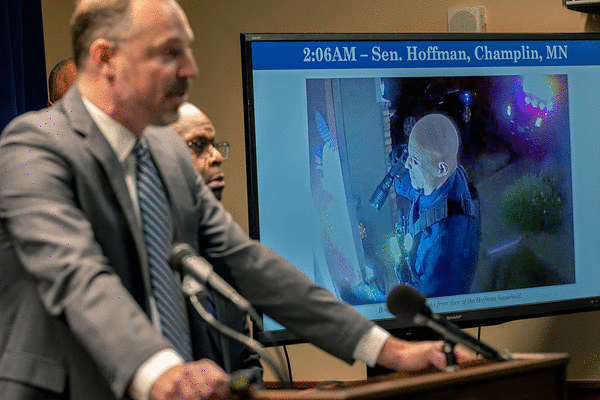
MINNEAPOLIS — When he pleaded guilty on Thursday, Vance Boelter revealed, sometimes in graphic detail, how he killed state Rep. Melissa Hortman and her husband, Mark, and shot state Sen. John Hoffman and his wife, Yvette.
But it isn’t fully known why Boelter chose them and the other lawmakers whose homes he targeted that night.
Similarly, there was no explanation of how Boelter evaded police after fleeing the Hortmans’ Brooklyn Park home and traveled 7 miles to his rental property in north Minneapolis. And the public may never know Boelter’s whereabouts from the morning of June 14 until he was spotted more than 17 hours later near his home in Green Isle, Minn.
Boelter’s guilty plea to federal murder and stalking charges may make some of these answers harder to get.
“More information comes out in a trial than a guilty plea,” said Amy Sweasy, a law professor at the University of Minnesota.
In a federal trial, prosecutors, through court hearings and written filings, present a detailed story about the alleged crimes, supported by the evidence gathered by investigators.
Boelter’s plea agreement cut that process short.
The Federal Bureau of Investigation and local law enforcement likely generated voluminous case files during their examination of Boelter’s crimes, including transcripts of witness interviews, property from the crime scenes, medical records, search warrants, body camera videos, photos, text messages, internet searches and more.
The federal and state case files may contain lots of overlapping evidence, but possibly some different facts too, legal experts said. Parts of these files could be revealed through public records requests.
Mark Anfinson, a First Amendment attorney and adjunct faculty at the University of St. Thomas, said that historically it’s extremely difficult for the public to get federal law enforcement records.
“The FBI is among the very stingiest federal agencies in the nation in terms of sharing information they obtain,” he said.
‘He was guilty of everything’
At Thursday’s hearing, Boelter provided a few previously unknown facts about his June 14 rampage, confirming he’d been planning the attacks for months and how he murdered Melissa Hortman. He affirmed other information about his crimes with simple “yes” statements.
Other circumstances about Boelter’s motive and movements may be revealed over the course of months and years through Boelter’s sentencing, a state criminal case, a civil lawsuit and a review of the police response.
Although a trial produces a fuller record of public information, Sweasy said “when you have a trial, you often don’t get answers to questions you want either.”
The former Hennepin County prosecutor said she handled many cases where victims were left struggling to understand a defendant’s motive even after a trial.
“What motivated his guilty plea here is that he was guilty of everything,” Minnesota U.S. Attorney Daniel Rosen said during a news conference after Boelter’s plea. Rosen, whose office prosecuted the case, declined to speculate on what led Boelter to “commit this sort of brutal murder.
“I wonder if any of us who live law-abiding lives would ever really be able to understand that,” he said.
As part of his plea, Boelter agreed to two consecutive life sentences in exchange for the U.S. Justice Department dropping its pursuit of the death penalty. U.S. District Judge John Tunheim said Thursday he expected sentencing could take place in July.
Legal arguments for Boelter’s sentencing may reveal some new facts about his premeditation and motive, as well as details on his actions, movements and life story, legal experts said. Boelter’s attorney might provide information about Boelter’s life and why he carried out the shootings.
“As is typical of these cases, at the time of sentencing, some additional details are likely to come out,” Rosen said.
Additional facts may surface from other court cases.
Boelter still faces criminal and civil cases in state court
Hennepin County prosecutors also charged Boelter with first-degree murder and attempted first-degree murder, along with animal cruelty for the shooting of the Hortmans’ dog, Gilbert.
Hennepin County Attorney Mary Moriarty released a statement saying Boelter’s plea deal doesn’t change the status of the state case.
“This was a devastating wave of targeted political violence that shocked our state and the nation,” Moriarty’s statement said. “My thoughts are with the Hoffmans, and with Mark and Melissa’s family and loved ones as the federal phase ends and we approach state prosecution.”
Boelter has not entered a plea in state court. Once those proceedings are final, Anfinson said, it may be easier for the public to access law enforcement records.
Ten months after being shot by Boelter, Hoffman and his family sued their attacker in Hennepin County District Court, seeking damages for their continued pain and suffering. That civil case is ongoing.
The Hoffmans could potentially access some law enforcement files through legal discovery. That information could become public if the family chooses to make it part of their arguments, legal experts said.
The Hoffman and Hortman families may have also gathered details about the federal and state criminal investigations through their participation as witnesses and victims, said Anders Folk, a former U.S. Attorney who is running for Hennepin County attorney. Some crime victims may also choose to share facts after their cases have concluded.
Other questions about law enforcement’s actions that weekend could be answered by an after-action report that will evaluate police response to the attacks and the 43-hour manhunt for Boelter. The International Association of Chiefs of Police is performing the review. The IACP did not respond to a request for comment but a legislative staffer said IACP is still conducting interviews with state lawmakers.
The report was expected to be completed this month but Howie Padilla, a spokesman for the Minnesota Department of Public Safety, said it will likely be released later this summer. The department previously said “the details of the findings” will be made public once the report is finished.
Still, the report may not provide every detail about the weekend’s deadly events. To date, Boelter has communicated with reporters while in federal custody but has said little publicly about his motive and actions.
“Mr. Boelter could at some point start speaking about it,” Sweasy said. “I don’t know how realistic that is.”
_____
Jeff Day and Sarah Nelson of the Minnesota Star Tribune contributed to this story.
_____
©2026 The Minnesota Star Tribune. Visit at startribune.com. Distributed by Tribune Content Agency, LLC.






Comments