In Palisades fire trial, judge bars evidence of alleged burned Bible and arson threat
Published in News & Features
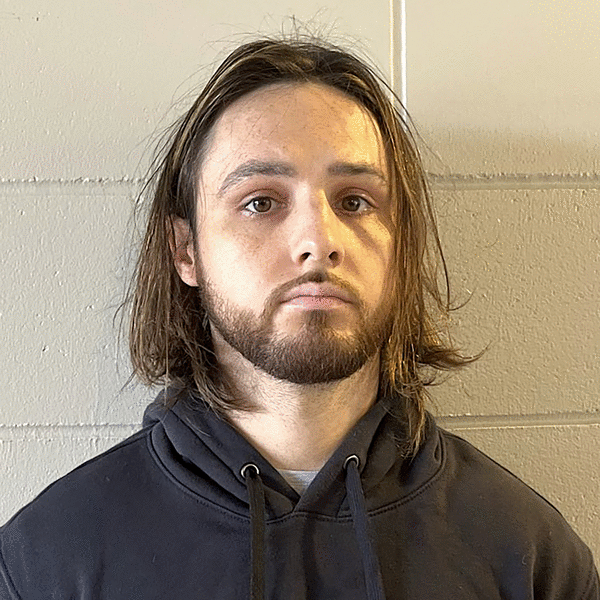
LOS ANGELES — A federal judge on Friday declined to allow testimony that the defendant on trial for the Palisades fire had at one point burned a Bible and threatened to burn down his sister’s house, while warning the defense attorney “to tighten up your questioning.”
U.S. District Judge Anne Hwang said Jonathan Rinderknecht’s prior acts were not “direct evidence of the charges in the case,” but that she was concerned that the defense’s cross examination of a federal agent left the impression that he had never expressed interest in deliberately lighting fires.
Rinderknecht is charged with starting the Lachman fire, which smoldered underground for a week before exploding into the deadly Palisades fire on Jan. 7, 2025. If convicted, he faces up to 45 years in prison.
Ahead of the trial, which began this week, Hwang ruled that prosecutors could not introduce those prior acts because they were prejudicial. But Asst. U.S. Atty. Mark Williams argued Friday that Rinderknecht’s defense attorney had opened the door to the topic with his questioning the day prior.
In Steve Haney’s questioning of the prosecution witness on Thursday, U.S. Alcohol, Tobacco, Firearms and Explosives Agent Michael Montevidoni, the defense attorney pointed out that his client never asked ChatGPT for advice to plot a fire.
“You never found any searches in any of the devices regarding arson, right?” Haney asked. “Any internet searches for deliberately starting a fire ... any Internet searches on what type of incendiary device, lighter, torch, flare, might be better used to start a fire? ... Never found any purchases of fire-starting materials?”
Over and over again, the ATF agent responded no.
Williams said that Haney’s questioning implied to the jury that Rinderknecht had never expressed a desire to commit arson, which the prosecutor said is “exactly what happened” when Rinderknecht threatened to burn down his sister’s home in Florida.
“Clearly threatening to burn someone’s house down does relate to the crime of arson,” Williams said. “Defense counsel was warned pre trial by your honor that if he gets into areas like this he would open the door.”
Williams argued that Haney’s questioning was an attack on the agent’s credibility and said the sense left on the jury was that he “didn’t find any of this evidence.”
“The act of burning a Bible, your Bible, which is what was indicated in the ChatGPT prompts is not arson,” Haney argued in response. “It was an expression of religious protest, that’s not arson.”
Haney argued that Rinderknecht’s remarks about burning down his sister’s home occurred five months after the Lachman fire, during a family argument.
“I don’t believe the door was opened,” Haney said. “I believe the line of questioning was clear. It was entirely a line of questioning with respect to his prompts and his searches on his online devices.”
Although Hwang declined to allow that testimony to come in, she said she had serious concerns “that there’s an insinuation or an impression that there is no evidence of your client ever purposely setting a fire to anything. Because that is not accurate.”
“I’m going to be as clear as possible … you need to tighten up your questioning,” Hwang warned. “To be clear, you are not permitted to argue in closing that Mr. Rinderknecht has no history of burning things or threatening to burn things.”
©2026 Los Angeles Times. Visit at latimes.com. Distributed by Tribune Content Agency, LLC.



Comments