US, Iran edge toward interim peace deal to reopen Strait of Hormuz
Published in News & Features
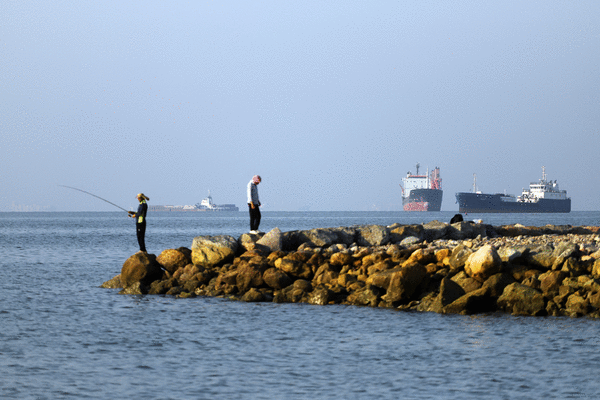
WASHINGTON — The United States and Iran moved closer to an interim peace agreement meant to reopen the Strait of Hormuz and help end a war that has damaged the global economy and caused chaos in the Middle East, but conflicting messages from both sides have caused lingering uncertainty.
U.S. President Donald Trump canceled what he characterized as imminent airstrikes on Iran on Thursday, saying negotiators had made progress. A senior administration official briefing reporters Friday said there was an 80% or 85% chance that an agreement gets signed, adding that some Iranian hardliners still want to kill any breakthrough. Those internal disagreements are getting worked out, the official said.
“The Islamabad Memorandum of Understanding has never been closer,” Iranian Foreign Minister Abbas Araghchi posted Friday on X. He vowed that “all details will be shared with the public in due course.” Trump reposted Araghchi’s statement.
Pakistan’s Prime Minister Shehbaz Sharif said that a “final, agreed upon text of the peace deal has been reached” and that his country is working with both sides “to finalize the next steps,” in a post on X.
Yet for all the progress, there was little clarity as to what the text of the so-called memorandum of understanding will contain, with the warring sides giving conflicting descriptions. And while the U.S. suggested the deal was essentially done, Iran has said it still needs to make a final decision. The disconnect is raising doubts about how quickly Hormuz can return to anything approaching its prewar operations.
One person familiar with the deliberations, asking not to be named discussing sensitive matters, said the MOU will be open to interpretation in certain areas, including what the reopening of the strait would mean in practice. While Trump said ships will have free passage, Iranian media suggested Tehran will still have a degree of control.
Trump has to strike a delicate political balance: He wants to present the deal as a win to Iran hawks in his own party as well as to an American public that has increasingly turned against the war he started in late February with a joint U.S.-Israeli bombardment of the Islamic Republic.
Vice President JD Vance appeared to be pushing back against some of those GOP hawks with a post on Friday in which he assailed “people who (rightly) said Donald Trump was a historic president a month ago now criticizing a deal based on unconfirmed media reports.”
“The president is going to get us a good outcome, one way or the other,” Vance said, vowing that Iran won’t get access to blocked funds just for signing an agreement.
The talk of an agreement is putting more focus on the G7 summit in Evian, in the French Alps, to take place Monday through Wednesday. A deal could be signed on the sidelines of that gathering, according to senior officials familiar with the matter. Geneva is nearby and is being floated as a potential location for the signing as soon as Sunday, according to people familiar with the plans.
Trump indicated Thursday that Vance would represent him at any signing. A senior U.S. official said Friday that no decisions about timing or location have been settled.
Underscoring the still-high tension between Washington and Tehran, Trump also denied and vented his frustration about Iranian media reports, some of which said the U.S. will unfreeze more than $20 billion of Iranian funds held in other countries.
The Iranians are “very dishonorable people to deal with,” Trump said in a social media post. “They better get their act together, and FAST!”
Iran’s foreign ministry said Tehran was still reviewing the draft.
“The relevant authorities must reach a consensus on every detail of the text and any potential agreement,” a ministry spokesman said, according to Iran’s IRIB News agency. “Details regarding the manner of signing the MOU will be discussed in later stages.”
One diplomat briefed on the negotiations over the MOU said it will allow Iran and perhaps other states near the strait — a vital chokepoint for flows of oil, liquefied natural gas and other commodities — to oversee the waterway’s security to some extent. The senior U.S. official said the United States believes Iran’s control over Hormuz has weakened.
Another diplomat familiar with the talks said the U.S. and its allies would aim to ensure normal levels of shipments through Hormuz within about a month of a deal being signed. That may be complicated by the high likelihood of Iran having placed mines in the strait, which the United Kingdom and France are preparing to help clear.
Roughly 140 ships passed through the narrow chokepoint each day before the conflict erupted. Iran then all but closed it by firing on ships with drones and missiles. The number of vessels has crept up in recent weeks, but is still far below pre-conflict levels.
Another senior U.S. official said it was a performance-based agreement. The main points beyond the strait being reopened, according to the official, are that Iran will relinquish or destroy its stockpiles of highly enriched uranium, dismantle its nuclear program and receive no money until it fulfills parts of the arrangement.
The interim peace deal will see the U.S. and Iran extend their ceasefire by around two months and go into further negotiations over the Islamic Republic’s nuclear program. The U.S. would lift its blockade of Iranian ports.
The war has killed thousands of people across the region, mainly in Iran and Lebanon. It has also pushed up inflation globally, hurting Trump and his party ahead of U.S. midterm elections in November.
The terms of the deal still need to be approved by Iran’s Supreme Leader Mojtaba Khamenei, according to a European official familiar with the matter. He’s been in hiding since the conflict erupted and the main mediators — Qatar and Pakistan — have found that communicating with him can take days.
Oil prices fell and equities jumped late on Thursday when Trump said he had canceled the new strikes on Iran.
Energy dropped further on Friday. Brent futures fell as much as 5.1% to trade at the lowest level since the early days of the war, while European gas slumped as much as 8.4%, before paring gains. While the global benchmark is still up almost 50% this year, it’s fallen from a high of $125 in late April.
Mehr, an Iranian news agency, reported the deal would include the release of $24 billion of Iranian funds held in foreign banks. Trump and Iran hawks such as U.S. Sen. Lindsey Graham have previously balked at the idea of unfreezing any funds for Tehran.
Mehr also said the agreement states the U.S. will withdraw forces from areas near Iran, lift oil sanctions and “present reconstruction plans” for the Islamic Republic worth around $300 billion.
Another potential sticking point is Israel, which is not part of the negotiations for the interim deal. The Jewish state has resisted any MOU that includes a ceasefire in Lebanon, where it’s fighting Iran-backed Hezbollah militants, and is wary of any deal with Iran. Prime Minister Benjamin Netanyahu has signaled he’d prefer more strikes to further degrade Iran’s military.
The U.S. and Israel initially wanted any deal with Iran also to curb its ballistic missile program and support for Middle Eastern militant groups such as Hezbollah and the Houthis in Yemen. It’s not clear whether that will be part of the MOU.
Israel’s minimum expectation is now that an end-of-war deal ensures highly enriched uranium is removed from Iran, according to a person familiar with the matter. Israel will deem any agreement a failure if Iran gets sanctions relief and without giving up its processed uranium, the person said.
_____
(With assistance from Jennifer A. Dlouhy, Josh Wingrove, Dan Williams, Paul Wallace, Michelle Jamrisko, Courtney Subramanian and Hadriana Lowenkron.)
©2026 Bloomberg L.P. Visit bloomberg.com. Distributed by Tribune Content Agency, LLC.





Comments