Cuban leader Díaz-Canel announces sweeping economic reforms to fend off US pressure
Published in News & Features
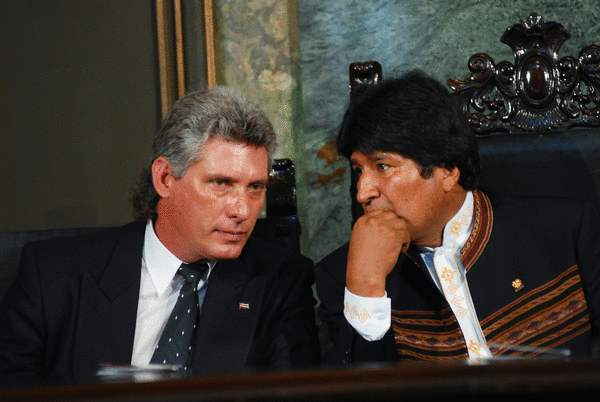
Amid a tense standoff with the Trump administration, Cuba’s leader, Miguel Díaz-Canel, has announced sweeping reforms that would grant more autonomy to state enterprises, expand private-sector activities and allow Cubans on the island and abroad to invest on equal footing with foreign investors.
In comments to reporters, Díaz-Canel outlined changes that Cuban economists have advocated and that Cuban leaders have resisted for decades, but said the country could not continue working as it is: “These are times when change is necessary.”
It is unclear when Díaz-Canel spoke to reporters who were described as part of the presidential office’s press team, but his comments were aired on television and radio early Friday morning.
Among the changes he mentioned are:
•A reduction of government and political organizations. He said the savings in the state budget will be used for social programs and a salary reform benefiting state workers.
•More autonomy for state enterprises so they can “operate without intermediaries or interference in their management.” He said state enterprises should have the authority to determine their own salary structures, use their profits, and handle import and export operations.
•Changes to fiscal policies so that the government does not continue bailing out inefficient state enterprises.
•Liberalization of foreign trade and the elimination of the requirement to use state importing agencies as intermediaries.
•Expansion of authorized activities for the private sector.
•Authorizing Cubans living on the island and abroad to invest and participate in the country’s economy “on equal footing alongside foreign direct investment, state-owned enterprises, and cooperative entities.”
•A new legal framework that is “stable ...that guarantees long-term security for businesses, is respectful and safe, and — above all — encourages” investments. Díaz-Canel said the government will also simplify approval of investments. Municipal governments will have more autonomy and be allowed to approve investment projects.
•Opening up tourism to “non-traditional” economic players, signaling the government might allow Cuban private entities to participate somehow in this key economic sector. “We cannot think about the major chains right now, given that many of them have withdrawn from the country due to pressure from the United States government,” he said.
•New authorities to grant land for agriculture, and allowing farmers to have access to supplies and foreign currency.
•Seeking foreign investors to expand the use of renewable energy. He also said the government would eliminate restrictions on importing electric vehicles that can be charged with solar power.
•Opening up trash collection to foreign investment.
Many of the changes showcase how tightly the Cuban government controls every aspect of the country’s economy. After six decades of a failed centrally planned economy, state enterprises will be allowed, for the first time, to operate more similarly to companies elsewhere in the world.
“Enterprises will determine their own scale and wage structures, and will have the authority—without limits or hindrances—to utilize their profits as they see fit or as collectively approved,” he told reporters. “They will have the power to engage in import and export activities and enter into contracts that generate foreign currency earnings; beyond their contributions to the country, they will be able to retain a portion of that foreign currency to expand their production and service capabilities.
“They will also be able to form economic partnerships with any type of economic actor and decide on their own clients and suppliers,” he added. “They will develop their own operational plans; while some activities may respond to state mandates, other plans must facilitate production and services for export and for the domestic population. Furthermore, they will have a broad scope of operations—meaning enterprises will be able to produce goods and provide services across any area they are capable of handling, fully leveraging their potential without restriction.”
Díaz-Canel said the measures have already been discussed by the government and will be approved soon. Given the lack of details, the real scope of the reform is not yet clear, nor is it clear whether it would be sufficient to lift the country’s economy out of its nearly collapsed state.
Previous attempts at reform, both under Raúl Castro and later under Díaz-Canel, have fallen short or even worsened living conditions on the island. Cuba’s current condition — much more impoverished, with an older population and more isolated than in the past due to U.S. sanctions — makes any attempt at major reforms even more difficult. As discontent with the government grows, more Cubans aspire to regime change rather than reform.
As in many other occasions in the past, the announcement again shows the Cuban government does not loosen its grip unless it is under pressure.
It is unclear whether the announced measures will be deemed significant enough by the Trump administration, which has ramped up the pressure on the island with sanctions and a de facto oil blockade to press the island’s communist leaders to make major political and economic changes.
While the reform signals Cuban leaders have understood the country’s situation is untenable — its economy is paralyzed, scheduled blackouts last more than a day, Cubans struggle to get food, medicine, and drinking water, and mounds of trash accumulate on the cities’ streets — they have drawn the line at political concessions.
Díaz-Canel’s comments to reporters suggest the island´s leaders see the reforms as necessary for their survival in power.
“The United States cannot forgive itself for the fact that, at this stage—despite all the maximum pressure it has exerted—the Revolution still exists, and the country continues to function,” he said. “The country is not at a standstill as it intelligently confronts this entire situation. We cannot state everything so clearly because the enemy is lying in wait, but I believe our response must be one of unity.”
©2026 Miami Herald. Visit at miamiherald.com. Distributed by Tribune Content Agency, LLC.




Comments