'I just need somebody to help': What 911 calls reveal about Alligator Alcatraz
Published in News & Features
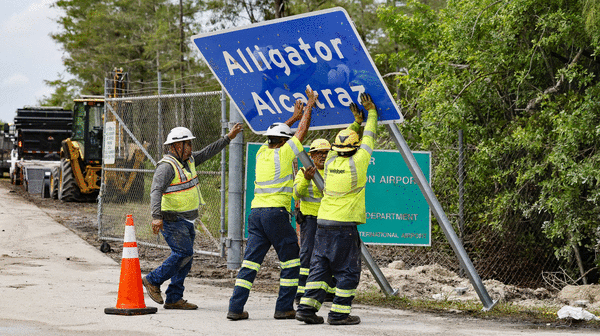
MIAMI — The calls came in from all over the world — France, Illinois and nearby Miami — as people with family and friends at one of the country’s most infamous immigration detention centers dialed the one number they trusted to get help: 911.
Again and again, confused and desperate family members, unsure how to reach Alligator Alcatraz, called and were connected to the Collier County Sheriff’s Office for help with their loved ones held in tents and cages in the Florida Everglades.
“A security guard called me today to tell me that the father of my children had a cardiac arrest and cannot feel his arm at all,” a Miami-Dade woman seeking care for a 41-year-old detainee told a dispatcher.
The Miami Herald reviewed more than 130 incident reports and 911 calls over 328 days, all routed to the Collier County Sheriff’s Office starting last summer, when the site was under construction. The calls, obtained through a public record request, ran through mid-May of this year, when state and federal officials acknowledged that discussions about closing the complex were underway.
The recorded conversations offer a glimpse into Alligator Alcatraz’s daily operations and the confusion about what goes on inside the detention camp, and illustrate the desperation of detainees and their families on the outside, who, at best, can beg for help.
“I just need somebody to please make sure that, like, get him some antibiotics or something. There’s no number for this place,” a woman who identified herself as Jessica pleaded, asking for medics to be sent for her fiance. “I just need somebody to help.”
Calls for help
Since opening, the detention center’s activities have remained opaque, with limited information provided to detainees’ families. Visits are not permitted and lawyers have faced challenges in gaining access.
The few details families receive come through alarming phone calls from detainees worried about their health and mistreatment at the facility. In turn, family members with no way to reach the Everglades detention camp call emergency services.
Calls from worried family members started pouring in last summer as the detention camp — promoted as an isolated complex built to hold the “worst of the worst” — was plastered across television screens and social media.
Alligator Alcatraz operates as its own mini city, equipped with emergency responders, medical staff and a dispatch team staffed primarily by private vendors. But the number publicly listed as the detention center’s contact is for the Krome North Processing Center, a different facility located in South Dade.
Alligator Alcatraz’s dispatch does not handle 911 calls. When the Sheriff’s Office receives an emergency call, it forwards the information to the detention center for internal handling.
Esvin Rodezno, a 29-year-old detainee, had been seeking medical attention for two days when his fiance, Jessica, called 911 on Aug. 5.
She said Rodezno was being refused care despite symptoms such as fatigue, sore throat and a rash that was “spreading to his head, his arm.” Medical staff at Alligator Alcatraz told him, “You’re not dying,” she said.
Jessica, who only provided her first name, was hoping the Collier County deputy would send a medical unit to the site to check on him.
The deputy said the best they could do was pass her information along to the medical staff at Alligator Alcatraz, and that someone could contact her.
“OK, do you think that they would actually take it seriously, though?” Jessica asked.
“I don’t work for them,” the deputy said. Alligator Alcatraz has its own on-site medical staff and that assistance is provided only when requested, she said.
Sounding doubtful and defeated, Jessica hung up. Efforts to reach her were unsuccessful.
The Florida Division of Emergency Management, which oversees Alligator Alcatraz’s operations, did not provide comment for this story.
A Department of Homeland Security spokesperson said its immigration detention centers provide “comprehensive medical services” and that detainees “who require higher levels of medical care are referred to local emergency services as needed.”
“Out of an abundance of caution and in the best interest of a detainee’s medical needs, illegal aliens may be transported to area hospitals using emergency medical services,” the spokesperson said in a statement. “As additional detainees with more complex medical needs have arrived at the facility, medical staff established additional medical protocols. This is the best healthcare that many aliens have received in their entire lives.”
Families and human rights advocates disagree. In a December report, the human rights organization Amnesty International accused the state and federal governments of providing inadequate medical care at the Everglades detention center. The report findings indicated “a routine denial of access to medical care and failure to fulfill individuals’ physical and mental health needs, placing individuals at serious risk of harm.”
“Individuals who reported pain or illness were routinely ignored by facility staff, and medical treatment, when provided, was delayed or substandard,” the report stated.
The report — disputed by the state and federal governments — also stated that the facility and its conditions had been designed to make the detainees’ detention “unbearable.” There have been rumors of people attempting suicide or dying at the facility, which the Herald has been unable to confirm.
The 911 calls reveal one such unusual occurrence.
In March, a man who identified himself as Emess and said he was calling from France told the dispatcher that his “brother right now is in a detention center and he is threatening to harm himself, and I need some help.”
Emess said his brother, a 30-year-old immigrant from Ivory Coast, had called him to send a message to loved ones that “he’s dead. He killed himself.”
His detained brother told him the code to his phone, said “I love you guys” and hung up.
The Herald tried to reach Emess, but the number was disconnected. A federal database for immigrant detainees states that his brother is being held at the Mesa Verde detention center in Bakersfield, California.
A DHS spokesperson said “suicides in DHS custody are tragic and rare,” and that there is a strict “intervention protocol to ensure the detainee’s health and wellbeing is protected,” but did not answer a question about how many detainees, if any, had killed themselves at Alligator Alcatraz.
“ICE requires annual suicide prevention training, enforces 15-minute checks on suicide watch, and ensures that only clinicians — not custody staff — can remove someone from suicide watch,” the DHS spokesperson said.
The internally handled calls documenting how the detention center resolved concerns relayed by 911 dispatchers were not available to the Herald. It is unclear whether they circled back with family members who called.
Some of the recorded calls make clear that the facility was aware of the detainee’s situation and that the detainee was already receiving medical care.
In early March, Miami-Dade Fire Rescue called the sheriff’s office because it had gotten a call from a woman who said that a 61-year-old detainee “had shortness of breath and difficulty breathing.”
The Collier County deputy transferred the call to Alligator Alcatraz, where it was confirmed that the detainee had already been located and was being evaluated by the detention center’s medical staff.
Later that month, a man from Illinois called about a detainee who he said had suffered a seizure.
“From what my family member told me, he had a seizure, he collapsed on the floor and he started foaming from his mouth,” the man told the deputy.
When the Collier County deputy called the detention center to report the incident, the Alligator Alcatraz dispatcher confirmed, “We did have a seizure patient, we haven’t got a name yet.”
Recordings obtained by the Herald also shed light on fallout after flare-ups inside the facility, where detainees and their lawyers have alleged violations of detainees’ First Amendment rights and abuse at the hands of guards.
On April 2, the detainees began to riot after the facility shut off the phones for the day without any explanation, according to federal court records. Guards pulled them out of their cages and beat them, leaving one with a bloody eye and another with a broken wrist, and pepper-spraying them indiscriminately, according to a filing by an attorney in the First Amendment case.
Two days later, Natalie, a West Palm Beach woman who wanted to be identified only by her first name, called to request that paramedics be sent to the detention center for her fiance, Djo Paul, a 29-year-old immigrant from Haiti.
“He’s experiencing chest pain, trouble with breathing, and, you know, due to the Mace, the pepper spray that was in the facility, and he’s not able to breathe,” she told the deputy.
She said Paul had developed “skin irritation issues.” The deputy told her they would forward the information and she would receive a call with an update.
Two days later, she called again. Paul had not received any medical care, and there had been another pepper spray incident, she said.
When the Herald spoke to Natalie, she said Paul had not received proper medical care at the facility and had been deported.
Confused employees
The recordings show that, early on, even Alligator Alcatraz employees were confused about how to handle everything from emergencies to transportation.
Staff at the detention center called the Collier County Sheriff’s Office seeking advice about how to handle trespassers. An employee of state vendor Critical Response Strategy called because ‘they were all let go today — she is stranded there and needs assistance getting to Miami.”
Some of the employee calls mirror the confusion families experienced when seeking medical care for a detainee. They, too, were unsure where to go.
On July 25, after employees attempted the Heimlich maneuver on a woman who had been choking, another called 911. The worker had passed out between the laundry and shower facilities and was surrounded by eight other panicked staff members deliberating what to do.
“Is she still actively choking?” the deputy asked.
“She is not. She passed out, and she’s breathing again, and she’s kind of going in and out,” the caller said.
The dispatcher requested that the caller stay on the line while she sent over the information to the paramedics. In the background, you can hear chattering from staffers trying to figure out what to do.
“Have any of the personnel walked out there to help you guys?” the dispatcher asked.
“Like, any of the guards?” the caller asked. The caller confirmed they had informed the guards of the incident. “Go ahead and talk to them, OK,” the dispatcher said, and the call ended.
Workers had been instructed to call their own dispatch, but the call was routed to the Collier County Sheriff’s Office.
One call indicated that the state might not have properly vetted an employee in its haste to operationalize the facility.
On July 31, a dispatcher from Alligator Alcatraz called the Collier County Sheriff’s Office for guidance on handling an employee with a traffic offense warrant. They asked how to confirm the warrant and whether they needed to detain her.
“We haven’t run into this yet, so it’s like all new,” the Alligator Alcatraz dispatcher told the deputy.
From its earliest days of operations, detainees have complained about the harsh environment of the Everglades facility, from giant bugs, sweltering temperatures and mosquitoes. They were not alone. Employees at the makeshift detention center were also subjected to similar conditions.
“Hi, I don’t know why I keep calling and I get another county, but I call the other number,” a muffled voice said in an Aug. 14 call to Collier County. “I feel like I am going to pass out.”
The employee said she was in the back end of the parking lot, on a golf cart. She said faintly that she was trying to get out of the sun and she did not have any water.
Other times, Alligator Alcatraz employees called about personal issues, such as their boyfriend not returning their car after borrowing it or reporting that someone had stolen their license plate.
Employees even directed one man to call emergency services when he arrived at the site in May in search of his immigration documents, he said.
“I went to the lost and found section but it’s not here. So they told me to just call 911.”
_____
(Esserman Investigative Fellow Claire Healy contributed to this report.)
_____
©2026 Miami Herald. Visit miamiherald.com. Distributed by Tribune Content Agency, LLC.






Comments