Trump cancels planned Iran strikes in latest reversal
Published in News & Features
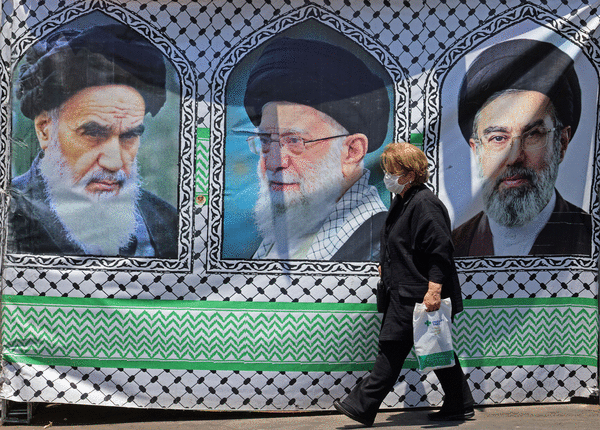
WASHINGTON — President Donald Trump pulled back threatened military strikes against Iran, a stark reversal that came just hours after he vowed to hit the Islamic Republic “VERY HARD” and threatened to seize its oil infrastructure.
Trump on Thursday cited what he said were “discussions” that “have been brought to the highest level of Iranian leadership” for a negotiated end to the war. He said that a “time and place of the signing” would “be announced shortly,” without providing further details.
However, Iran’s semi-official news agency Fars said the country had not yet approved the text of any agreement with the United States, citing an informed source.
“I have, as President of the United States of America, cancelled the scheduled strikes and bombings against Iran this evening,” Trump posted on social media.
Oil prices plunged nearly 4%, with Brent trading below $90 a barrel after Trump’s comments. Shares spiked.
Trump’s announcement is the latest in a string of threats he has pledged — and revoked — to strike since the start of the conflict in February. He has insisted a deal was within reach dozens of times, but none has yet materialized. Earlier Thursday, he promised to seize Kharg Island, a crucial energy hub for Iran, a move that would likely require U.S. ground troops.
But he walked that back almost immediately, noting on Fox News that he was “not sure America has the appetite” for that.
The new promise of an impending deal came days after a two-month-long ceasefire collapsed amid a wave of tit-for-tat strikes. People familiar with the diplomacy have said talks between the U.S. and Iran — with Qatar playing an increasingly important role as a mediator — have continued and progressed despite the violence.
Each side is using the exchanges of fire as a way to try to pressure the other and gain better terms in the negotiations, one of the people said.
Trump said that “discussions and final points have been, in both concept and great detail, approved by all parties involved, including the United States, Israel, Saudi Arabia, UAE, Qatar, Turkey, Pakistan, Bahrain, Kuwait, Jordan, Egypt, and others.” Notably, the list did not include Iran.
The president added that the U.S. naval blockade of Iran “will remain in full force and effect until this Transaction is finalized.”
On Wednesday, Iran said the Strait of Hormuz would be closed to all types of vessels, suggesting it would tighten its grip on the waterway. Their claim came the same day Trump said the U.S. military had supported the passage of “more than 200 commercial ships” through the strait, resulting in “more than 100 million barrels of oil” making it to market. He went on to claim the U.S. controls the strait, “not Iran.”
Talks between the warring sides have been stuck on several crucial points. Tehran insists the US unfreeze more than $10 billion of Iranian funds held in countries such as Qatar, and Trump is demanding the Islamic Republic relinquish or destroy its stockpiles of highly enriched uranium. Iran also wants a ceasefire in Lebanon, where Israel is fighting Hezbollah, a key ally of Tehran.
Trump Thursday told Fox News he has spoken to Iranian officials directly, telling them to stop bombing U.S. assets. He didn’t say who he spoke to, in what would be a very rare instance of a U.S. president conversing directly with Iranian authorities.
The back-and-forth has whipsawed markets with traders looking for any signal a deal is close. Trump doesn’t have much time if he wants to avoid a further jump in oil prices. Crude will rise to $150 if the strait remains shut by August, according to energy-market consultancy FGE NexantECA. Western governments are drawing down emergency petroleum stockpiles at a record pace to keep a lid on prices.
In recent weeks, some oil producers have found ways to export oil by making so-called dark transits. While conventional vessel-tracking data show little change in shipments, senior shipping executives, Asian oil buyers and satellite imagery suggest traffic through Hormuz is becoming more steady and increasing in volume.
Even so, the passages are still far below the pre-war average of about 135 ship transits a day.
_____
(With assistance from Devika Krishna Kumar.)
©2026 Bloomberg L.P. Visit bloomberg.com. Distributed by Tribune Content Agency, LLC.






Comments